Categories
Una in focus

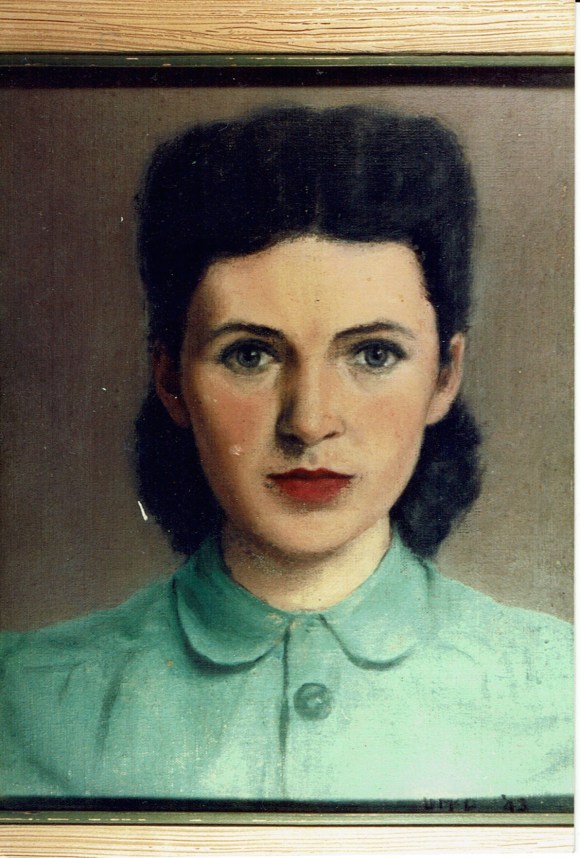
Self-Portrait in Green

uw-selfportrait

Art historian Dr Éimear O’Connor HRHA, takes a close look at Una’s 1943 self-portrait and finds the influence of an early mentor,  the prolific painter and portraitist, Sean O’Sullivan.

Painted during what became known as The Emergency in Ireland (1939-1946), which took place in the context of World War Two, the artist’s simple peplum-collared blouse in Self Portrait in Green, (oil on canvas, 25 x 30 cm) was typical of the era. So too, her soft, behind the ear hairstyle is one that we might now recognise from film and photographs of the time.

Watters gazes at her viewer with confidence, and yet with a hint of reticence, her asymmetrical features filling the canvas with an honesty that is typical of the use of the mirror while working on the painting. Her demeanour and the centralised composition of her self-portrait are characteristic of the self-confidence of Irish women artists in the post-Treaty years, many of whom, including Watters, engaged with modernist art forms such as cubism and abstraction, to develop personal, and highly individual styles.

Watters was 25 when she painted Self Portrait in Green, a highly accomplished work that warrants consideration about the artist’s training. During her teenage years she received guidance about painting in general, and likely, portraiture in particular from her cousin, artist  Sean O’Sullivan. That she received such guidance suggests that Watters demonstrated artistic talent at an early age, the evidence for which in terms of earlier works may yet come to light, but which certainly seems to have caught the attention of her cousin.

Moreover, Self Portrait in Green is reminiscent of O’Sullivan’s method of portraiture at the time. In the late 1930s, Watters was taught by artist,  Maurice MacGonigal at the School of Art in Dublin. It would appear, however, that she was sitting in on classes during her spare time, as her name does not appear on the student registers. That she was doing so is quite possible; O’Sullivan might well have made the necessary arrangements with MacGonigal at the time. Importantly too, Watters worked as a librarian, so she would have had access to books, and journals about the history of art, and about contemporary art, all of which would have contributed to her artistic education.

Self Portrait in Green reveals a great deal about Watters’ innate talent and artistic education in terms of composition and colour balance. Her simple blouse was chosen to highlight the colour of her eyes, which, in turn, are lightly shaded with a similarly toned shadow. Her lipstick, typical of red shades made so popular during the Second World War, was chosen to contrast with her green blouse, a painterly decision that gives extraordinary life to the work.

The same colour is used to highlight her cheeks, much as a make-up artist might do nowadays. The overall effect of the controlled palate of colour gives a softness to the work that is gentle on the viewer’s eye. Her face is lit by natural light from the viewers’ right, thereby casting the opposite side in shadow that delineates her youthful features.

It is in the painterly treatment of her eyes that the viewer can really appreciate the artist’s flair, and her training. Deliberately composed so that her gaze appears above the centre of the canvas, her eyes appear as mountains might above the horizon in a landscape. Large, and well defined, her steady gaze draws the viewer in to the shy determination that shines from within. The few flicks of white paint around her dark and enlarged pupils, are a tiny detail, and yet, they are the touches that bring her face to life.

A powerful portrait for an artist of such youth, Self Portrait in Green prefigures the outstanding range of post-impressionist and modernist inspired work that Watters undertook throughout her career. Unafraid to experiment, Watters was a woman of immense artistic ability. How wonderful it is to see her career re-examined, and reinstated within the context of the art and artists of her day.

Dr Eimear O’Connor

Categories
Una in focus

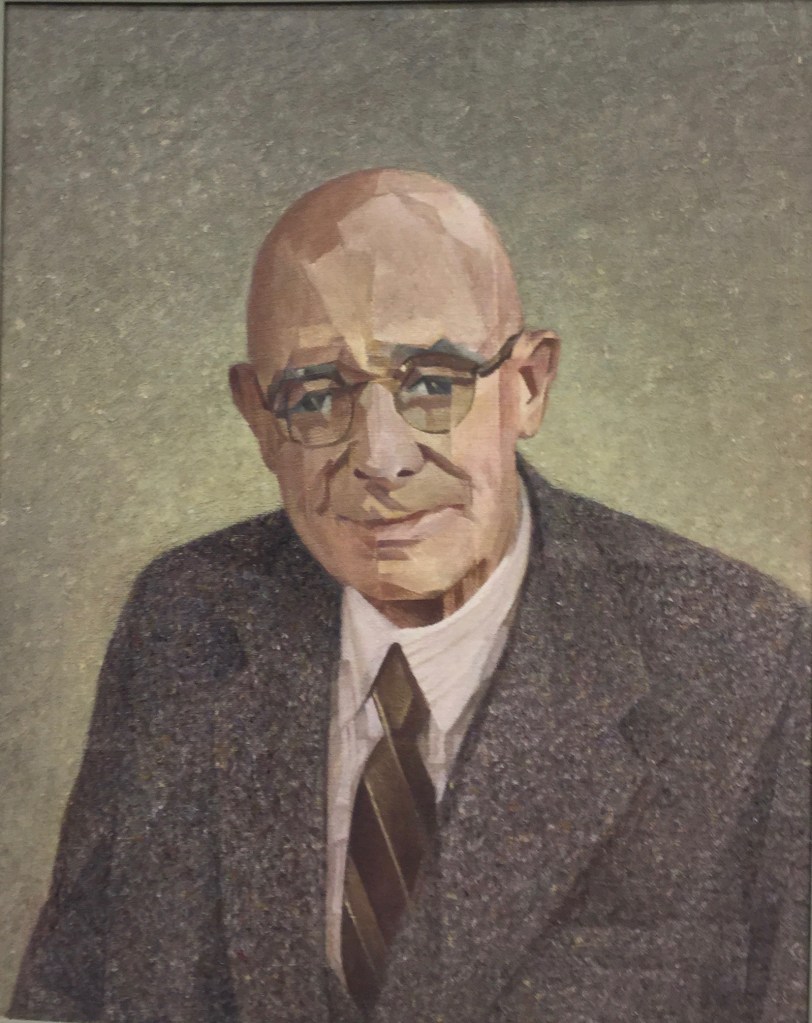
Portrait of Brian O’Higgins

27 Brian O'Higgins 1963

Una Watters’ niece, Sheila Smith and her daughter Karen, write about the background to one of Una’s large, late-career portraits which demonstrates her unusual textured approach to portraiture. 

One of Una Watters’ strengths was portraiture as evidenced by the sheer number of pencil sketches and drawings of family and friends in her portfolio of work. Subjects frequently testify to the great likeness that Una achieved in these works. Late in her career, she also completed several portraits in oil, which featured in the 1966 retrospective exhibition, including one of her husband, E R Watters (1965), another of Tomás O’Muircheartaigh (1962), which we have still not managed to trace, and a portrait of Brian O’Higgins (1963).

The O’Higgins portrait (oil on canvas, dimensions unknown) was completed after the subject’s death. There was a family and professional relationship with Una Watters as O’Higgins had commissioned artistic work from her and was also her uncle. (His wife, and Una’s mother, were sisters.)

Brian O’Higgins (1882–1963) was a distinguished Irish language poet, soldier and patriot. He was a travelling teacher with the Gaelic League and a founder member of the Irish Volunteers.  He took part in the 1916 Easter Rising and was imprisoned in Frongoch in Wales, one of several imprisonments he endured. While in prison, he wrote extensively – prayers, spiritual pieces and poetry. Sometimes known by his pen name, Brian na Banban he also composed both inspirational verse and marching songs, such as “Dawning of the Day”, “Eight Millions of Englishmen” and “Marching Song of Na Fianna Eireann”.

In testimony to the Bureau of Military History, Sean Prendergast, an army captain whom he fought with in 1916, said O’Higgins’ verses and songs “had stirred us to such depths during the past number of years. Few men could be so sincere and so true than he”. Most famous of his songs is undoubtedly “A Stóir mo Chrói” (Treasure of my Heart), a haunting ballad which is still covered by contemporary singers such as  Maura O’Connell, Bonnie Raitt and The Chieftains.

In 1924 O’Higgins set up a publishing house which printed devotional and patriotic booklets with rallying titles such as Unconquered Ireland (1927)and featuring beautifully decorated covers with stylised Celtic designs. He also published and edited the Wolfe Tone Annual between 1932-62. From the 1950s, Brian and his son, Criodán, extended their range into Irish Christmas cards, again utilising Celtic calligraphy and featuring verses written by Brian. The cards were sent all over the world and were particularly popular in the US.

When they needed another illustrator, Una’s sister, Sheila – mother of Sheila Smith, one of the authors of this article – suggested Una since by this stage she was an accomplished artist. As well as the Christmas cards, Una also illustrated a number of devotional pamphlets produced by the company including Little Book of St Patrick (1957), Little Book of St Francis (1958), Little Book of Exile (1959) and the Little Book of Memories (1960).

Although Una was keen to paint her uncle, she didn’t manage to do so before his death.  She executed the portrait using photographs and her personal recollection of him, according to an article in the Irish Independent on June 2, 1964. “All who have seen it have acknowledged that the attitude is typical of the man they had known in his many moods. Certainly, in painting it, Mrs. Watters has treated her deceased subject with great sympathy and affection.”

It is a large work and done in the angular style Una favoured, especially so in the rendering of the domed head. O’Higgins is looking directly out of the frame, which engages the viewer immediately. His tweed jacket looks almost tactile – the design of the cloth stands out from the painting.

The portrait is one of only three of Una’s works on public display.  The others are The People’s Gardens in the Hugh Lane Gallery Hugh Lane Gallery (see Logan Sisley’s blog of May 6 on this site) and The Four Masters in Phibsboro Library.

The O’Higgins portrait hangs in the Local Studies Room in Navan Library It was presented to the library by the O’Higgins family, having previously hung in the offices of the publishing house on O’Connell Street.  When the libraries reopen after the COVID-19 crisis, it will be possible to view the painting in situ. However, as it is not in the main library, a call in advance is advisable. (046) 9021134

Sheila and Karen Smith

Categories
Una in focus

Going Nationwide


Mary Morrissy, the curator of unawattersartist.wordpress.com, recounts how an essay by a ten-year-old schoolgirl introduced Una Watters to a national audience. 

On March 6, in association with the Herstory project, the RTE  Nationwide programme dedicated a show to Una Watters.  Una’s niece, Sheila Smith, and her nephews Garry and Gerry Byrne, came to EPIC The Emigration Museum in Dublin armed with a selection of Una’s work that is still in the family’s possession and spoke to the show’s presenter, Blathnaid Ni Chofaigh

The Herstory project was founded in 2016 to showcase authentic female role models and to set up an education programme to foster interest in forgotten women achievers. In association with RTE Junior, Irish schoolchildren were asked to nominate their “lost” heroine.

Alexa Bauer (10) of Dublin 7 Educate Together school, nominated Una Watters for the project and wrote an accompanying essay on The Ladies Committee (1964) explaining her choice.

My great aunty Rosie (still alive) and my great-grandmother Molly were both good friends with . . . Una. In our living room, we have a painting by her called “The Ladies Committee” and my great-grandmother is apparently in it, as well as a catalogue of all her [Una’s] paintings. . .

Una Watters should be one of Ireland’s most famous painters, but has sadly faded away.

Alexa’s great-grandmother, Molly Smith, who owned a shop in Finglas close to where Una Watters lived, is the woman dressed in black in the centre of the painting.

img_1946

Alexa was also interviewed by Nationwide and was present at the EPIC museum to celebrate the launch of the Herstory Festival 2020 which included a series of illuminations on the facade of the GPO to mark St Brigid’s Day Una’s stylised image, which was featured in the illuminations (below) was designed by National College of Art and Design student Rebecca Sodegrad.

gpo-original

Images, apart from The Ladies Committee, courtesy of Nationwide, RTE.

Mary Morrissy


Categories
Una in focus

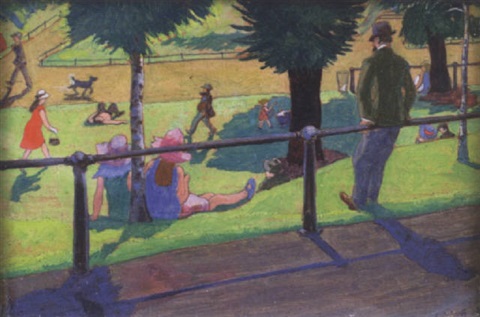
The People’s Gardens

In the second of a series of  occasional blogs considering individual paintings of Una’s, Logan Sisley, Acting Head of Collections at the Hugh Lane Gallery, discusses “The People’s Gardens”.

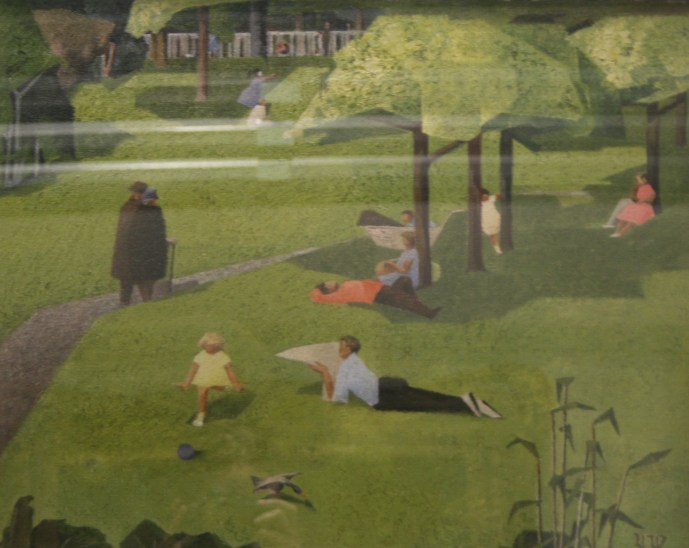
Una Watters is represented by one painting in the Hugh Lane Gallery Collection, a charming Dublin scene painted in 1963 called The People’s Gardens (oil on canvas, 40.6 x 50.8 cm). It shows Watters’ distinctive angular modernist style with contrasts of light and shade and areas of pure colour.

It is one of a number of paintings by Watters depicting Dublin life. The People’s Gardens is a public garden within the Phoenix Park near the Parkgate Street entrance. It opened in the mid-1860s in order to address the lack of public recreational space in Dublin. It contains an ornamental lake, children’s playground, picnic areas and Victorian bedding schemes. Watters captures the undulating terrain of the gardens.

As is typical of her work, the trees and figures are pared down to angular forms. This shows the influence of earlier modern art movements such as Cubism and Futurism, albeit interpreted in her own style. Her clever use of shadows adds depth – notably under the trees and in the figure of the girl kicking the ball, the man reading a paper and the duck taking off (or landing). These also demonstrate a keen observation of people and an eye for detail. The strong shadows and summer dresses suggest a warm sunny day, yet the elderly couple walking arm-in-arm on the path are still dressed in heavy coats and hats.

Leisure scenes in outdoor settings such as this have been a popular subject for painters since the 19th century. Other examples at the Hugh Lane Gallery include Edouard Manet’s Music in the Tuileries Gardens (1865), Eugene Boudin’s Normandy beach scenes (1867 and 1893), Edgar Degas’ Beach Scene (c. 1876-1877), John Lavery’s river scene, Sutton Courtney (1917) and William Leech’s Beach, South of France (1921-6).

The People’s Gardens was shown at the 1964 Royal Hibernian Academy Annual Exhibition. The Thomas Haverty Trust bought the painting and lent it for Watters’ posthumous retrospective exhibition in 1966. The following year the Trust donated the work to Hugh Lane Gallery. The Haverty Trust was established following the death of the artist Thomas Haverty who left a sum of money for the purchase of paintings by Irish artists for public galleries and institutions. Between 1935 and 1966, the Trust gave the Hugh Lane Gallery over 40 works including paintings by Mary Swanzy, William Leech, Brigid Ganly and Maurice MacGonigal (who encouraged Watters in her art studies).

As an artist so intrinsically linked to the city, it is fitting that Watters’ work found a home in Dublin’s city gallery. She painted while working for Dublin Corporation’s libraries and met her husband Eugene at a dance at the Teachers’ Club, one of the gallery’s neighbours on Parnell Square.

Logan Sisley

nationwide1a

Logan Sisley and Bláthnaid Ní Chofaigh discuss The People’s Gardens at the Hugh Lane Gallery for RTE Nationwide programme  on March 6, 2020.

Categories
Una in focus

Cappagh Road

In the first of a series of occasional blogs, we are going to look at individual paintings of Una’s to showcase her work in more detail.  Here Mary Morrissy, curator of unawattersartist.wordpress.com,  discusses “Cappagh Road”.

Cappagh Road is one of several oils by Una Watters that depict the new corporation estates in Finglas in 1960, where Una lived and worked.  It was used last year on the cover of a memoir, Down by the Liffeyside (Somerville Press) by Colbert Kearney (who knew Una personally) and is the perfect embodiment of the world described in the book – the migration experience of thousands of  inner-city dwellers to the outer suburbs in the 1950s.

Una Watters’ Cappagh Road (oil on canvas, 50.5 x 40.3cms) is a microcosm of  the “new” suburb in its brave infancy, when much of life was still lived out on the street, rather than behind closed doors. Look at the two burly women on the right in their heavy coats, gossiping, as one pushes a go-car (what we used to call buggies in the 1950s) in which a toddler sleeps, skewed to one side.

We know they’re gossiping from their physical gestures. The blue-scarved woman is saying something to her companion, but the tilt of her head tells us that it’s a secret or a sly aside that’s being shared. This is one of Una’s great strengths – being able to communicate emotion through gesture.  The faces here are roughly rendered yet their actions are full of character.

On the left of the scene, another young mother – or an older sister, perhaps? – cradles a bottle of milk while trying to restrain a child in a blue bonnet who’s on the brink of a tantrum.  You can see the “I want” refrain in the operatic yawn of the child’s mouth.

A boy in short trousers grabs another by the sleeve as they chase after a ball in the middle of the street.  Is he trying to hold his companion back, or pass him out? Three more take up the rear in hot pursuit of the runaway ball.  In the mid-ground of the painting, another boy is stepping off the kerb heedlessly and about to collide with a hatted man on a bicycle who is swerving to avoid him. The moment of avoided impact is rendered by a circular compass-like brush stroke.

A young blade – a university student or a clerk? – is waiting for the bus.  He stands, debonair, slightly louche-looking, one hand around the pole of the bus stop, the other hand thrust into his pocket. The bus is coming though he doesn’t see it. There it is at the vanishing point of the painting, as green and solid-looking as the trees it emerges from.

It is a winter’s afternoon – a weak sun braves the chilly sky; the street lights are already on, the shop (the local chipper) is warmly aglow, the people are rugged up. Only the eerily precise black dog, padding softly across the foreground, sniffing out his territory, tail alert, seems intent on his own business. (Una’s husband, Eugene Watters, superstitiously saw this dog as darkly prophetic.)

Una often slyly inserted herself into such crowd scenes, often as a watchful observer, but there’s no sign of her here.

Cappagh Road was one of three paintings Una made of Finglas in the early 1960s.  The two others – Schoolbreak (1960) and Building Scheme (1961) have not been traced.  Perhaps, on the evidence of this painting, someone out there might recognize its companion pieces?

If you do, or think you may have in your possession any Una Watters painting, please use the contact page on this site.