Categories
News

For your diary

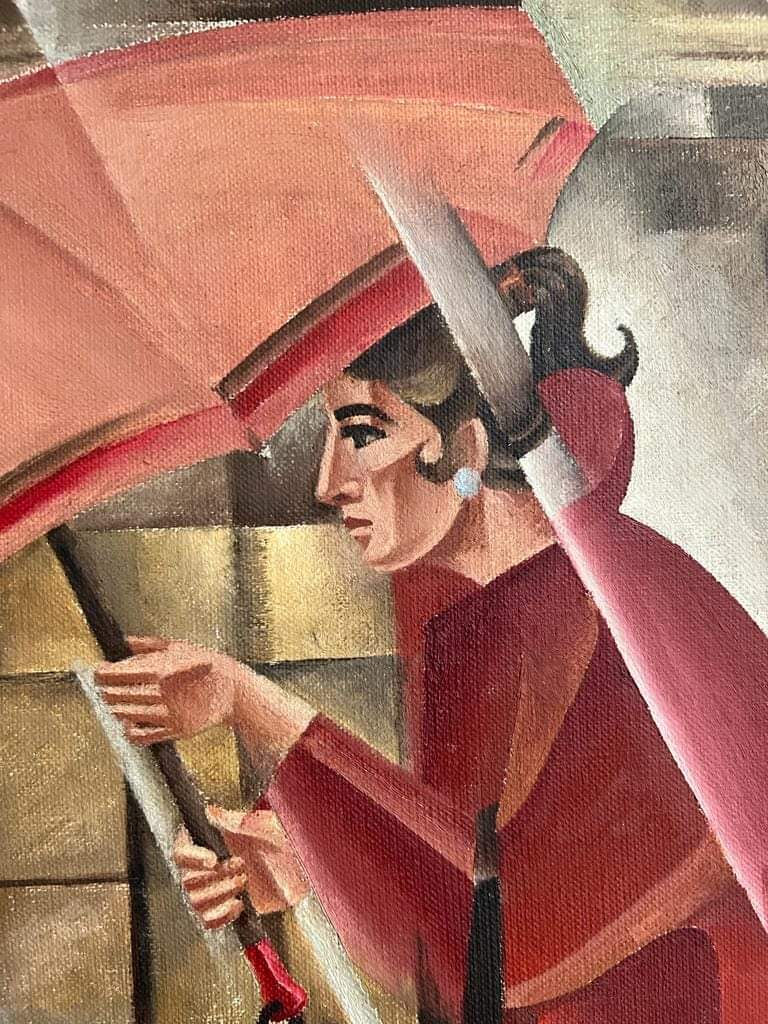
After the flurry of the presentation of Una’s Girl Going by Trinity in the Rain to the national collection by Colbert Kearney in 2023, things have been quiet on the Una Watters front.

However, this year will see more activity. It’s an anniversary year – 60 years on from her death in 1965 – and hopefully that may see an upswing in Una Watters-related activities.

First development this year is the inclusion of Girl Going by Trinity in the Rain in the National Gallery of Ireland’s diary. Always a beautiful production, this year is no different, and Una appears for the week of May 26, 2025.

The director of the gallery, Dr Caroline Campbell, remarks in the diary’s introduction that Una’s Girl has already become a” popular favourite” among gallery patrons. This makes a trifecta of images the NGI has used of Una’s signature painting – it appeared in last year’s calendar and is for sale in postcard form in the gallery shop. (Speaking of merch, I’m waiting for the gallery umbrella and tote bag!)

As Sara Donaldson author of the notes accompanying the image in the diary writes – “Watters’s awareness of Cubist forms is evident everywhere, while Futurist-inspired ‘lines of force’ represent the sheets of rain, evoking the atmosphere of a wet urban scene.”

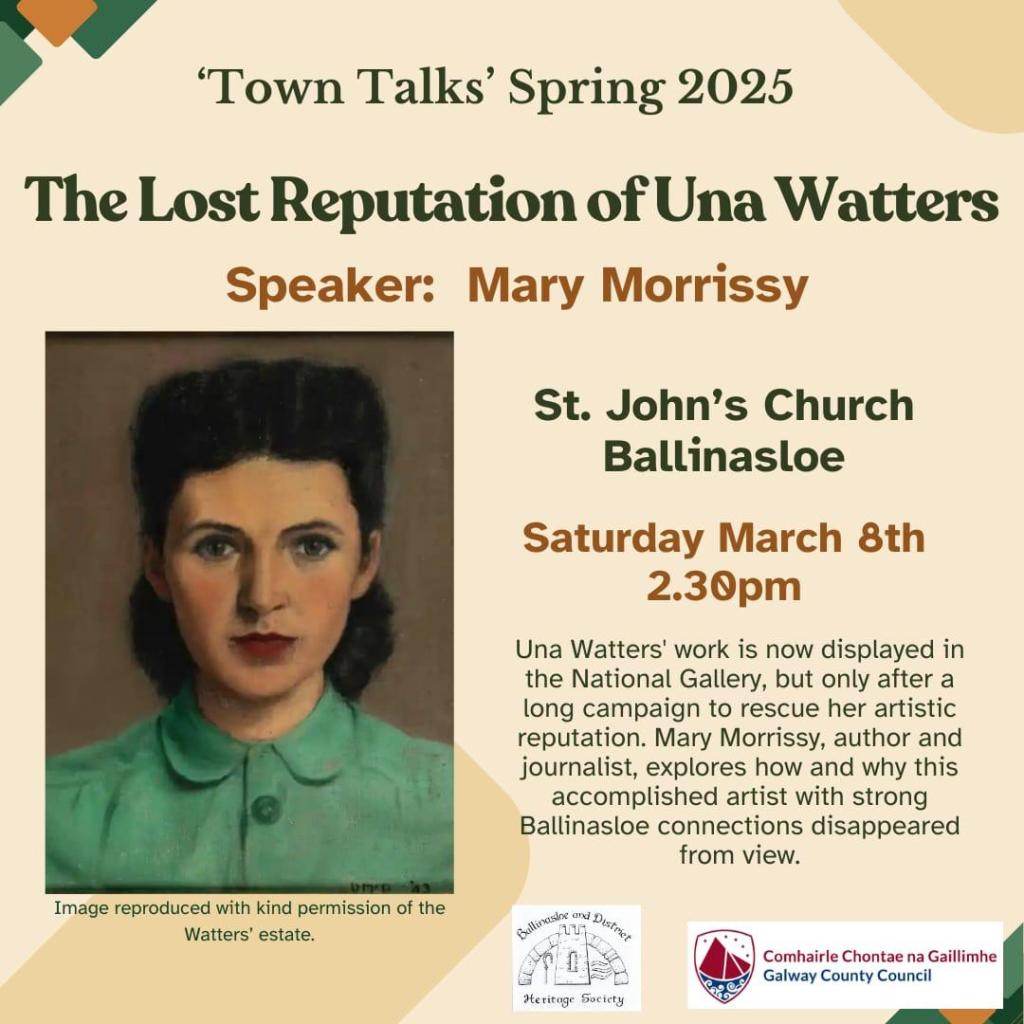
Speaking of dates for the diary, I will be doing a lecture – “The Lost Reputation of Una Watters” as part of Ballinasloe & District Historical Society’s Town Talks series in March – more details to come closer to the time.

Meanwhile, I’m on work on a book on Una so if any of you out there have stories or memories of her or Eugene Watters, do contact me via the email on the blog.

Categories
News

Lighting again!

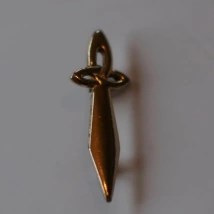
Una Watters’ winning design of An Claidheamh Soluis (The Sword of Light) which became the official emblem of the 1966 Easter Rising commemorations has got a new lease of life thanks to Ballinasloe entrepreneur, Enda Creaven.

Creaven (below) has reproduced a limited edition of Una’s design in the form of a lapel pin which comes in both nickel-plated silver and gold and retails at E10.

Una’s design was chosen as the winner in a public competition run by the Arts Council in 1965. During the 1966 golden jubilee year, it appeared on badges, brooches and tie pins, it was stamped on all official publications, showed up in hallmark form on silverware struck by the Assay Office (see above), and perhaps most memorably, on blue and yellow wooden plaques pinned to the fronts of buses.

The Sword of Light has deep mythological and nationalist resonances – it was the weapon with magical properties used by King Nuada of the Tuatha de Danann to slay giants, according to Celtic mythology. Its image was later adopted by scholars of the 19th-century Gaelic revival to symbolise both armed rebellion and cultural renaissance, and in the early 20th century the Gaelic League (Conradh na Gaeilge) called its weekly newspaper – edited by Patrick Pearse – An Claidheamh Soluis.

According to the 1966 Commemoration Committee, the winning Sword of Light motif was meant to represent “intuitive knowledge, education and progress”. In fact, the search for a new Rising logo was part of a government attempt to replace the Easter Lily emblem, which the republican movement, proscribed at the time, was selling door to door in order to raise funds. Ironically, Una Watters’ winning design – a sleek, stylised depiction of the Sword – subliminally references the pure, clean lines of the lily.

Winning the competition was a high point in Watters’ career, and a showcase for her refined design aesthetic. Unfortunately, she didn’t live to see the success of her design during the 50th anniversary year; she died unexpectedly in November 1965.

Enquiries about the new pins to: enda@theirday.com

Above clockwise: 1. The original gold lapel pin issued in 1966. 2. A wooden plaque which featured on buses. 3. Enda Creaven’s new lapel pins alongside a nickel brooch version that was issued in 1966.

Categories
News

Ms February 2024

Just five days ago, I made a cheeky call to the National Gallery of Ireland to include Una Watters’ Girl Going by Trinity in the Rain in one of its future annual calendars. Hey presto, no sooner wished for than granted! The NGI, it seems, was way ahead of me!

The 2024 calendar has just gone on sale in the gallery shop and my spies in Dublin tell me Una’s Trinity Miss holds the February slot. Other new NGI acquisitions share the pages of the calendar – a minor French fellow by the name of Paul Cezanne, for one, along with old gallery favourites such as John Singer Sargent, Paul Signac, William John Leech, Mildred Anne Butler, John Lavery and Mary Swanzy.

Aren’t they in good company!

The inclusion of Una’s work in the calendar is a real vote of confidence in her work. For us here at the blog, it means that Girl Going by Trinity in the Rain will be restored to our walls. It’s almost 11 months since the men from the gallery came to take the original away.

It’ll be like old times seeing Trinity Girl on a daily basis.

The February page might well be open all year!

Paul Cézanne, La Vie des Champs, 1876-77, which features on the cover of the calendar. Photograph: National Gallery of Ireland

Categories
News

Picture Postcard

First the painting, now the postcard! Una’s Girl Going by Trinity in the Rain, now proudly part of the national collection, got another boost this month with the news that there’s now a postcard of the painting on sale at the National Gallery of Ireland shop.

This fine postcard reproduction also gives the painting the potential of reaching a mass audience.

I’m a sucker for a postcard memento so I’m delighted to know that Una’s striking image has a chance to reach gallery visitors who, like me, enjoy extending the memory of standing in front of the real thing with a pocket-sized reproduction.

Speaking of the real thing, Girl Going by Trinity hangs in Room 15 of NGI, along with several of Una’s contemporaries, Mainie Jellet, Mary Swanzy and Louis le Brocquy.

November is both Una Watters’ birth and death month (born this day, November 4, 1918 – died November 20, 1965). The Dublin weather she depicts here is distinctly Novembrian. Perfect for a calendar!

What about it, National Gallery? Una Watters as November’s calendar girl?

Categories
News

Banner Headline

This fine specimen of angelic manhood is a detail from another new Una Watters discovery – as a result of contacts made at an event at Phizzfest earlier this year. It’s an unusual find in that it’s not a painting but a banner made for St Michael’s School in Finglas.

The principal of the school was a Sister Philippa who knew Una’s sister, Maureen McDonnell ( Sister Mel) a fellow nun at the Holy Faith School in Glasnevin. She asked her to approach Una to design a banner for the school on Wellmount Road which had opened in 1959. Another sister, Sister Therese Kearney (95), remembers the request being made.

In the summer of 1960, she has written, the school pupils made their first appearance in Glasnevin grounds for sports day. “They had no banner to represent their school. Sister Philippa immediately asked Sister Mel McDonnell’s sister Una to paint a banner for the school.”

Because the work was done as a favour, rather than being officially commissioned, it has remained, like much of Una’s craft work, under the radar. Although not signed, the provenance is direct with Sister Mel’s involvement in the process and the surviving Sister Therese’s written testimony.

The banner measuring (121.92cm x 91.44cm) depicts the archangel St Michael in Celtic warrior mode, with blonde hair, muscled arms holding a golden spear and shield. His wings are a celestial blue but there’s nothing ethereal about them – they’re robust-looking and rendered in the geometric style that Una used later in her treatment of trees and foliage. There’s no doubt that this is St Michael triumphant – the expression on the archangel’s face is serenely confident – although there’s no sign of the dragon. Instead, Una’s St Michael appears to be standing on a chain, a nicely abstract rendition of his liberating powers.

As well as designing it, it’s probable that Una, an accomplished seamstress, also made the banner and trimmings herself. St Michael is painted on what looks like calico and backed with dark green silk. The border with a Celtic barley twist design runs all the way around with a golden fringe at the bottom. Five fabric hooks allow it to be attached to a mobile wooden frame, a neat combination of function and design.

The banner is not just decorative. The school principal, John Barry, explains that it is used regularly in school ceremonies – graduations, sports days and to mark the opening of the school year when the head girl hands it over to the incoming sixth year class. The school currently has 630 pupils.

Meanwhile Una and her work is also referenced in a historical exhibition within the halls of the Department of Finance. Archivist Cliodhna Walsh was involved in organising it to mark the lifting of the marriage bar for female civil servants 50 years ago in 1973.

Like many women, Una was forced to leave her job in the library service when she married Eugene Watters in 1945. The ban on working probably gave Una more time to pursue her art, but it also meant she had to use her art to generate income, hence some of her illustrative and calligraphic work covered elsewhere on this site.

“As important as it is to remember how the marriage bar wrenched so many women away from public life, it is also lovely to acknowledge the vibrant artistry of a woman who contributed much to Irish culture,” Ms Walsh has observed about Una’s contribution to the exhibition.

A reproduction of Una’s Girl Going by Trinity in the Rain features in this private exhibition as well as images of her design for the 1966 Easter Rising emblem based on the Sword of Light. Because this was entered in a public competition, the design copyright rests with the Department.