Categories
Una in focus

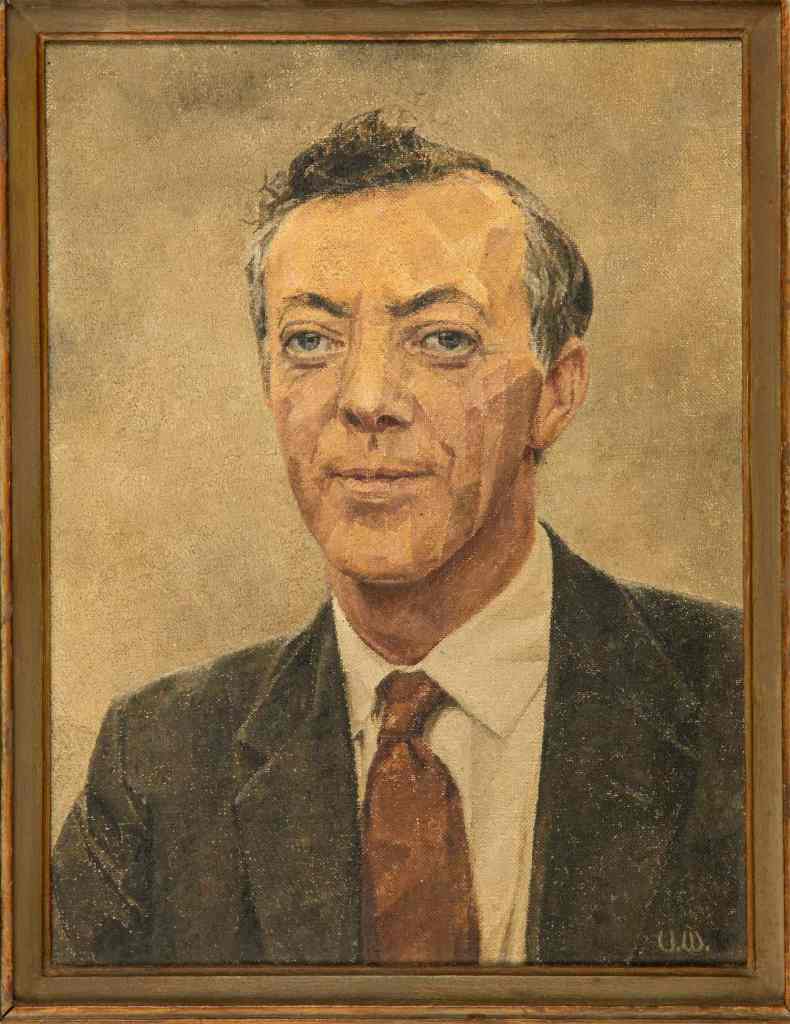
Portrait of Eugene

Colbert Kearney, a pupil and a long-time friend of Eugene Watters, remembers seeing Una’s portrait of her husband in the making when he visited their home in the early 1960s.

I remember this portrait, E. R. Watters (oil on canvas, 1965, 33 x 43 cms) emerging on Una’s easel in Cappagh Cross and admiring her ability to conjure up such a convincing image of a man I had been familiar with since—some seven years earlier—he had taught me during my final year in St Fergal’s Boys National School on the Cappagh Road in Finglas.

Seeing it again more than half a century later was a Pygmalion moment: I expected the image in the frame to turn and talk to me, so miraculously had the artist captured not only the appearance but also the essence of the man at a crucial stage in his career.

Una had been married to Eugene for 20 years and probably knew him better than he knew himself.  Not having children of their own, they spent most of those years in the Arcadian tranquility of her native place in the countryside beyond Finglas, the remainder in and around Eugene’s native Ballinasloe.  Otherwise they lived quietly and for each other.  And for their respective art – his writing and her painting.

Teaching had not been Eugene’s chosen profession.  An obviously brilliant student, he had won a scholarship to University College Galway and must have thought his dream of studying his beloved languages—Greek and Latin, English and Irish—at the highest level had come true.  But his family could not afford to maintain him in Galway and he had to settle for teacher training in Drumcondra.  He never forgot the heartbreak of the scholarship forgone, never lost his love of learning, could never conceal a degree of disdain for academics.

A consolation during these years of Emergency, (1939-1945), was his service as  a commissioned officer in the National Army.  He was immensely proud of this role and was married in his uniform.  For boys who were eager to learn he was a wonderful teacher; the others kept their heads down in order to avoid military discipline Lieutenant Watters was not above imposing in the classroom.

He could never forgive teaching for taking the time he wanted to devote to writing.  His first major success had been as Eoghan Ó Tuarisc in the Oireachtas literary competitions but soon this was matched by the work of Eugene Watters.  While working away, Eugene and Una shared a relatively secluded life, avoiding the pubs and cliques of Bohemian Dublin, but this changed when Alan Figgis published first Eugene’s novel,  Murder in Three Moves in 1960, and in 1964, his long poem The Week-End of Dermot and Grace and his Irish collection Lux Aeterna.

He had emerged on to the main stage and could contemplate to bidding farewell to the  classroom.  Many cautioned him against trading his permanent pensionable post for the vicissitudes of full-time writing but Una, knowing his mind better than anybody else, was a solitary voice of support.

And that is when she has caught him in this portrait, dated to 1965.  At 46 he’s conscious of being close to the height of his powers, knowing that the poems published in the previous year constituted an unprecedented, bilingual achievement.   Nor is there anything amateur about this man of letters.  His demeanour, especially his eyes, are those of a soldier whose discipline has seen him through a long campaign, of a Platonist who has seen into the life of things.

But not even he could see what a happy chance it was that Una had seized the moment when she did.  Within a year she was dead and Eugene—soon unrecognisable from the confident figure of the portrait—was about to spend some grim years in the wilderness, an Orpheus search of his Eurydice, repeating with a new conviction a favourite quotation from Herodotus:  to theion esti phthoneron.  The gods are envious.

eugene-and-una-wedding

Eugene and Una on their wedding day, March 10, 1945

Categories
Una in focus

The Bridge of Time

It’s always exciting to come across a “new” Una Watters – at least new to us, particularly almost a year-and-a-half into our quest to trace  Una’s extant work.

The original call we ran for Una’s paintings in an article in the Irish Times in July 2019 produced quite a flurry of work; similarly, the March 2020 edition of the RTE Nationwide programme and the Liveline radio programme around the same time, but since the COVID-19 pandemic, everything had gone very quiet.

Then, last week, just when we thought the 10 untraced works from Una’s 1966 exhibition – see elsewhere on this site – were going to remain stubbornly elusive – one of them, miraculously,  turned up.

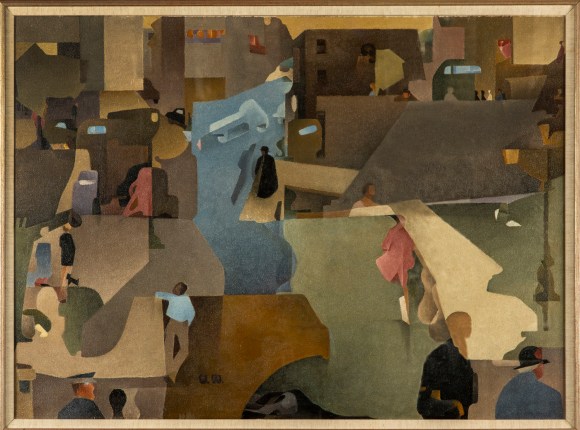
City Bridge (oil on canvas, 55 x 75cm ) was painted some time in 1965, the year of Una’s untimely death.  It was a very prolific year for Una as it turned out.  She completed five major oil paintings that we know of, as well as designing the Easter Rising Jubilee symbol after winning an Arts Council competition for the commission.  (Poignantly, Una’s sister, Sheila Byrne, recalls that the award and prize money arrived on the day her funeral cortege left for Ballinasloe for burial.)  In the weeks immediately before her death she also completed a set of experimental watercolours – see “The Emerald Ballroom Watercolours” page on this site.

City Bridge was exhibited in the Oireachtas exhibition of 1965 with a price tag of £35.  Whether it was sold then or not is not clear, but it’s unlikely. The painting appeared in the 1966 memorial exhibition organised by Una’s husband, Eugene, a year after her death.  There was no owner attribution in the catalogue, so it’s likely it was gifted, like much of Una’s work, to a friend or acquaintance after the 1966 show.

Where it’s been since then is a matter of speculation but we now know that it was acquired in the early 2000s by the late art dealer Seán O’Criadain, along with another of Una’s paintings, Meditation (not featured in the 1966 exhibition).  Meditation was subsequently sold at auction but O’Criadain held on to City Bridge.

O’Criadain was a legendary figure in the Irish art world (as well as being a poet, literary editor and Harvard lecturer) who championed, in particular, artists of the late 19th and early 20th centuries such as William John Leech, Harry Clarke and Roderic O’Connor, long before it was fashionable. Una’s painting has remained in O’Criadain’s collection and we’re grateful to David Britton and Peter Lamb for alerting us to the fact.

Having not seen the painting itself, due to current circumstances, it’s probably not fair to comment on it, but from the image it’s certainly one of Una’s more complex and enigmatic works. The bridge motif  is clear in the jigsaw-like quadrants of colour she employs  – dove-greys, moss greens and various shades of blue.  This geometric patterning was a feature of her later work, but here it’s used in a much more abstract way. In its style and colour palette, Una seems to be harking back to a kind of fluid pre-cubism.

The bridge of the title is fragmented, broken-up, dismembered. The shafts of shadow – or is it stone? – seem to be in balustrade shapes, and the river seems to dive into the layered grey city that crowds the background in shortened perspective.

Una’s characterful figures animate the painting as usual  – the idling, dark-skinned boy in the left foreground lolling against the bridge parapet, the policeman – or lockhard? – in his peaked cap in the left foreground, the white-haired matron with the serious hat on the far right.  But there are other more enigmatic figures.  Who is the jaunty man in a pink coat with flying tails and the hint of a tricorn hat who looks like a refugee from the  regency city?  The figure in the black bowler hat and cloak in the centre of the canvas also looks distinctly anachronistic.

The blocky curvature of the upper-decks of buses suggests this has to be Dublin, as does the street furniture – look at that lamp standard. But which bridge is it?  Or is it an amalgam of all the city’s  bridges?  Or is it none of them?

Or is this the bridge of time itself linking the city of the present to the past?

The thoughts of Leopold Bloom in Joyce’s Ulysses at the funeral of Paddy Dignam in Glasnevin cemetery come to mind: – ‘How many! All these here once walked around Dublin. Faithful departed’.

Mary Morrissy

Categories
Una in focus

Social distancing in the park

la grande jatte

harry-kernoff-the-peoples-garden,-phoenix-park-dublin

Mary Morrissy, curator of this site, takes a wander in the park and sees influences of Seurat and Kernoff in Una Watters’ The People’s Gardens (1963)  

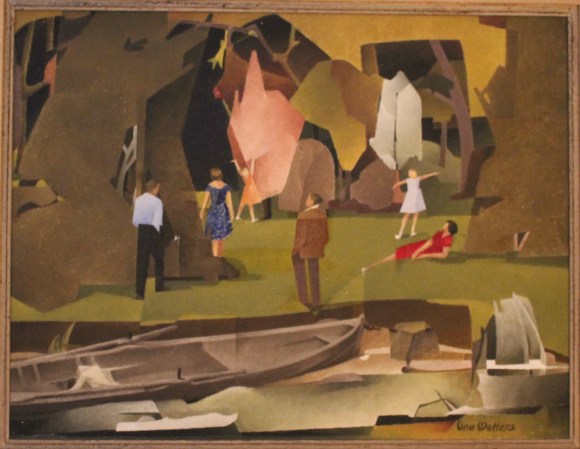
Three park views, three different painters.  Una Watters painted the third of the sequence here, The People’s Gardens (oil on canvas, 40.6 x 50.8 cm) in 1963 but as a keen student of art,  it seems inevitable she was familiar with the other two – Georges Seurat’s Sunday Afternoon on La Grand Jatte (1886) and Harry Kernoff‘s People’s Gardens (1945).

Harry Kernoff  (1900-1974) was a near contemporary of Una’s and The People’s Garden, Phoenix Park Dublin (oil on board ,13.5 x 19.5 cm) was painted on the same site in 1945, nearly 20 years before Una’s.  Apart from the location it’s possible to see other influences, particularly in the animation of the figures and the way the shadows are rendered.  Kernoff and Una would certainly have known one another’s work through RHA exhibitions.  They showed together at least once in an Oireachtas exhibition in October 1965, where Una’s Sean Tithe (see in Uncatalogued Work on this site) appeared alongside work by Kernoff and two of  Una’s mentors,  Maurice McGonigal and Sean O’Sullivan. harry kernoff - st stephen's green

O’Sullivan was Una’s cousin, and would have been another link between her and Harry Kernoff.  (It’s recorded that Kernoff painted his 1936 St Stephens’ Green,  from a perch at the window of O’Sullivan’s studio at 126 St Stephen’s Green; see right.)

As well as a shared colour palette, Una’s and Kernoff’s paintings of the People’s Gardens  seem similarly motivated. Here are ordinary people observed in leisure, although Una’s rendering keeps its distance and is more stylised than Kernoff’s up-close, jaunty realism.  Artist Michael Kane writing in the Irish Arts Review described Kernoff as painting “the world around him as a kind of earthy, egalitarian paradise, and celebrated its gaiety and diversity with unapologetic optimism”.

That description would not be out of place when looking at Una’s urban work such as The People’s Gardens or Cappagh Road, discussed in an earlier blog on this site.

But Una’s The People’s Gardens also owes a major debt to Seurat’s 1886 pointillist masterpiece, A Sunday Afternoon on La Grande Jatte. In this work, now housed at the Art Institute of Chicago,  Seurat depicted the haute-bourgeoisie of Paris, statuesque matrons with their bonnets, bustles and brollies, accompanied by their prosperous, top-hatted gents and polite children, taking the air on the fashionable side of the Seine, dressed in their Sunday best.  The figures in Seurat’s painting stand, as one critic has described it, with the “solemnity of sculptures of the Parthenon”.

bathersCompare them with the figures in Seurat’s  Bathers at Asnières (1884) on the left here  – at the National Gallery London – which the painter saw as a companion piece to La Grande Jatte.  He imagined the two works  hanging side by side almost in a dialogue with one another. The male figures in the Bathers are working-class labourers lounging on the bank or immersing themselves in the waters of the Seine on a white hot muggy day,  with the chimneys of factories smoking in the background. All of the figures are gazing towards their right – at the more fashionable side of the river where the viewer can imagine the posher denizens of La Grande Jatte are strolling. The little boy on the extreme right waist-deep in the water with the red hat could even be cat-calling at his “betters” on the other bank.

The democratic spirit in Una’s The People’s Gardens depicting everyday people enjoying a day of leisure at a municipal facility, are more akin to Seurat’s Bathers. But there are definite painterly echoes of La Grande Jatte in Una’s composition.  Look at that sturdy little girl in yellow chasing a ball in the left foreground of Una’s painting; isn’t there an echo of the more sylph-like girl in red, skipping in the mid-ground of Seurat’s master-work?  The kite-flying figure in blue in full flight in the background of Una’s work is mirrored by the man in Seurat’s mid-ground left,  dressed in a rust-coloured suit with his spy glass raised. There are those pooled shadows again, and Una’s trees, with their solid angularity, have something of the same abstraction as Seurat brought to the pointillist cushions of foliage crowning his trees.

Sheila Smith, Una’s niece, has observed that Una liked to place people she knew – and sometimes herself – into her paintings.  In The People’s Gardens, Sheila has identified the elderly couple on the path, one of them leaning on a walking stick, as Una’s parents.

The location of both Una’s and Kernoff’s painting is an area of the Phoenix Park in Dublin originally called the Victorian People’s Flower Gardens. It was a site Una had already painted in The People’s Park, below, a watercolour from 1943 and she returned to it in 1963 with The People’s Gardens, now housed in the Hugh Lane Gallery.  (Logan Sisley, acting head of collections at the Hugh Lane Gallery,  has written elsewhere on this blog about the painting.)

The Gardens were initially established in 1840 as the Promenade Grounds and consist of about 22 acres.  They were set up to display Victorian horticulture at its best with ornamental lakes, a children’s playground, a picnic area and formal bedding schemes. The statue that’s visible in Una’s watercolour, below, may well be the bust of executed 1916 leader Seán Heuston, a memorial in stone executed by sculptor and painter Laurence Campbell and erected in the park in 1943.


The People’s Park (1943) Una Watters; Statue of Sean Heuston (credit William Murphy); early 20th century postcard of the People’s Gardens, Phoenix Park.

Categories
Una in focus

Self-Portrait in Green

uw-selfportrait

Art historian Dr Éimear O’Connor HRHA, takes a close look at Una’s 1943 self-portrait and finds the influence of an early mentor,  the prolific painter and portraitist, Sean O’Sullivan.

Painted during what became known as The Emergency in Ireland (1939-1946), which took place in the context of World War Two, the artist’s simple peplum-collared blouse in Self Portrait in Green, (oil on canvas, 25 x 30 cm) was typical of the era. So too, her soft, behind the ear hairstyle is one that we might now recognise from film and photographs of the time.

Watters gazes at her viewer with confidence, and yet with a hint of reticence, her asymmetrical features filling the canvas with an honesty that is typical of the use of the mirror while working on the painting. Her demeanour and the centralised composition of her self-portrait are characteristic of the self-confidence of Irish women artists in the post-Treaty years, many of whom, including Watters, engaged with modernist art forms such as cubism and abstraction, to develop personal, and highly individual styles.

Watters was 25 when she painted Self Portrait in Green, a highly accomplished work that warrants consideration about the artist’s training. During her teenage years she received guidance about painting in general, and likely, portraiture in particular from her cousin, artist  Sean O’Sullivan. That she received such guidance suggests that Watters demonstrated artistic talent at an early age, the evidence for which in terms of earlier works may yet come to light, but which certainly seems to have caught the attention of her cousin.

Moreover, Self Portrait in Green is reminiscent of O’Sullivan’s method of portraiture at the time. In the late 1930s, Watters was taught by artist,  Maurice MacGonigal at the School of Art in Dublin. It would appear, however, that she was sitting in on classes during her spare time, as her name does not appear on the student registers. That she was doing so is quite possible; O’Sullivan might well have made the necessary arrangements with MacGonigal at the time. Importantly too, Watters worked as a librarian, so she would have had access to books, and journals about the history of art, and about contemporary art, all of which would have contributed to her artistic education.

Self Portrait in Green reveals a great deal about Watters’ innate talent and artistic education in terms of composition and colour balance. Her simple blouse was chosen to highlight the colour of her eyes, which, in turn, are lightly shaded with a similarly toned shadow. Her lipstick, typical of red shades made so popular during the Second World War, was chosen to contrast with her green blouse, a painterly decision that gives extraordinary life to the work.

The same colour is used to highlight her cheeks, much as a make-up artist might do nowadays. The overall effect of the controlled palate of colour gives a softness to the work that is gentle on the viewer’s eye. Her face is lit by natural light from the viewers’ right, thereby casting the opposite side in shadow that delineates her youthful features.

It is in the painterly treatment of her eyes that the viewer can really appreciate the artist’s flair, and her training. Deliberately composed so that her gaze appears above the centre of the canvas, her eyes appear as mountains might above the horizon in a landscape. Large, and well defined, her steady gaze draws the viewer in to the shy determination that shines from within. The few flicks of white paint around her dark and enlarged pupils, are a tiny detail, and yet, they are the touches that bring her face to life.

A powerful portrait for an artist of such youth, Self Portrait in Green prefigures the outstanding range of post-impressionist and modernist inspired work that Watters undertook throughout her career. Unafraid to experiment, Watters was a woman of immense artistic ability. How wonderful it is to see her career re-examined, and reinstated within the context of the art and artists of her day.

Dr Eimear O’Connor

Categories
Una in focus

Portrait of Brian O’Higgins

27 Brian O'Higgins 1963

Una Watters’ niece, Sheila Smith and her daughter Karen, write about the background to one of Una’s large, late-career portraits which demonstrates her unusual textured approach to portraiture. 

One of Una Watters’ strengths was portraiture as evidenced by the sheer number of pencil sketches and drawings of family and friends in her portfolio of work. Subjects frequently testify to the great likeness that Una achieved in these works. Late in her career, she also completed several portraits in oil, which featured in the 1966 retrospective exhibition, including one of her husband, E R Watters (1965), another of Tomás O’Muircheartaigh (1962), which we have still not managed to trace, and a portrait of Brian O’Higgins (1963).

The O’Higgins portrait (oil on canvas, dimensions unknown) was completed after the subject’s death. There was a family and professional relationship with Una Watters as O’Higgins had commissioned artistic work from her and was also her uncle. (His wife, and Una’s mother, were sisters.)

Brian O’Higgins (1882–1963) was a distinguished Irish language poet, soldier and patriot. He was a travelling teacher with the Gaelic League and a founder member of the Irish Volunteers.  He took part in the 1916 Easter Rising and was imprisoned in Frongoch in Wales, one of several imprisonments he endured. While in prison, he wrote extensively – prayers, spiritual pieces and poetry. Sometimes known by his pen name, Brian na Banban he also composed both inspirational verse and marching songs, such as “Dawning of the Day”, “Eight Millions of Englishmen” and “Marching Song of Na Fianna Eireann”.

In testimony to the Bureau of Military History, Sean Prendergast, an army captain whom he fought with in 1916, said O’Higgins’ verses and songs “had stirred us to such depths during the past number of years. Few men could be so sincere and so true than he”. Most famous of his songs is undoubtedly “A Stóir mo Chrói” (Treasure of my Heart), a haunting ballad which is still covered by contemporary singers such as  Maura O’Connell, Bonnie Raitt and The Chieftains.

In 1924 O’Higgins set up a publishing house which printed devotional and patriotic booklets with rallying titles such as Unconquered Ireland (1927)and featuring beautifully decorated covers with stylised Celtic designs. He also published and edited the Wolfe Tone Annual between 1932-62. From the 1950s, Brian and his son, Criodán, extended their range into Irish Christmas cards, again utilising Celtic calligraphy and featuring verses written by Brian. The cards were sent all over the world and were particularly popular in the US.

When they needed another illustrator, Una’s sister, Sheila – mother of Sheila Smith, one of the authors of this article – suggested Una since by this stage she was an accomplished artist. As well as the Christmas cards, Una also illustrated a number of devotional pamphlets produced by the company including Little Book of St Patrick (1957), Little Book of St Francis (1958), Little Book of Exile (1959) and the Little Book of Memories (1960).

Although Una was keen to paint her uncle, she didn’t manage to do so before his death.  She executed the portrait using photographs and her personal recollection of him, according to an article in the Irish Independent on June 2, 1964. “All who have seen it have acknowledged that the attitude is typical of the man they had known in his many moods. Certainly, in painting it, Mrs. Watters has treated her deceased subject with great sympathy and affection.”

It is a large work and done in the angular style Una favoured, especially so in the rendering of the domed head. O’Higgins is looking directly out of the frame, which engages the viewer immediately. His tweed jacket looks almost tactile – the design of the cloth stands out from the painting.

The portrait is one of only three of Una’s works on public display.  The others are The People’s Gardens in the Hugh Lane Gallery Hugh Lane Gallery (see Logan Sisley’s blog of May 6 on this site) and The Four Masters in Phibsboro Library.

The O’Higgins portrait hangs in the Local Studies Room in Navan Library It was presented to the library by the O’Higgins family, having previously hung in the offices of the publishing house on O’Connell Street.  When the libraries reopen after the COVID-19 crisis, it will be possible to view the painting in situ. However, as it is not in the main library, a call in advance is advisable. (046) 9021134

Sheila and Karen Smith