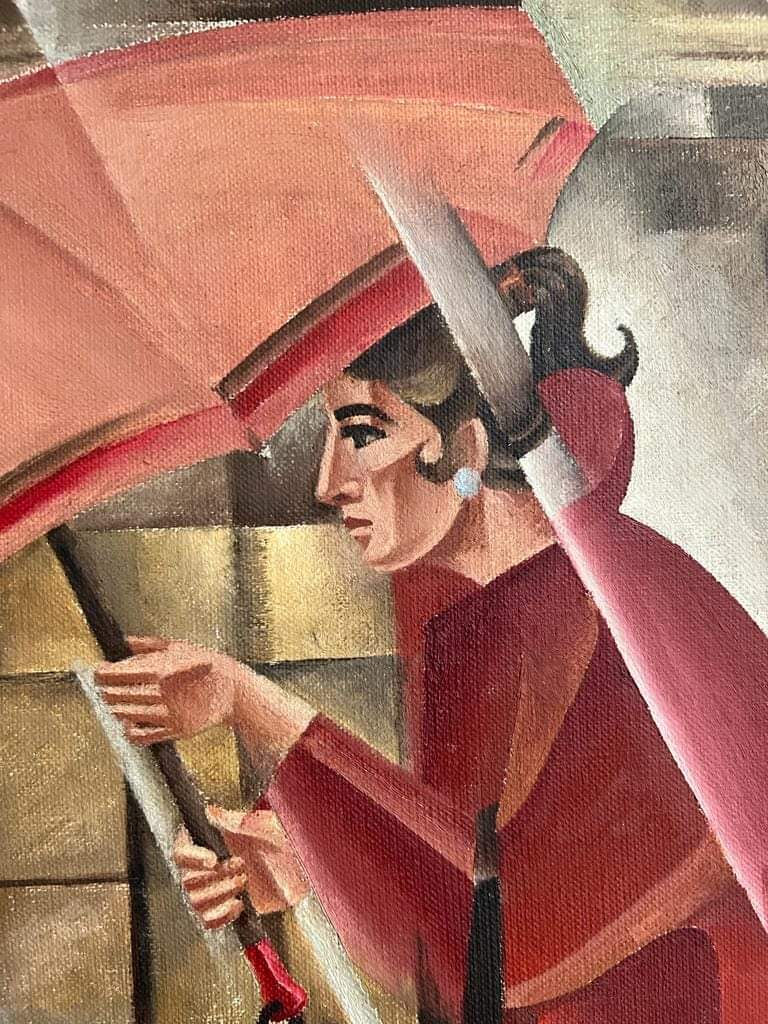
Just five days ago, I made a cheeky call to the National Gallery of Ireland to include Una Watters’ Girl Going by Trinity in the Rain in one of its future annual calendars. Hey presto, no sooner wished for than granted! The NGI, it seems, was way ahead of me!
The 2024 calendar has just gone on sale in the gallery shop and my spies in Dublin tell me Una’s Trinity Miss holds the February slot. Other new NGI acquisitions share the pages of the calendar – a minor French fellow by the name of Paul Cezanne, for one, along with old gallery favourites such as John Singer Sargent, Paul Signac, William John Leech, Mildred Anne Butler, John Lavery and Mary Swanzy.
Aren’t they in good company!
The inclusion of Una’s work in the calendar is a real vote of confidence in her work. For us here at the blog, it means that Girl Going by Trinity in the Rain will be restored to our walls. It’s almost 11 months since the men from the gallery came to take the original away.
It’ll be like old times seeing Trinity Girl on a daily basis.
The February page might well be open all year!
Paul Cézanne, La Vie des Champs, 1876-77, which features on the cover of the calendar.Photograph: National Gallery of Ireland
First the painting, now the postcard! Una’s Girl Going by Trinity in the Rain, now proudly part of the national collection, got another boost this month with the news that there’s now a postcard of the painting on sale at the National Gallery of Ireland shop.
This fine postcard reproduction also gives the painting the potential of reaching a mass audience.
I’m a sucker for a postcard memento so I’m delighted to know that Una’s striking image has a chance to reach gallery visitors who, like me, enjoy extending the memory of standing in front of the real thing with a pocket-sized reproduction.
Speaking of the real thing, Girl Going by Trinity hangs in Room 15 of NGI, along with several of Una’s contemporaries, Mainie Jellet, Mary Swanzy and Louis le Brocquy.
November is both Una Watters’ birth and death month (born this day, November 4, 1918 – died November 20, 1965). The Dublin weather she depicts here is distinctly Novembrian. Perfect for a calendar!
What about it, National Gallery? Una Watters as November’s calendar girl?
This fine specimen of angelic manhood is a detail from another new Una Watters discovery – as a result of contacts made at an event at Phizzfest earlier this year. It’s an unusual find in that it’s not a painting but a banner made for St Michael’s School in Finglas.
The principal of the school was a Sister Philippa who knew Una’s sister, Maureen McDonnell ( Sister Mel) a fellow nun at the Holy Faith School in Glasnevin. She asked her to approach Una to design a banner for the school on Wellmount Road which had opened in 1959. Another sister, Sister Therese Kearney (95), remembers the request being made.
In the summer of 1960, she has written, the school pupils made their first appearance in Glasnevin grounds for sports day. “They had no banner to represent their school. Sister Philippa immediately asked Sister Mel McDonnell’s sister Una to paint a banner for the school.”
Because the work was done as a favour, rather than being officially commissioned, it has remained, like much of Una’s craft work, under the radar. Although not signed, the provenance is direct with Sister Mel’s involvement in the process and the surviving Sister Therese’s written testimony.
The banner measuring (121.92cm x 91.44cm) depicts the archangel St Michael in Celtic warrior mode, with blonde hair, muscled arms holding a golden spear and shield. His wings are a celestial blue but there’s nothing ethereal about them – they’re robust-looking and rendered in the geometric style that Una used later in her treatment of trees and foliage. There’s no doubt that this is St Michael triumphant – the expression on the archangel’s face is serenely confident – although there’s no sign of the dragon. Instead, Una’s St Michael appears to be standing on a chain, a nicely abstract rendition of his liberating powers.
As well as designing it, it’s probable that Una, an accomplished seamstress, also made the banner and trimmings herself. St Michael is painted on what looks like calico and backed with dark green silk. The border with a Celtic barley twist design runs all the way around with a golden fringe at the bottom. Five fabric hooks allow it to be attached to a mobile wooden frame, a neat combination of function and design.
The banner is not just decorative. The school principal, John Barry, explains that it is used regularly in school ceremonies – graduations, sports days and to mark the opening of the school year when the head girl hands it over to the incoming sixth year class. The school currently has 630 pupils.
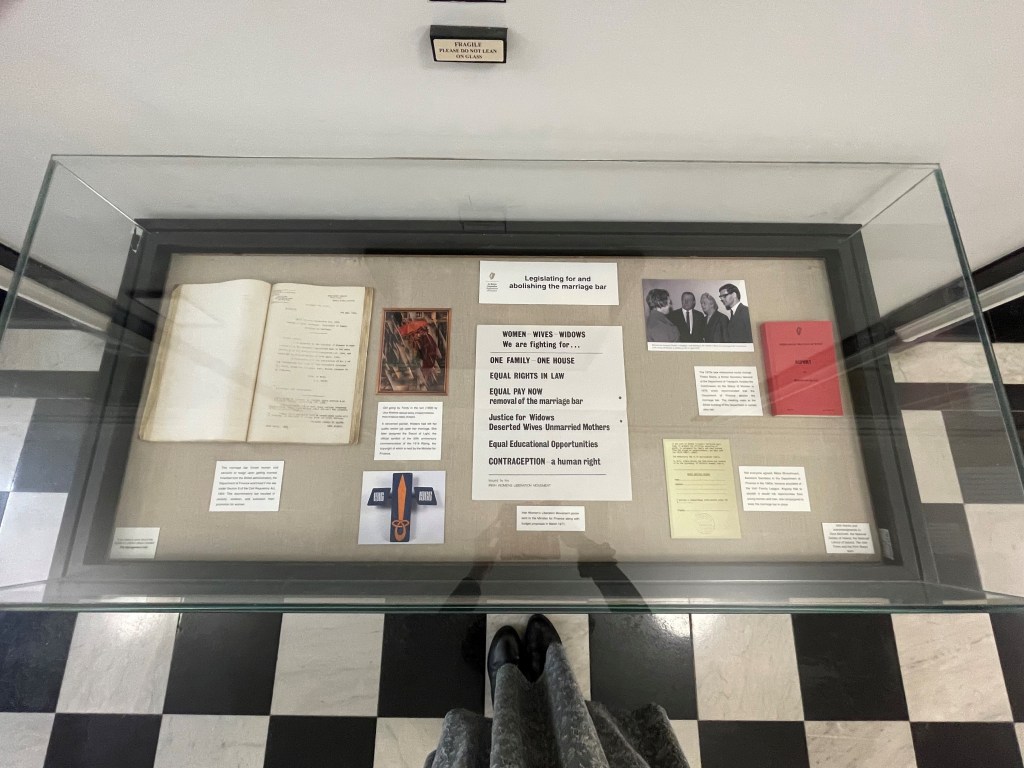
Meanwhile Una and her work is also referenced in a historical exhibition within the halls of the Department of Finance. Archivist Cliodhna Walsh was involved in organising it to mark the lifting of the marriage bar for female civil servants 50 years ago in 1973.
Like many women, Una was forced to leave her job in the library service when she married Eugene Watters in 1945. The ban on working probably gave Una more time to pursue her art, but it also meant she had to use her art to generate income, hence some of her illustrative and calligraphic work covered elsewhere on this site.
“As important as it is to remember how the marriage bar wrenched so many women away from public life, it is also lovely to acknowledge the vibrant artistry of a woman who contributed much to Irish culture,” Ms Walsh has observed about Una’s contribution to the exhibition.
A reproduction of Una’s Girl Going by Trinity in the Rain features in this private exhibition as well as images of her design for the 1966 Easter Rising emblem based on the Sword of Light. Because this was entered in a public competition, the design copyright rests with the Department.
It’s not just in the art world that Una Watters’s work is getting noticed. Her Self-Portrait in Green (1943) appears on the cover of poet and academic Gerald Dawe’s just published book. Politic Words is a collection of essays and writings on the literary and cultural influence of Irish women writers and critics, such as Edna Longley, Eavan Boland, Eiléan Ní Chuilleanáin, Lucy Caldwell and Leontia Flynn.
The book also considers the legacies of traumatic Irish history such as the Famine and the Northern Troubles, as well as the political impact of Brexit. Politic Words: Writing Women/Writing History is the final part of a trilogy of cultural studies by Dr Dawe and is published by Peter Lang in its “Reimagining Ireland” series.
Meanwhile, Dr Paige Reynolds, Professor of English at Holy Cross College, Worcester, Massachusetts, has chosen Una’s Girl Going by Trinity in the Rain (1959) – now on display at the National Gallery – as the cover for her study of modernism in the work of Irish women’s contemporary fiction.
Dr Reynolds examines the work of Elizabeth Bowen, Edna O’Brien, Anne Enright, Anna Burns, Eimear McBride, Claire-Louise Bennett and Sally Rooney, among others, in what the publishers promise will be a new literary history. The volume could not have a more fitting visual ambassador than Una Watters. As Dr Reynolds has said: “It’s both perfectly in tune with the arguments of my book – and gorgeous.”
Modernism in Irish Women’s Contemporary Writing: The Stubborn Mode from Oxford University Press, will be published in November.
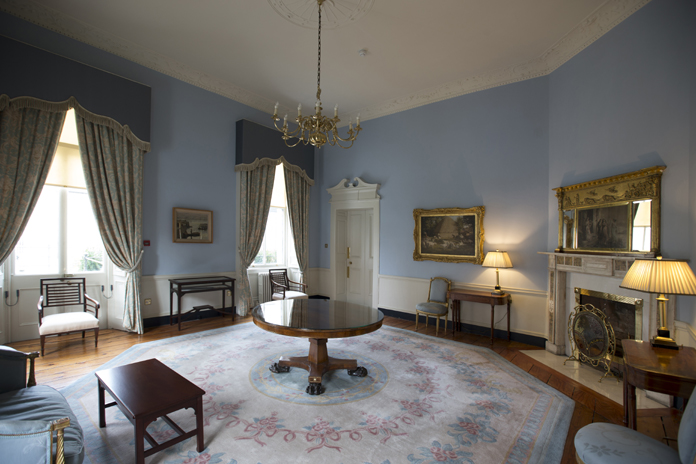
Una Watters’ The People’sGardens (oil on canvas, 40.6 x 50.8 cms), which is part of the Hugh Lane City Gallery collection, has been given on long-term loan to the Mansion House in Dublin. It will hang in the Blue Room (or the Lady Mayoress’s Parlour) in the Mansion House where, traditionally, all the paintings have come from the city’s municipal’s collection at the Hugh Lane.
The outgoing Lord Mayor Councillor Caroline Conroy personally requested the painting before her term ended last month. Ms Conroy, who’s a Green Party councillor, represents the Ballymun and Finglas local electoral area. Perhaps the Finglas connection prompted her choice?
The People’s Gardens dating to 1963 was shown at the following year’s Royal Hibernian Academy Annual Exhibition and depicts a slice of Dublin’s public life in the gardens which are part of the Phoenix Park. The Thomas Haverty Trust bought the painting and lent it for Watters’ posthumous retrospective exhibition in 1966. The following year the Trust donated the work to the Hugh Lane.
The Haverty Trust was established following the death of the artist Thomas Haverty who left a sum of money for the purchase of paintings by Irish artists for public galleries and institutions. Between 1935 and 1966, the Trust donated over 40 works to the Hugh Lane including paintings by Swanzy, William Leech, Brigid Ganly and Maurice MacGonigal (who encouraged Watters in her art studies).
As Logan Sisley, Acting Head of Collections at the Hugh Lane, noted in a blog on this site (The People’s Gardens: May 6,2020) the painting is typical of Una’s work with the trees and figures pared down to angular forms. “This shows the influence of earlier modern art movements such as Cubism and Futurism, albeit interpreted in her own style. Her clever use of shadows adds depth – notably under the trees and in the figure of the girl kicking the ball, the man reading a paper and the duck taking off (or landing). These also demonstrate a keen observation of people and an eye for detail. The strong shadows and summer dresses suggest a warm sunny day, yet the elderly couple walking arm-in-arm on the path are still dressed in heavy coats and hats.” (See also The Gardens Revisited: April 12, 2022)
In concert with the recent acquisition of Girl Going by Trinity in the Rain (1959) by the National Gallery and now on public view in Room 15, it is very heartening to see Una’s work on show after many years in the stacks at the Hugh Lane.
The painting hasn’t been shown in Parnell Square since the 1970s although, according to gallery records, it was on loan to the City Hall between 1969 and 1974 and again in the 1980s. It was also hung in the ILAC Centre Library in 1987 along with a number of other works from the Hugh Lane, including Harry Kernoff, John Leech and Lizzie Stephens, all of them depicting scenes of Dublin.
However, the painting’s new home although public is limited in its access. The Mansion House is open to the public annually as part of the Culture Night and Open House initiatives and occasionally for open days but it’s not possible to walk in off the street and view the work. However, group tours of the Mansion House can be arranged by contacting the Office of the Lord Mayor at lordmayor@dublincity.ie.
Perhaps it’s time for a tour by Una Watters’ groupies?




 Una Watters (1918-1965)