After four years of campaigning to re-establish the reputation of Una Watters, we had a proud moment today when we went to view her work in its new (and rightful) home – the National Gallery of Ireland.
Girl Going by Trinity in the Rain now hangs in Room 15, alongside many of Una’s contemporaries – Louis le Brocquy, Mary Swanzy and Mainie Jellet – artists with whom she would have exhibited in the 1950s and 60s. Furthermore, it places her at the centre of the national visual stage and allows hundreds of new people to enjoy her work which has been hidden for so long.
The descriptive tag beside the painting notes its faceted surface which “demonstrates Watters’ awareness of Cubism and Futurism” as well as her depiction of the driving rain “as a novel means of distorting the picture plane”.
We have to agree with him. Shown in the gallery’s Irish rooms, the painting sits between Tony O’Malley ‘s Self-portrait, winter, Heavy Snowfall at Trevalyor (1962/63)and Patrick Collins’ Liffey Quaysides (1957). Una’s striking work is already proving popular with visitors, according to Donal Maguire, director of the gallery’s ESB Centre for the Study of Irish Art.
The 1959 oil on canvas which was donated by Colbert Kearney to the gallery earlier this year, was gifted to him by Una’s husband, Eugene Watters, following Una’s death in 1965.
The lasting legacy of his donation is that Una’s work is now free to be seen by everyone who visits the gallery.
Photograph: Left to right, Colbert Kearney, the director of the NGI, Dr Caroline Campbell and Mary Morrissy.
May has been a great month for Una Watters news. As a result of an event at Phizzfest, Phibsboro’s community and arts festival, where I gave a talk on Una earlier in the month, a new painting has been discovered.
The watercolour of the River Suck, where Una and Eugene spent many happy hours fishing, is one of several Una made during the 1950s (we’re not yet sure of the date of this one) and its owner came along to the Phizzfest, having not known about last year’s exhibition, or been aware of the surrounding publicity. The owner of The Pine Wood ( oil on canvas, 1961) also came to the full-house event. We had an image of this work but hadn’t definitively identified its owner.
We’ve also discovered through contacts made at Phizzfest that Una made a banner for St Michael’s School, Finglas – again we’re not sure of the date – as a result of a request by her sister, Maureen, who was a Holy Faith nun ( Sister Mel) based in Glasnevin. Better still, the banner still exists. We’re hoping to see it in the coming weeks and take photographs of it. This is yet another testament to Una’s design skills and her range, as well as her embedded artistic presence in her own community.
Also present at Phizzfest was Gary Byrne, Una’s nephew, who brought along two samples of Una’s work – an early oil of The People’s Gardens (1943) and a pen and ink drawing – Old Woman – both of which you can find on this website under Uncatalogued Work.
Finally, and best of all, we’ve had word from the National Gallery that they plan to hang Girl Going by Trinity in the Rain “imminently” – perhaps as early as June. Watch this space – or should I say – watch that space on the walls of the NGI, where we’ve always felt Una rightly belongs.
Catch up on Una Watters at Phizzfest where I’ll be giving an illustrated lecture – “Una Watters: Total Eclipse”- which will look at her work in context and explore the reasons for her retreat into invisibility.
Raining Una Watters, that is. We’re delighted to be able to announce that the Una Watters’ painting, Girl Going by Trinity in the Rain (1959, oil on canvas, 61×81 cms), is now part of the National Gallery’s collection, thanks to the generosity of its owner, Colbert Kearney.
Colbert was gifted the work by Eugene Watters after Una’s posthumous exhibition in 1966. He was a pupil of Eugene’s at St Fergal’s National School in Finglas (see Colbert’s guest blog, “Portrait of E.R. Watters”, June 17, 2020) and they remained firm friends until Eugene’s death. It was always Colbert’s intention to pass the painting on but after last year’s retrospective (March 10 – April 2, 2022 @ the United Arts Club), the idea of donating to the NGI seemed like the logical next step.
Girl Going by Trinity is a quintessentially Dublin work – the Trinity College location makes it so – and the driving, sleety rain will be a familiar meteorological trope for anyone who has known winter in the city.
As Colbert’s partner, I’ve lived with this work for over 20 years, and it’s the work that inspired my quest to locate as much of Una’s work as possible, and the decision to mount Una’s retrospective last year with Sheila Smith, her niece. The idea was to bring Una to a wider audience and to the forefront of artistic attention. We hope that the NGI’s acquisition of her work will cement that progress.
The opportunity came at a reception for the Sarah Cecelia Harrison Inaugural Essay Prize sponsored by the gallery last November. My essay on Una reached the final three (See “Una takes her place”, November 25, 2022). At the reception Colbert had a conversation with the director of the ESB Centre for the Study of Irish Art, Donal Maguire, and enquired if the gallery would be interested in having an Una Watters in the collection. I think Donal wondered if it was the cheeky white wine talking, but once he was assured that Colbert was serious, the process only took a few months.
In late January we had to say goodbye to the painting, so it could go before an acquisitions committee. At that stage, we didn’t know if it would be accepted or if we would see it again (although of course we sincerely hope we will see it again on the walls of the National Gallery!) so we spent much of the early new year savouring our time with it.
We moved it to a new spot – hung lower than usual. (I got this idea from sculptor Corban Walker’s exhibition As Far As I can See at the Crawford Gallery (Oct 15, 2022 – Jan 15, 2023). Along with his own work, Walker chose 30 works from the Crawford Collection to show. Because of his restricted stature, Walker hung the works lower than normal and it afforded a much more intimate relationship with the paintings.)
Now at eye-level, there were still new things I was seeing in Girl Going by Trinity in the Rain – its complex treatment of light, the quivering rain drops (impasto dashes of white paint) on the tips of the umbrella, the life-like animation of the Goldsmith statue beside the flesh-and-blood young woman who appears paradoxically monumental, the misty illumination around the girl’s ponytail.
I’d never noticed before the proliferation of verticals in the work – the stick of the umbrella, the railings, the balustrades – and how the rain itself is architectural in its form like literal stair-rods. The patterned geometry of the stone work leans close to abstraction; even the half-belt on the girl’s coat looks solid, brick-like, as if she’s melding with the building, her face full of sharp architectural planes.
I could go on, but I won’t, or I’ll get lonesome for it! And there’s nothing really to mourn. The painting lives.
Girl Going by Trinity in the Rain joins its sister work – The People’s Gardens (1963, oil on canvas, 40.6 x 50.8 cms) – which is already in the Dublin City Hugh Lane Gallery collection (See Logan Sisley’s guest blog May 6, 2020). It means Una Watters’ name is enshrined in the national cultural memory, where it belongs.
Although the Hugh Lane organised private viewings of their Una to coincide with our retrospective last year, they wouldn’t lend The People’s Gardens, and it’s a very long time since it was on public display in Parnell Square.
Both of these works deserve to be widely seen. So next time you’re in either of these galleries, ask about their Una Watters works; it’s possible to see them by appointment. After all, they belong to all of us now.
This blog has tended to concentrate on Una’s paintings, but as noted elsewhere on this site, Una did a great deal of jobbing art and design work. During the 1950s, she provided illustrations and calligraphy for her uncle Brian O Higgins (1882-1963), the poet and patriot, whose portrait by Una is highlighted in a guest blog (May 19, 2020).
O’Higgins had founded a publishing company in 1924, whose output ranged from rousing political pamphlets (Unconquered Ireland, 1927) to devotional tracts (The Little Book of St Francis, 1958) as well as Christmas and greeting cards, all of which showcased the work of Irish artists and illustrators.
The cards, in particular, were a popular venture for the company. In the 1950s, a decade of mass emigration from Ireland (half a million people left the country between 1951 and 61), these were dispatched to the Irish diaspora all over the world, but particularly to the US.
The company’s publications reflected O’Higgins’ own passions – politics and prayer. He was a die-hard, anti-Treaty Republican figure, a founding member of the Irish Volunteers and a 1916 combatant. He was imprisoned several times between 1918 and 1921 and went on hunger strike during the Civil War. He served the Clare constituency as a TD until 1927 when he lost his seat. He resigned from Sinn Féin in protest in 1934 and sided against DeValera in 1938. O’Higgins was also a devoted Catholic. (He died aged 81 in St Anthony’s Church in Clontarf while attending Mass.)
But his political and religious agenda chimed with a broader economic nationalism, borne out of De Valera’s economic war of the 1930s which had rigidly promoted a policy of Irish self-sufficiency. Even though Seán Lemass was in the process of moving the economy away from this insular path in the late 1950s, O’Higgins was still clearly appealing to patriotic supporters of the “Buy Irish” strand of De Valera’s isolationism.
The craft skills of Irish artists were central to the publications he produced, honouring traditional skills – in particular calligraphy and Celtic design. These pamphlets promoted the arts and crafts movement in the Ireland of 1950s, as much as the Yeats’ sisters’ Cuala Press did during the same period.
O’Higgins’ publishing firm had an export market in mind. The subject matter of both the secular and religious publications might seem twee and verging on the “Oirishy” for contemporary taste but they were cannily serving their target audience. Prayer-book sized ( approx 10.5 x 14 cms), slim and light, and easy to post – remembering that large diaspora – they served as both devotional tools for the practising Catholic and nostalgic mementos for the lonely exile.
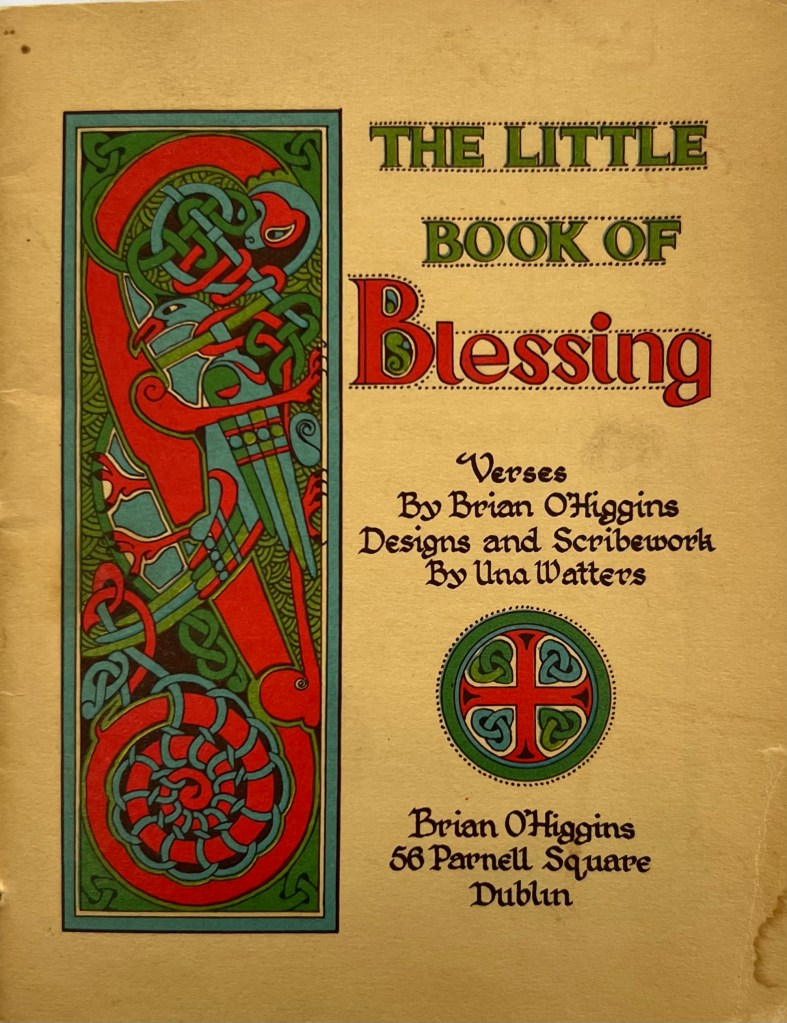
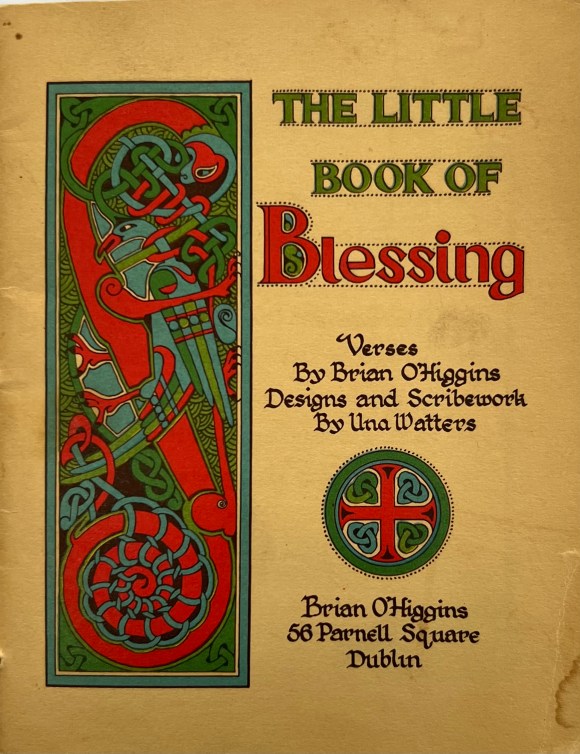
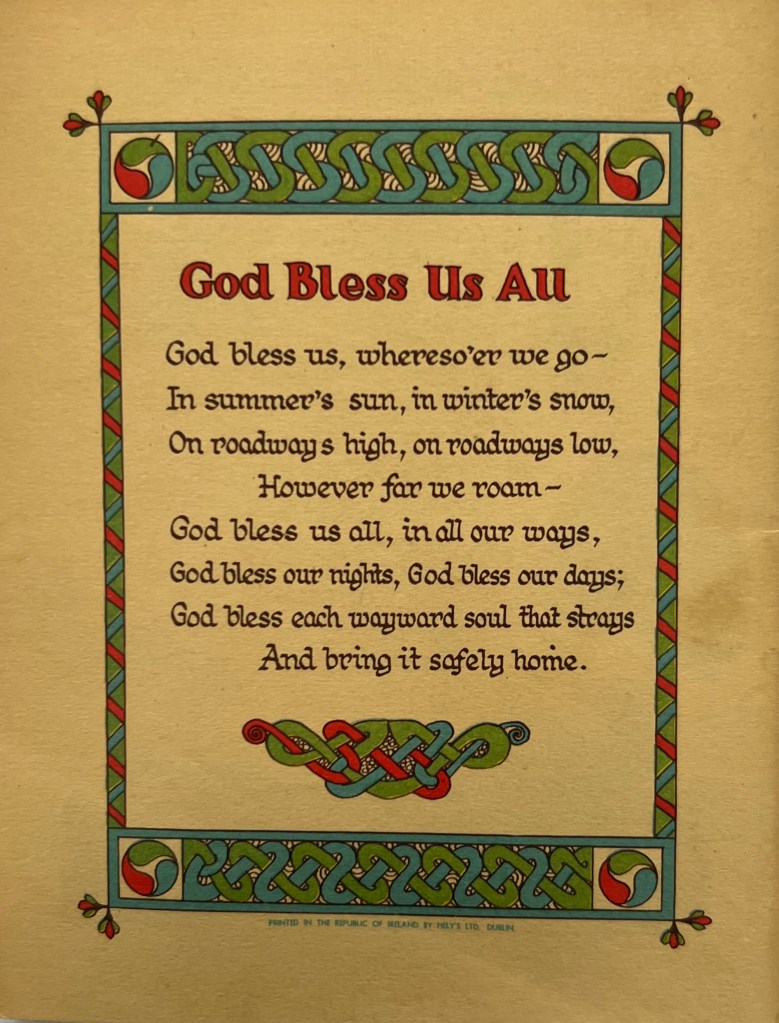
The difficulty for the Una Watters scholar is in identifying the specific publications she worked on. While the verses were clearly authored by O’Higgins (he was a prolific poet, balladeer and songwriter) or drawn from traditional sources, the art work for smaller items was not always credited. That’s why we’re really excited to have been a gifted a pristine copy of one of these publications – The Little Book of Blessing (1959) – which is very definitely one of Una’s with her name prominently on the cover. (see above)
Glenn Slaby – http://www.glennslaby.com – came across Una Watters by chance when he was doing his own research on Brian O’Higgins after he had acquired a copy of the Little Book of Blessing. (He thinks he may have picked it up at a library sale or at the sale of a family library owned by a woman of Irish descent in New Rochelle, NY, where he lives. ) “I love, enjoy picking up old, and/or unusual books,” he writes. Adding to its rarity value, is the fact that this pamphlet is not listed among O’Higgins’ attributed publications.
Glenn has kindly donated the booklet to this site, and we intend to hold it as part of a material resource for scholars interested in Una’s work. In time, we will offer it for safe-keeping to a national institution.
Glenn included with the pamphlet a letter which he found inside dated June 22, 1967, in which Nora (no surname), the writer of the letter (based in Belfast), notes she is sending the booklet to Bernie in the US in the hope that “it will bring back happy memories of the Old Country & his Youth”.
Artistically, the influence of the great monastic scribes is obvious in Una’s Celtic designs. Compare Una’s frontispiece (see above) with this detail from the Book of Kells.
Una’s interest in and debt to manuscript illustration is also evident in her witty portraits in The Four Masters, (1959, oil on canvas, 60 x 70cms) the painting which now hangs in Phibsboro library. (See post: February 20,2022) and in private work done for family and friends – take a look at her St Patrick’s Breastplate on the Uncatalogued Work page on this site.
Once again, thank you to Glenn Slaby for his generous gift.
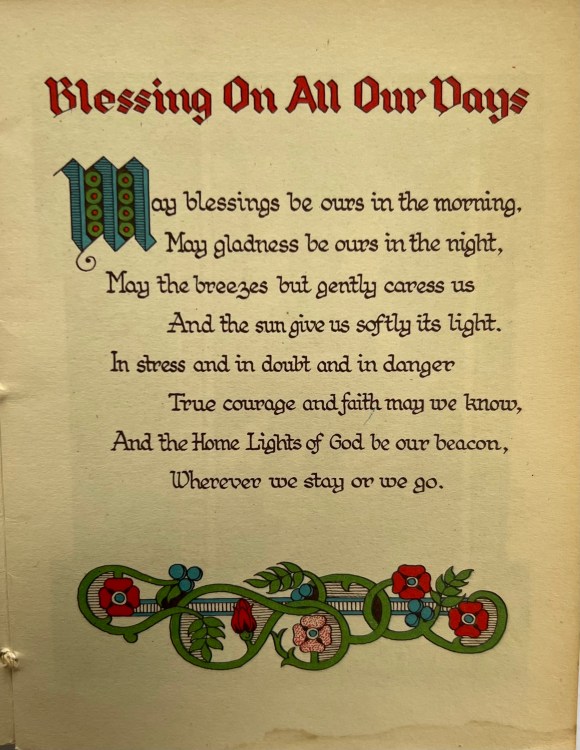
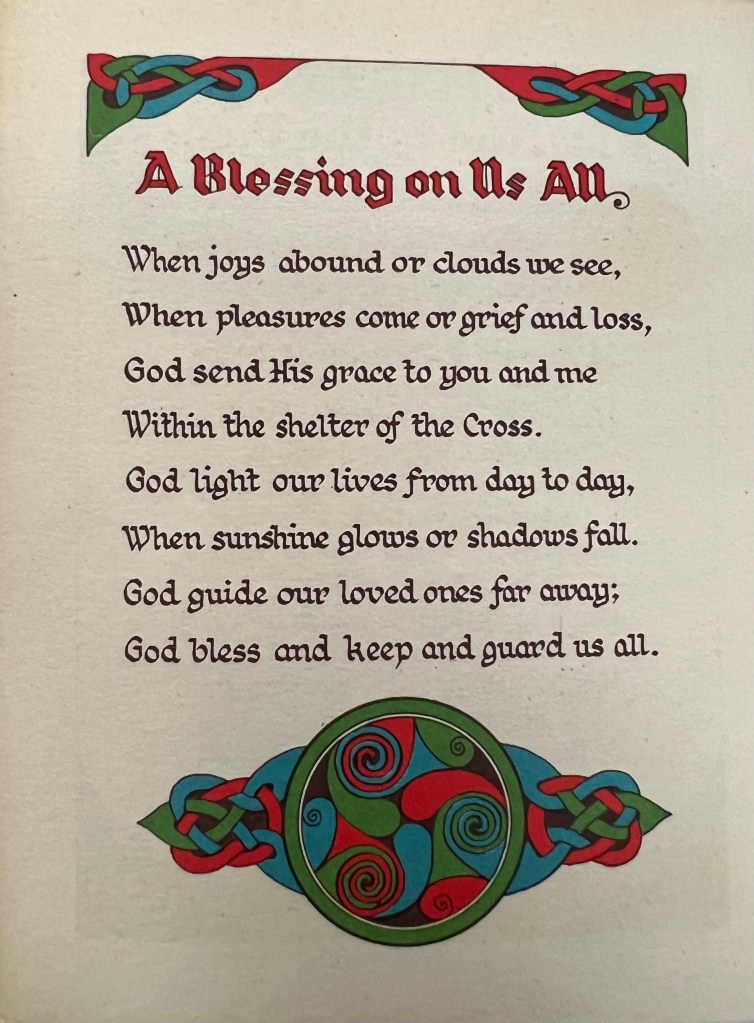
Below see some sample pages from The Little Book of Blessing.






 Una Watters (1918-1965)