Categories
News

Show time for Una!

We’re very pleased to announce that the retrospective exhibition we’ve been working towards for the last two-and-a-half years, Una Watters: Into the Light, will go ahead at the United Arts Club in Dublin next month. (Details below)

Our aim is to recreate as closely as possible the last retrospective of Una’s work, a posthumous exhibition organised by her husband, Eugene Watters. We used the catalogue of this exhibition as a guide in our quest to trace Una’s “lost” paintings. Because we didn’t manage to find all 37 works in that show, the 2022 retrospective is, by necessity, smaller. However, it does feature some work not in the 1966 exhibition and some newly discovered watercolours.

Although Una Watters: Into the Light is by its nature a backward glance at Una’s work, we like to think it’ll be a step forward in terms of her visibility and reputation.

The Farm, featured above, (oil on canvas, 36 x 31.5 cms) is one of the paintings that you’ll be able to see in the show which will run from March 10 to April 2.

It’s a late work (1964) and represents territory very close to Una’s heart, featuring as it does her parental home and the land around it at Cappagh Cross, Finglas.  The same landscape is depicted in Harvest (see our blog, “The Grim Reaper”, Nov 21, 2020) and even tangentially in the background of Flowerpiece (“A Time of Gifts”, Dec 22, 2021)

What probably isn’t clear from the reproduction here is that Una used gold leaf for the meadow that dominates the painting, devouring over half of the pictorial space.  Gold leaf is more often associated with religious paintings although the modernist painter Patrick Scott (1921 – 2014), a near contemporary of Una’s, and one of the first Irish exponents of pure abstraction, incorporated geometrical forms in gold leaf against a pale tempura background in his iconic mature work.

Meditation Painting 28 – Patrick Scott. Photograph: IMMA

Some of Una’s early work concentrated on religious themes e.g. Annunciation (1943) which was shown in the original 1966 retrospective and is now, unfortunately, lost.  Another painting, The Flight into Egypt, is mentioned in correspondence. Due to an oversight by Una’s husband, Eugene, it was not included in the 1966 show although it was in the possession of Una’s sister at the time. This work, too, has not been located.

Una’s use of gold leaf in The Field, a secular work, is an interesting choice. It lends a spiritual emphasis to the pastoral idyll, elevating nature to the sacred realm. Harvest, one of her last works, has the same golden glow, though without gold leaf so its atmosphere is predominantly nostalgic.  (The work is known colloquially among family members as Tea in the Fields.)

One of the figures in The Farm might well be Una herself and it, too, might be a recollection of a childhood scene.  The naieve depiction of the farm buildings and house, the ducks in the pale blue pond, even the expanse of the meadow suggest a child’s eye perspective, intimating the vastness of the landscape and, temporally, the seeming endlessness of summer days.

It’s unclear what the figure in white is doing – pointing to something or perhaps she’s picking blackberries? Is that a pail in her left hand? Compare the stance of this figure to the two gambolling girls – Eugene Watters’ nieces – in Wild Apples (“Wild Apples”, June 24, 2020). Another female figure is lolling against a green mound while on the far right a calf, or is it a large dog, stands motionless in the sunshine. So far, so figurative. But the long, stalky green shadows and those trademark cubist trees show Una’s late abstract tendencies, as does the patterning of the landscape.

It’s unlikely that Una would ever have travelled to the far-reaches of abstraction that Patrick Scott inhabited, although his early work was, like Una’s, highly representational. (He jokingly referred to himself as an Irish Grandma Moses.) But it does beg the question – would Una, like Scott, have moved further into abstraction had she lived?

Una Watters: Into the Light runs at the United Arts Club, 3 Upr Fitzwilliam Street, Dublin 2, March 10 – April 2, 2022.
Categories
Una in focus

A time of gifts

Just in time for Christmas, we’ve discovered another Una Watters. This one, an early oil from the mid-1940s, was a gift to the father of the present owner of the work, who now lives in the UK. But unlike a lot of Una’s paintings which were distributed by her husband Eugene Watters after her untimely death, we know Una gifted this one herself shortly after it was completed.

We know the approximate date of the work (45.2cms x 55.2cms) because it’s signed with her married name. So it was most likely completed after Una’s marriage in 1945 and before the end of 1946, since it was a wedding gift to the recipients who married in that year.

“The picture used to hang in in our dining room in Blanchardstown,” the current owner recalls. “My father was the GP for the area at that time. Apparently, Una was a patient of his and the painting was a wedding gift to my parents from her.”

The owner made contact after seeing a post on the excellent “Dublin of Ould” Facebook group, which marked Una’s birthday anniversary in November. Thank you to them for being the conduit for this new Una Watters’ discovery!

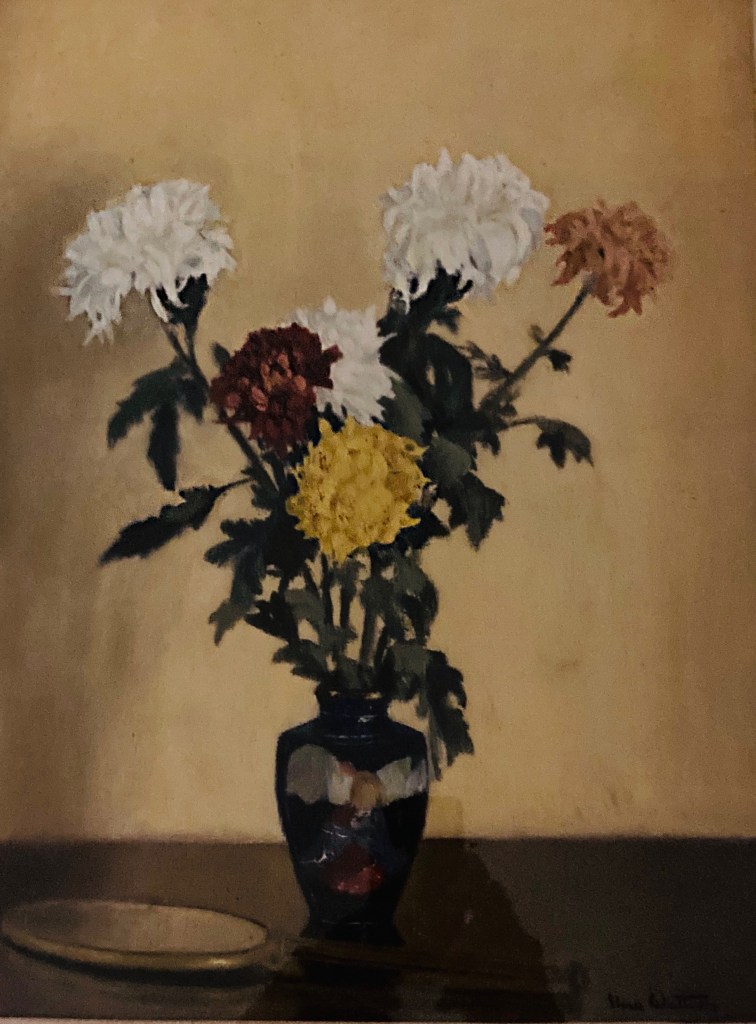
The painting is a still life, unusual for Una, showing an arrangement of flowers, mop-headed chrysanthemums in white, pink, crimson and yellow in a dark, opaque vase which may itself be decorated. (An eagle-eyed follower of this site has suggested that, in fact, the vase is transparent and the reflections of the blossom heads can be seen in the glass – see comments above) A saucer stands nearby and the vase seems to be sitting on a brown surface, probably a table. The background is a parchment shade, but it’s vaguely illuminated by an unspecified light source outside of the frame.

Despite this illumination, the mood of the painting is sombre, although, of course, we’re only going by photographs here which can be deceptive in terms of light. But the chrysanthemums look like they might be on the turn, or are certainly a bit windblown, and the leaves are very stark against the subdued background.

Una returned to still life in her very late work – see the impressionistic Emerald Ballroom watercolours elsewhere on this site – and in one of the works that featured in the 1966 posthumous exhibition.

Flowerpiece (1965 – dimensions unknown) also depicts a flower arrangement but the mood couldn’t be more different. The flowers are rendered in Una’s late geometric style so the bowl and the blooms – pansies? – seem cut from the same material, both solid and structural, but also airy. The lighting here is almost celestial glancing off the cut-glass bowl and refracting out into a lemony haze beyond the glass, uniting the pale blue sky and the tender greenery visible beyond the metal window frame (almost certainly the view from the Watters’ cottage in Cappagh Cross.)

The mood is joyful, transcendent. These are not flowers on the turn, but abundant and gloriously in tune with nature, as it would seem is their creator.

Categories
News

Una soars with Finglas ravens

Another reason to celebrate Una Watters’ birthday month, is a new sculpture to be launched in Kildonan Park, Finglas, this week that pays homage to Una’s work

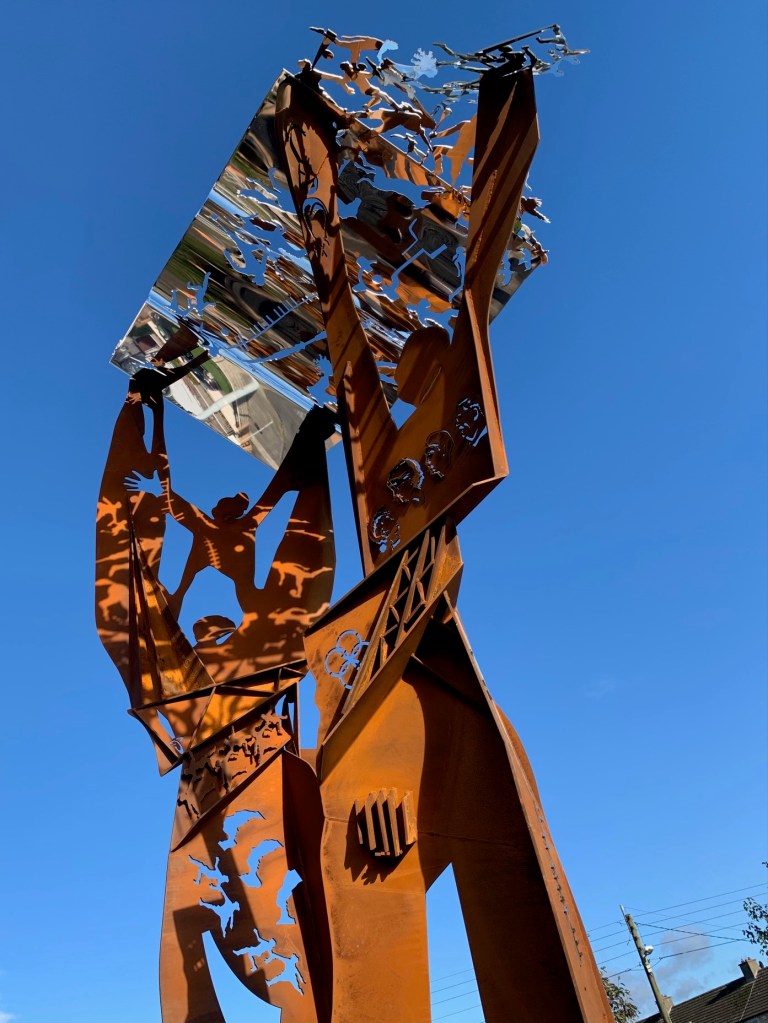
The Bridge: Finglas Ravens Soar, is a seven-metre-tall steel sculpture by Sara Cunningham-Bell, commissioned by Dublin City Council/Sculpture Dublin, for the 20-acre public park comprising two figures with arms raised holding high a mirrored steel ‘river rug’.

The sculpture is a compendium piece, threaded through with symbols and motifs reflecting the artistic and cultural life of the locality – including the figures of running schoolboys from Una Watters’ seminal painting, Cappagh Road, and representations of An Claidheamh Soluis (Sword of Light), the symbol she designed to mark the 50th anniversary of the Easter Rising in 1966 – see elsewhere on this site.

Coincidentally, the sculpture was installed on November 4, Una’s 103th birthday.

Inspired by the Irish translation of Finglas – ‘Fionnghlas’ (clear streamlet) – the sculpture draws on other influential figures associated with the area, such as Sophie Pierce-Healy, an aviatrix who flew her plane, “The Silver Lining”, from Kildonan Aerodrome, Ireland’s first commercial airport in the 1920s, along with celebrated uileann piper Séamus Ennis.

The Kildonan Park work was a ‘participative’ commission. Over the past year, hundreds of local residents have engaged with Sculpture Dublin by taking part in over 40 creative workshops, focus groups, public meetings and other engagement activities related to the installation.

The Bridge: Fiacha Dhubha Fhionglaise ar Foluain’ will have a public launch on site at Kildonan Park on Saturday, November 13, at 2pm.

Categories
Una in focus

Happy Birthday, Una Watters

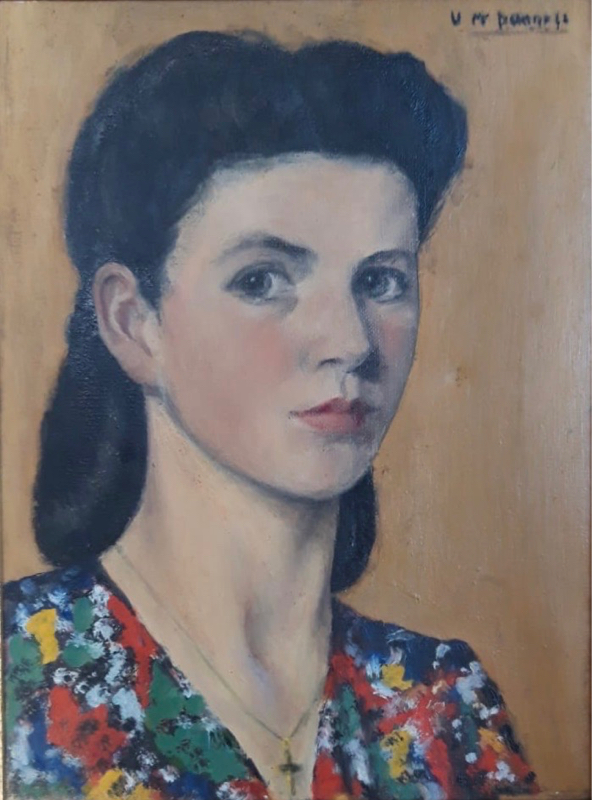
Una Watters was born 103 years ago on this day. We celebrate her birthday with this charming early self-portrait. This is one of the few oil paintings that she signed with her maiden name, Una McDonnell. (She married Eugene Watters in 1945.) So it’s a portrait of the artist as a young woman.The painting (oil on canvas, 23 x 31 cm) dates to 1942 when she was just 24. It may well have been completed while she was studying at the National College of Art where she attended part-time on the encouragement of Maurice MacGonigal, the college’s director.

Like the 1943 Self-Portrait in Green, featured elsewhere on this site, the sitter’s gaze is clear and candid, although there is something tentative about the expression. The graceful contour of her neck is accentuated by a gold crucifix on a delicate chain. The colourful floral dress looks more girlish than the sophisticated presentation in Self Portrait in Green and although Una looks straight at us, she is slightly off-centre in the composition, her right shoulder out of frame. This adds to the impression of uncertain youth. It lacks the forthright pose of the 1943 work. Although painted only a year later, the confidence of the “green” portrait is noticeable, perhaps as a consequence of the formal training she was receiving.

As far as we know, this portrait was never exhibited (it wasn’t in the 1966 exhibition, for example) and remained in the McDonnell family endorsing the notion that it may well have been an apprentice work.

As Frances Borzello remarks in Seeing Ourselves: Women’s Self-Portraits, self-portraits are often done for practice, or alternatively for self-promotion. “A comparison of the artist with a painted subject was the best way to prove one’s skill at catching a likeness.”

Una’s interest in portraiture was established early. She did impromptu sketches of family and friends from a young age. She went on to complete several accomplished oil portraits – of Eugene Watters, Brian O’Higgins and Tomas O Muircheartaigh – where according to the sitters or their familiars, she had the skill of achieving great likenesses.

As Colbert Kearney remarks of her portrait of Eugene Watters: “Seeing it again more than a half a century later, was a Pygmalion moment: I expected the image in the frame to turn and talk to me so miraculously had the artist captured not only the appearance, but also the essence of the man.”

So are we seeing the “real” Una here? Well, perhaps, though as Dr Eimear O’Connor pointed out writing about Self Portrait in Green, the self-portrait is more than autobiographical statement. It’s also about technique – the compendium of painterly decisions on light, colour and composition that reflect the artist’s innate talent.

Categories
Una in focus

She stoops to conquer?

Guest blogger Michael Waldron, Assistant Curator of Collections and Special Projects at the Crawford Gallery, Cork, takes a closer look at Una’s 1959 painting, “Girl Going by Trinity in the Rain”.

On my first in-person encounter with this painting, shafts of autumn sunlight, filtering through Venetian blinds, fell across its surface. This serendipitous meeting of art and atmosphere added another dimension to an already striking composition. 

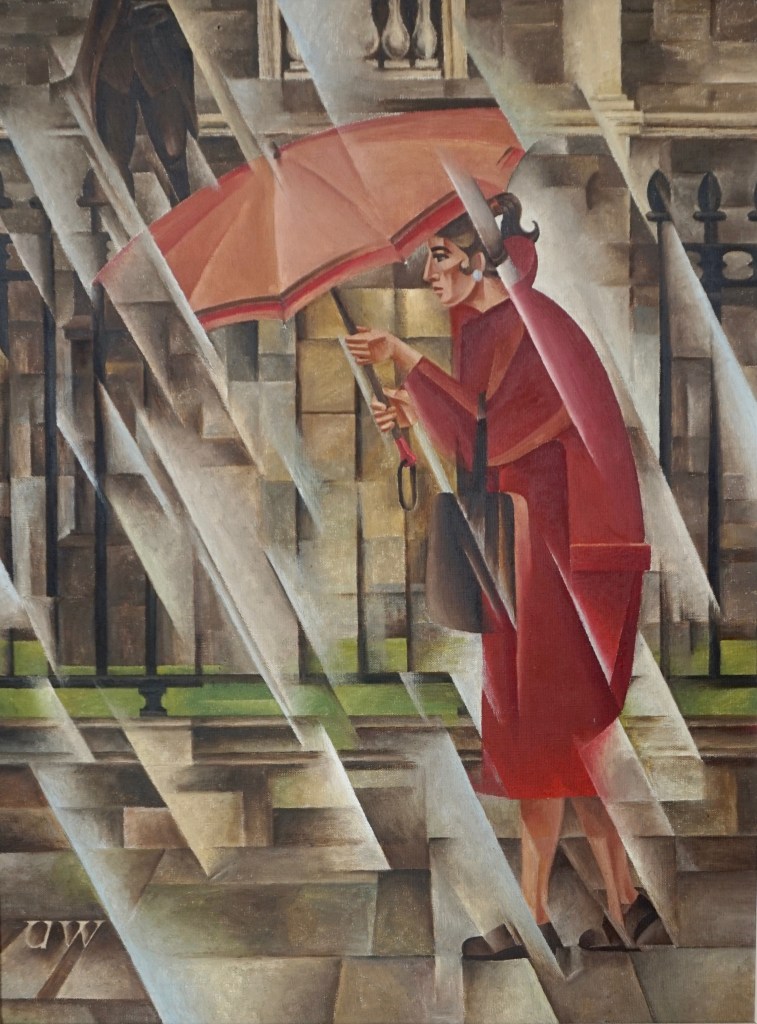
Assuredly contemporary, Girl Going by Trinity in the Rain ( oil on canvas, 61 x 81 cm) is of its time. Coming in the years following the Mother and Child Scheme, establishment of the Arts Council of Ireland (1951), completion of Busáras (1953), and the Marian Year (1954), this was an Ireland on the cusp of significant social change. (The first female recruits to An Garda Síochána (1959), the founding of RTÉ Television (1961), and the publication of Edna O’Brien’s bellwether novel, The Country Girls (1960), were just on the horizon.)

Although not avant-garde by any stretch, Watters’ painting, nonetheless, has its roots in the revolutionary aesthetics from earlier in the century. In its dynamic, slightly prismatic energy, there are resonances with the paintings of Mary Swanzy, Mainie Jellett, Evie Hone, Norah McGuinness, and to a lesser degree, of Louis le Brocquy and Colin Middleton. Rather than specific reference points, however, these may be taken to inform the stylistic territory that Watters was herself exploring.

In Watters’ painting there are faint echoes too of States of Mind: Those Who Go (1911) by Umberto Boccioni. https://www.moma.org/collection/works/78653. Dissolving into horizontal whisps, the downcast figures in this work of Italian Futurism seem to be the disillusioned heirs to the confident 19th century urbanites of Impressionism.

Such dynamic Cubo-Futurist fragmentation are also hallmarks of Giacomo Balla’s pre-First World War work. en.wikipedia.org/wiki/Giacomo_Balla. Within this art historical space, however, a stronger aesthetic equivalent to Watters is perhaps the second-generation Italian Futurist painter Alessandro Bruschetti (1910-1980), whose aeropaintings are stylistically similar, if politically very distant. https://artsandculture.google.com/entity/alessandro-bruschetti/g120vzl_v?categoryid=artist

Rainy, urban settings were among the subjects of a coterie of modernist artists during the later nineteenth century. In the case of the Impressionists, the atmospheric qualities of rain and its effects on colour and light – so celebrated in Rain, Steam, and Speed – The Great Western Railway (1844) by J.M.W. Turner – perhaps offered an opportunity to capture something ephemeral.

Exemplary of such renderings, Gustave Caillebotte’s Paris Street; Rainy Day (1877) is a scene of fashionable Bourgeois individuals walking in a wintry Place de Dublin. Les Parapluies (The Umbrellas), Pierre-Auguste Renoir’s famed 1880s painting, is another fine example – this time with a more direct Irish context.  

In 1959, the year Watters painted Girl Going by Trinity in the Rain, a historic agreement was reached between Dublin and London which would see an alternation of Lane Bequest paintings displayed in the Hugh Lane Gallery and The National Gallery. Les Parapluies was – and still is – among this infamous group of works that drew together national politics, international relations, and the art world.

Moreover, this “1st Loan Agreement” came after decades of lobbying at the highest levels and would certainly have been spoken of in Watters’ social circles and home life. (Incidentally, Watters’ The People’s Gardens (1963) – written of previously here by Logan Sisley – is part of the Hugh Lane Gallery collection.)

While these may be circumstantial, even tangential contexts, it is worth noting them when attempting to situate Girl Going by Trinity in the Rain and Watters’ informed approach to subjects and style. Both, like Watters’ painting, possess a sense of solidity. But if either of these works was on the Irish artist’s mind when composing her painting, she decisively abandons their cooler grey-blue palettes in favour of red and peach tones that warm the sombre, inhospitable Dublin streetscape.  

Les Parapluies – Pierre August Renoir

Mary Morrissy has previously (and astutely) described Watters’ composition and suggested a thematic connection between her inclusion of John Henry Foley’s statue of Oliver Goldsmith (top left) and the mythological story of Danaë receiving the golden rain.

Searching for other meanings, we might look to the eponymous ‘girl’ as she passes in profile outside the railings of Trinity College: is there an implied reference to Archbishop McQuaid’s enforcement of the Catholic ‘ban’ on entering the institution between 1956 and 1970?

Or perhaps there is a simpler joke implied here: does our ‘girl’ (the artist?) – leaning slightly, yet resolutely into the rain – ‘stoop to conquer’ as per Goldsmith’s 1770s stage comedy? 

Michael Waldron