Categories
News

Una in print

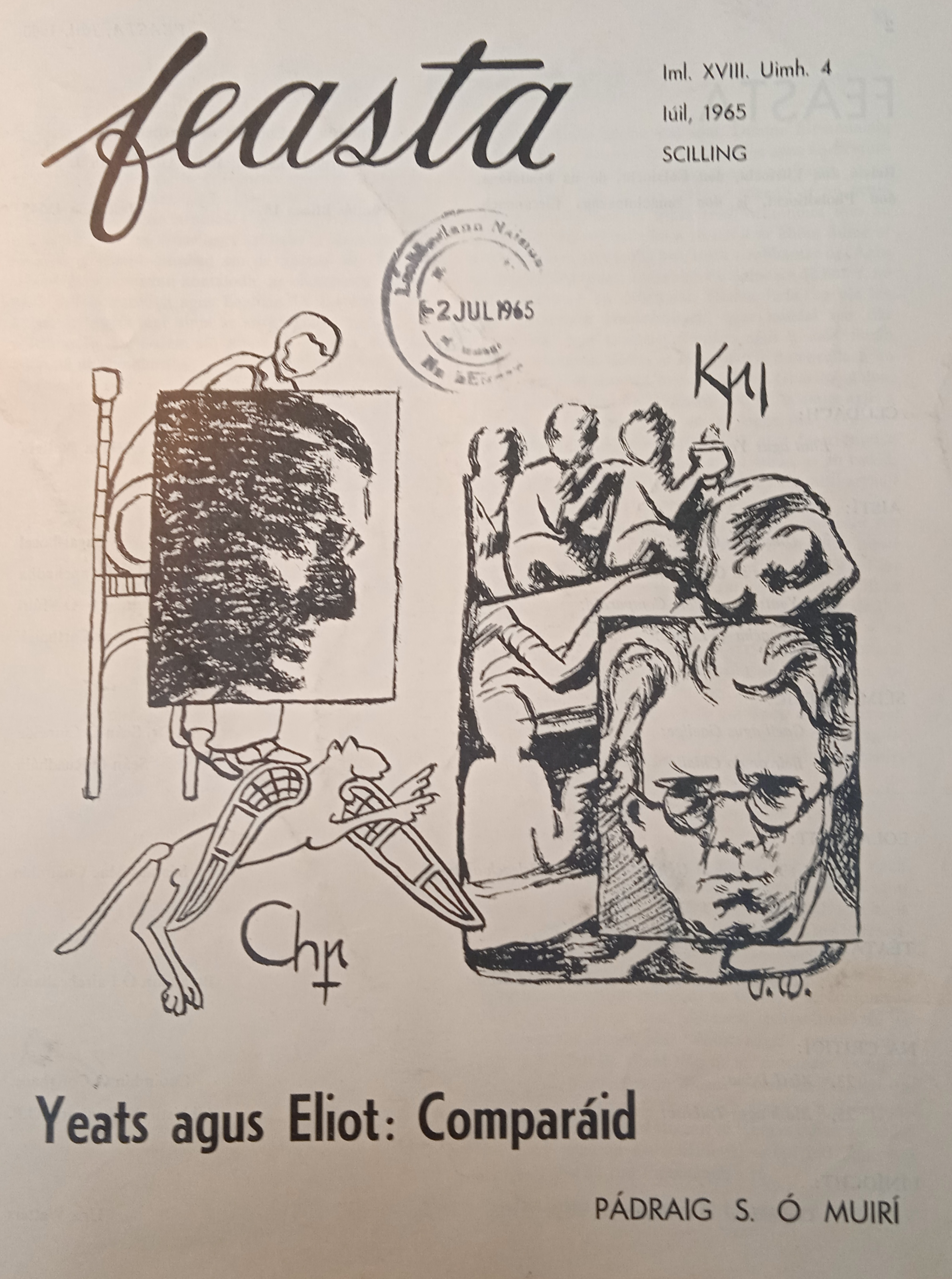
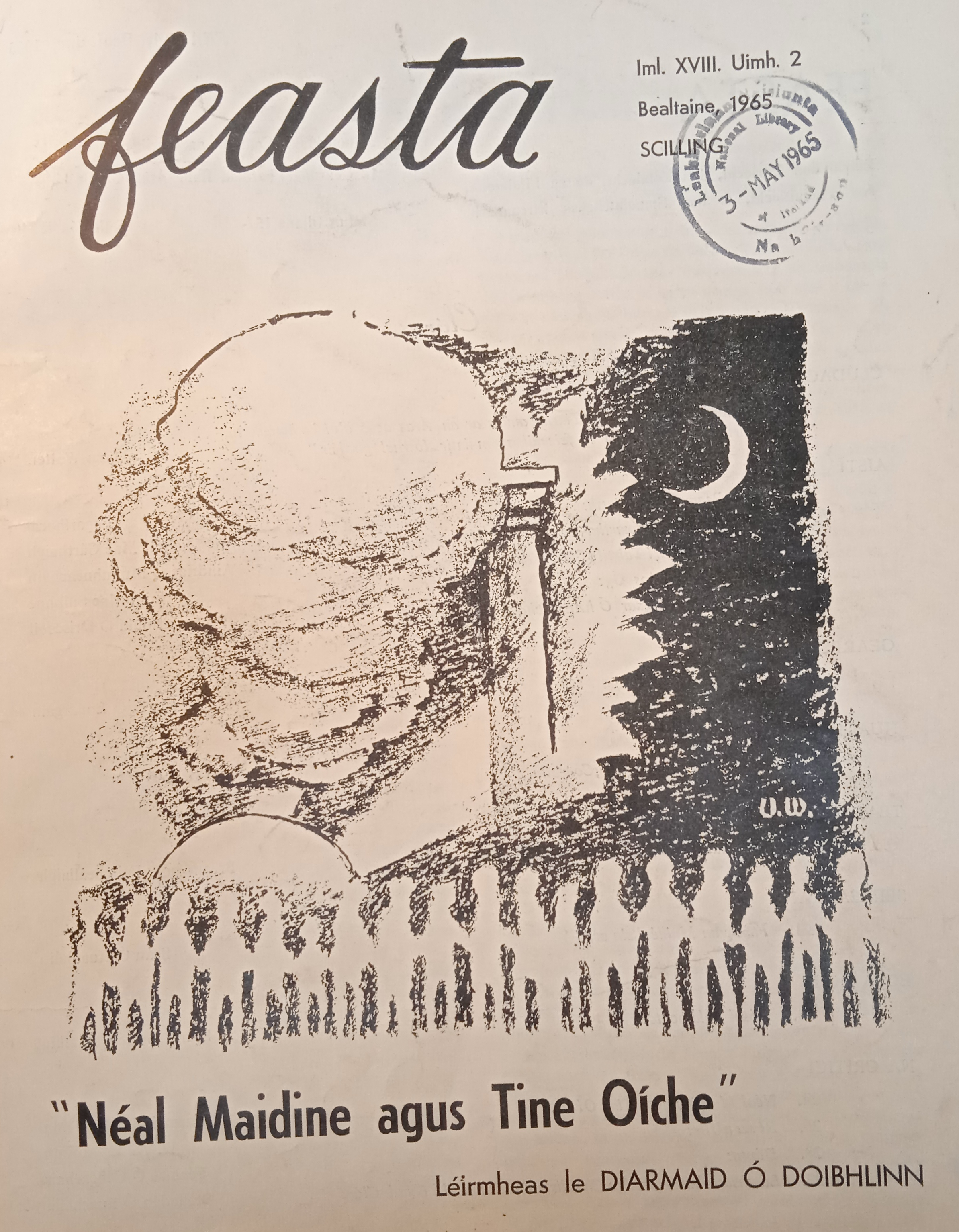
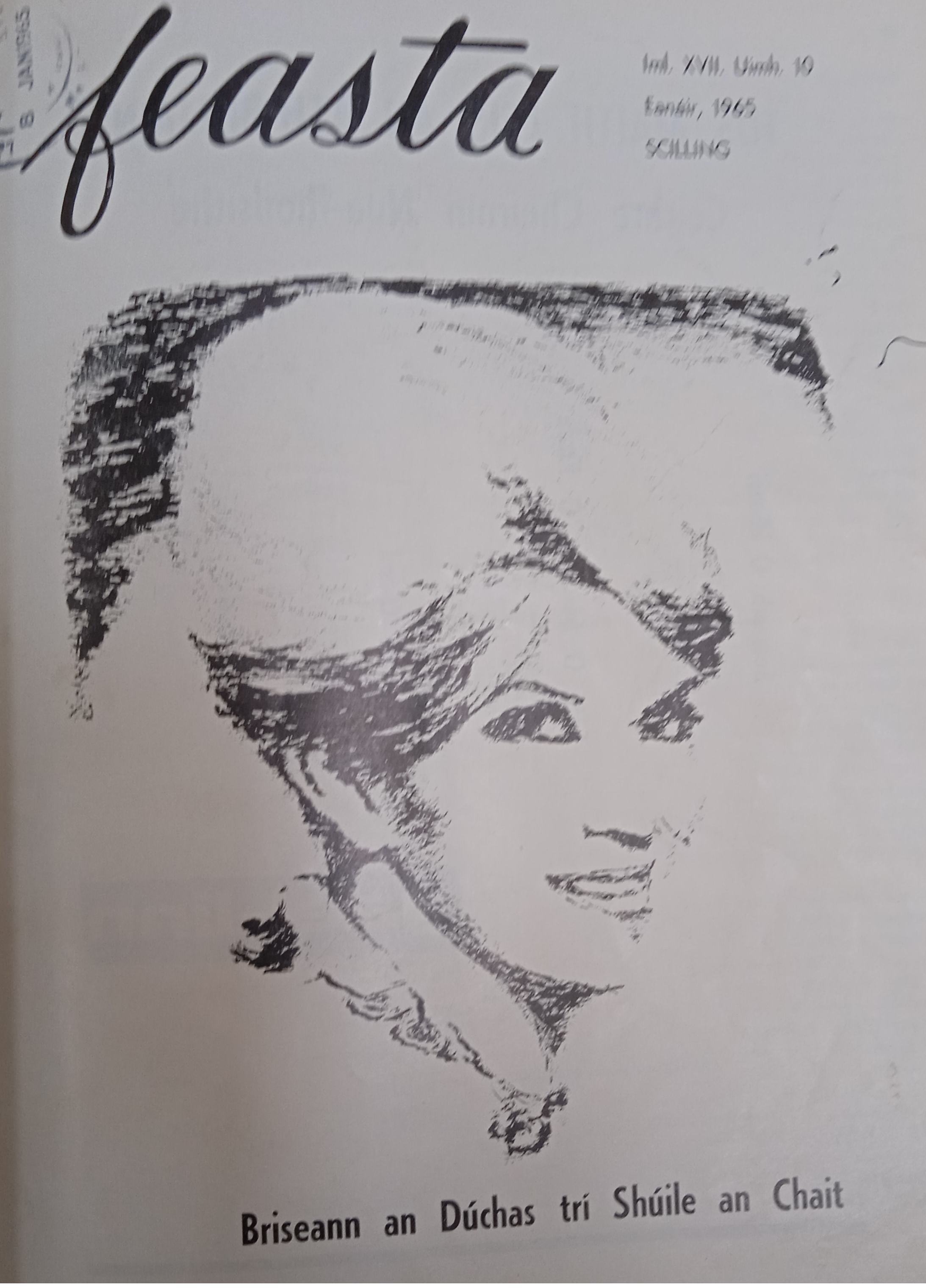
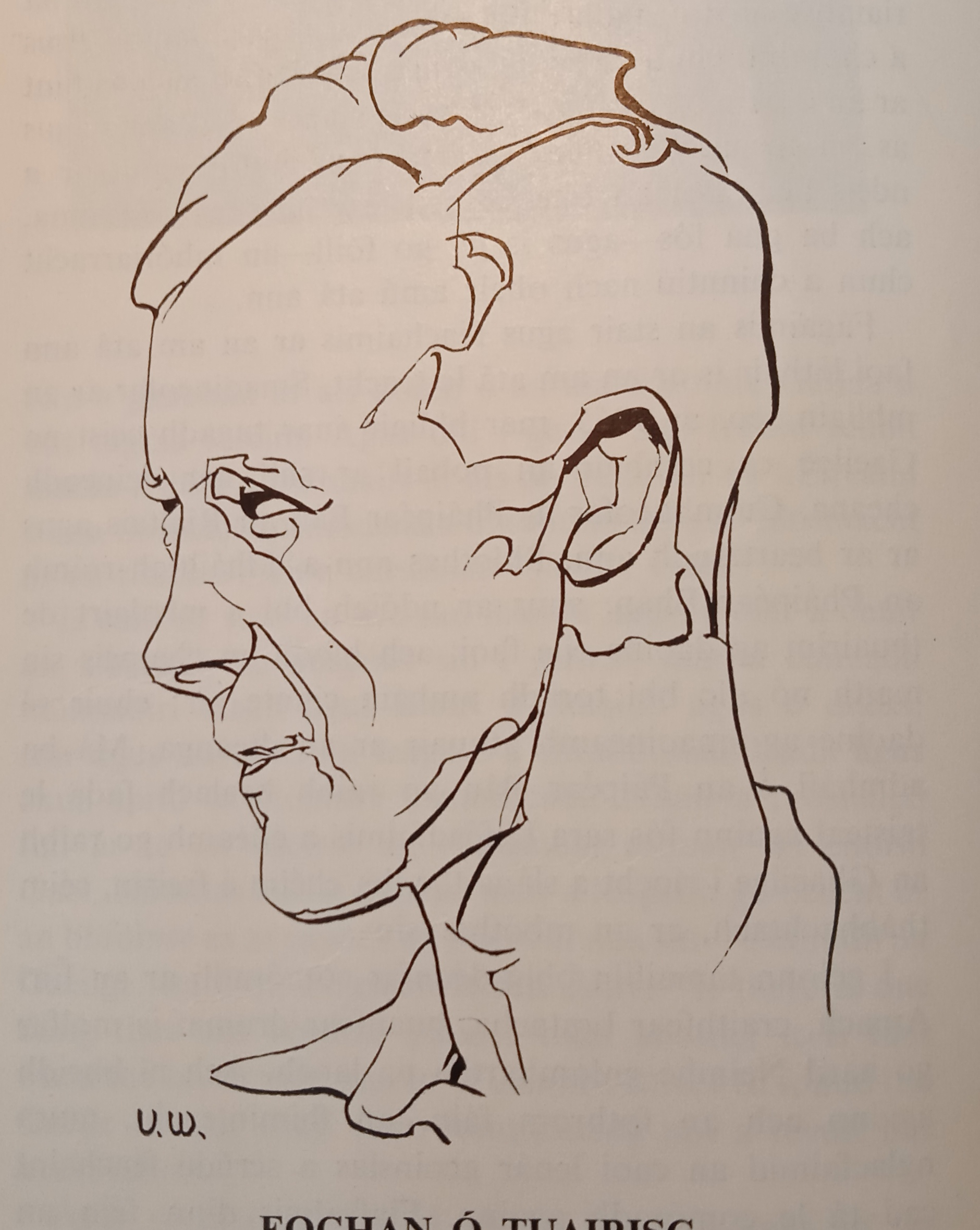
An under-considered facet of Una Watters’ work has been her illustrative and graphics work. We’ve seen elsewhere on this blog – https://unawattersartist.com/2023/02/18/unas-little-book-of-kells/ – that she did a great deal of commissioned art and calligraphic work for Brian O’Higgins’s publishing company, which produced Christmas cards and religious booklets for the commercial market. But she also did magazine illustration, most prominently with the Irish-language journal, Feasta.

Feasta was published monthly between 1948 and 2023 by Conradh na Gaeilge and became one of most significant literary magazines published in the Irish language. Una Watters became a regular contributor to Feasta after her husband, Eugene (writing as Eoghan Ó Tuairisc) took over the editorship of the journal in 1963.

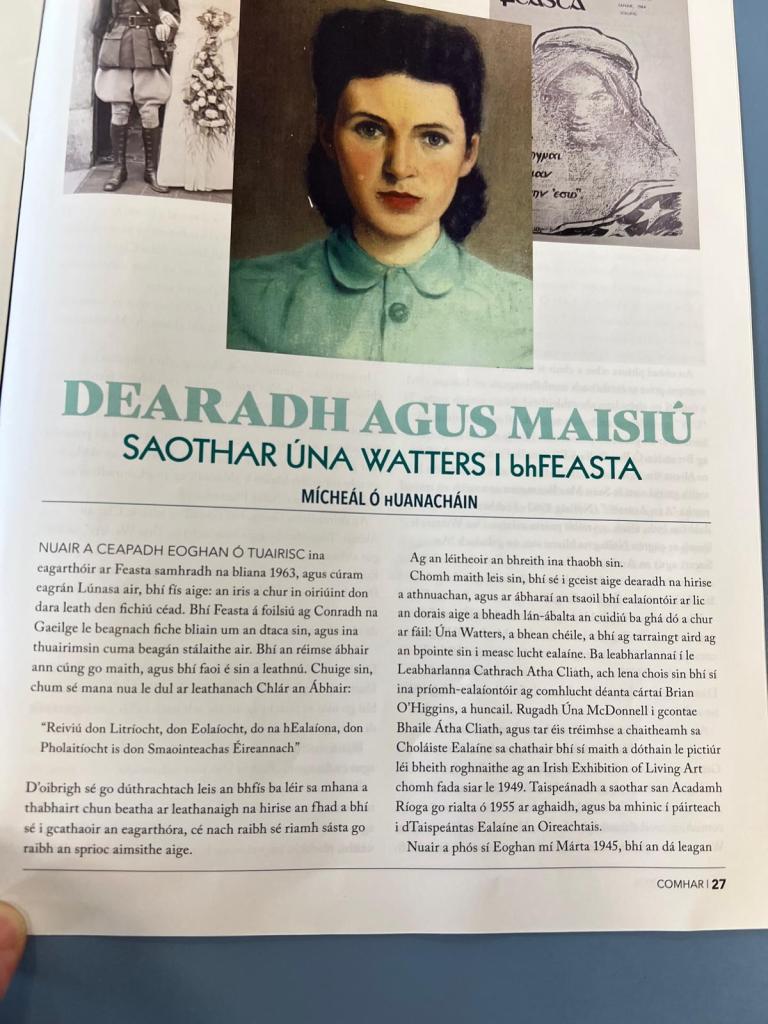
Her work for Feasta has been documented in an important article by broadcaster and Irish scholar Mícheál Ó hUanacháin, in the August issue of Comharhttps://comhar.ie/iris/85/8/dearadh-agus-maisiu/. Ó hUanacháin was heavily involved in the production of Feasta and saw Una’s work for the magazine at first-hand.

Because the article is in Irish, I will have to paraphrase the content and hope Mícheál will forgive me.

Eugene took over the editorship of Feasta in the summer of 1963. According to Ó hUanacháin, Eugene felt the magazine had a somewhat stale air with a narrow range of subject matter. He wanted to change all that. He immediately set to, rebranding it as a review “of literature, art, politics and Irish thought”. In keeping with this new motto, he also wanted to renew the appearance of the magazine. That was where Una came in.

Una’s first cover for Feasta appeared for the 1963 Christmas edition – An Sagart agus an Amharclann – about the influence of the clergy on the theatre. As well as the cover, her work was evident all over the Christmas 1963 edition – there was a card she’d designed for the O’Higgins company, a collage of portraits of actors in an Irish language production of “Roots”, a drama by English playwright Arnold Wesker at the Damer theatre, and a visual for a column on chess.

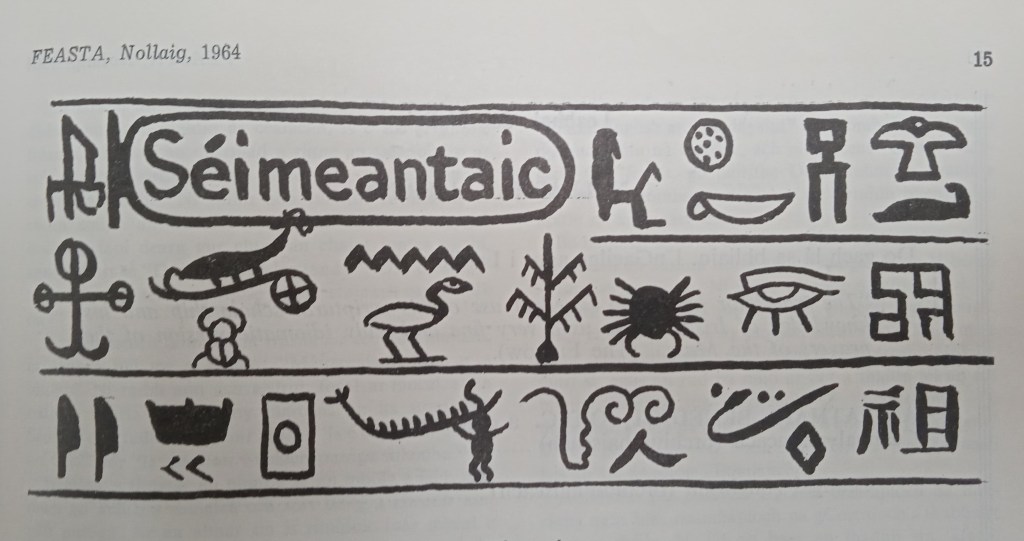
Between then and October 1965, Una completed 16 covers for the magazine. The subject matters varied widely – Jackie Kennedy, the singer Dusty Springfield, W B Yeats and T S Eliot, Roger Casement – as well as many incidental illustrations – graphics for a drama column, sketches of classical composers, and typographic symbols which were used as article dividers. She was an integral part of Eugene’s vision for and reshaping of the magazine as a lively publication engaged with cultural and current affairs.

Unfortunately, as Ó hUanacháin remarks, with Una’s death, that vision was halted in its tracks. Eugene gave up his editorship of the magazine, replaced temporarily by Ó hUanacháin himself. However, Una’s work lived on. For many years afterwards, her incidental graphics were still gracing the pages of Feasta.

Categories
News

Double take

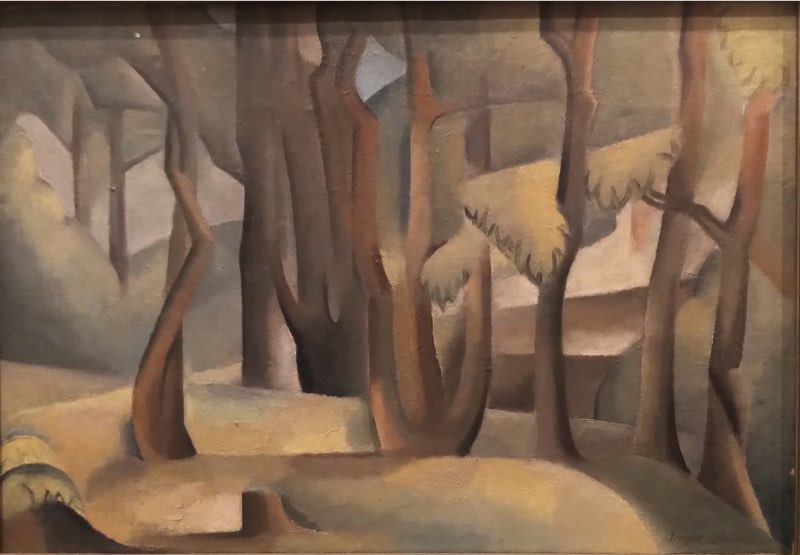
On a recent visit to Australia, I rounded a corner in the National Gallery of Victoria in Melbourne and was stopped in my tracks by this work. Could an Una Watters’ landscape have possibly found its way into one of Australia’s premier galleries without my knowing?

Well. . . no.

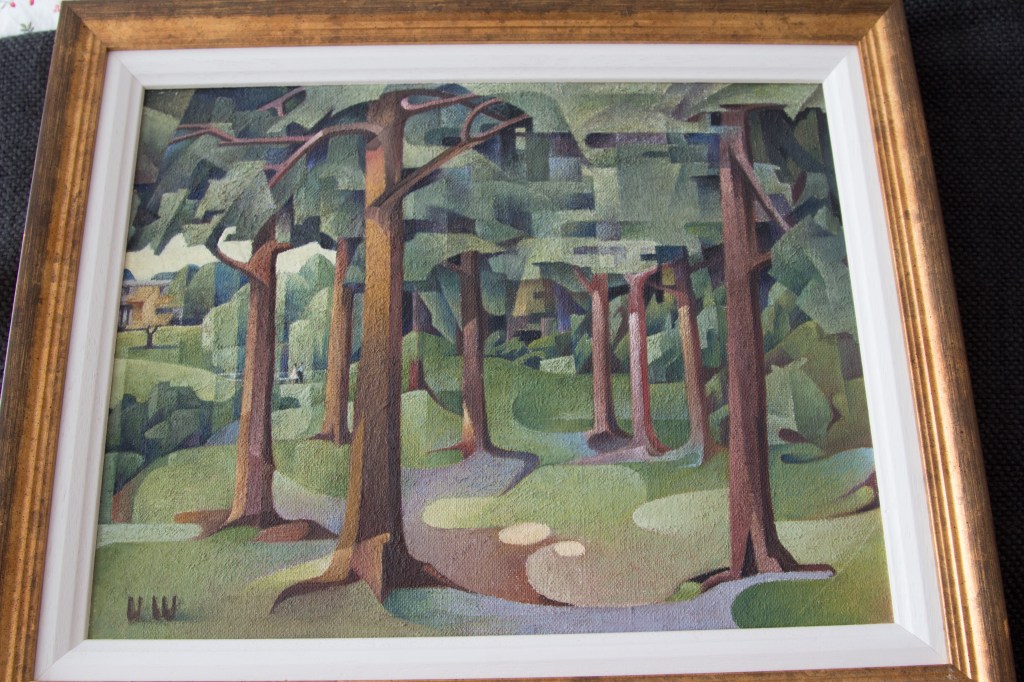
This is Gum Trees dated to 1933-35, by Dorrit Black (1891 – 1951), oil on canvas (42.0 x 59.8 cms), but it is so redolent of Una’s landscape work – the cubist influences, the undulating foreground, the stark geometry of the trees, the very deep recession of the work – that it could have been made by Una in another life. The techniques are similar to those in Wild Apples or The Pine Wood and the colour tones are reminiscent of the recently discovered To the Sea.

Clockwise: The Pine Wood, To the Sea, Wild Apples – Una Watters

Black had a huge impact on the development of modern art in Australia, according to Paul Finucane and Catherine Stuart in their beautiful and exhaustive compendium of Australian women artists – Odd Roads to be Walking: 156 Women who Shaped Australian Art – (Sheila Foundation Press.) She paid several visits to Europe in the 1920s and 30s and studied under André Lhote, the French painter, art critic and teacher who combined Cubism with a post-Impressionist palette. As a mentor he would influence a whole generation of late 19th/early 20th century Irish artists, who attended his studio classes, in Paris and in the south of France. It’s not too much of a stretch to imagine his influence indirectly on Una Watters, a generation later.

Ironically, one of the artists I was seeking out while in Australia was the tonalist painter Clarice Beckett (1887 – 1935) whose biography has echoes of Una Watters’ story, but on a larger and more heartbreaking scale. She died young (Beckett was 48) after which her work vanished from view and her artistic legacy disappeared with it. She was rediscovered by chance in the late 1960s by art curator Rosalind Hollinrake, who managed to trace a staggering 1600 of her canvases to a remote, open-sided shed in rural Victoria where they had been left to rot. Only 369 were salvageable; the rest were beyond repair.

The Gallery of South Australia in Adelaide now owns 21 of her works, all on view and part of Dr Hollinrake’s personal collection. It represents the largest single assemblage of Becketts in Australia, though her work also appears in state collections in Sydney and Melbourne. So a really satisfying end to a sad story of neglect.

Wet Evening ( 1927) – Clarice Beckett

While in Australia, I gave a talk on Una’s work to the Aisling Club, an association of ex-pats and enthusiasts of Irish culture and history, who meet in the spectacular 26th floor premises of the Irish Consulate on Market Street, Sydney.

So, I’ve been busy spreading the word. And who knows? If Una Watters’ work has made its way Down Under, there’s no excuse for anyone in that Sydney audience not to recognise an Una now if they see one!

Categories
News

Wheels within wheels

It’s always a triumph when a lost Una Watters comes to light. It’s a red-letter occasion when two are unearthed in the same week. As an indirect result of my recent talk in Ballinasloe about Una’s Galway-inspired work, an owner of one of her untraced oils from the 1966 posthumous exhibition has come forward.

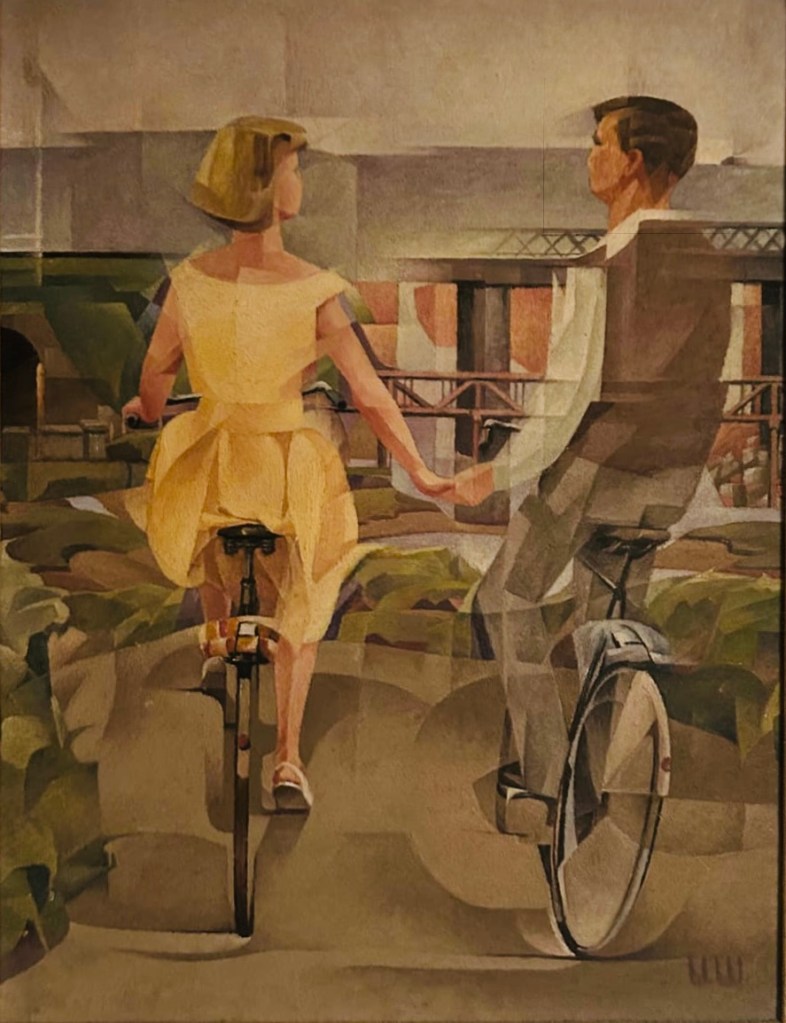
With the help of Eugene Watters’ niece, Georgina O’Donovan, we’ve identified the new find as To the Sea (oil on canvas, 43.1 x 54.6 cms) dated to 1962. It depicts a couple on bicycles, viewed from the back, as they cycle towards the sea, their swimming gear rolled up in towels on the back carriers.

I presumed, at first, this was a Galway scene, but on further investigation, it seems this is an east coast painting, more specifically, we think, Laytown, Co Meath. Una’s naming of paintings is always a help in this regard, being plain and informative. To the Sea suggests proximity; cycling to the sea from Ballinasloe would have been quite a trip.

The bridges in the background also led me to believe it might have been Ballinasloe and its environs. (Una had a weakness for bridges) There seems to be several bridges in evidence here – a railway bridge, an iron footbridge, and on the left a stone arch. The railway bridge could be the Laytown Viaduct and the stone arch could belong to the Boyne Valley Viaduct. Geographically, these might not be visible in the same frame but Una often used this composite approach to her cityscapes – see my earlier blog on City Bridgehttps://unawattersartist.com/2020/06/09/the-bridge-of-time/ – where several stone landmarks of Dublin are impressionistically viewed together, jigsaw-like, on the same plane.

The horizon of the painting is quite high – note the perspective of the road winding away behind the bridge, and the sea – typical of an uncertain Irish summer – is the opaque grey expanse at eye-level for the figures. A steamer puffing smoke ploughs away on the high horizon mark above the male cyclist’s head.

Una would have known this area very well from holidays there as a child and Georgina O’Donovan remembers her parents and Eugene and Una taking several cycling holidays together. “There is an innocence about it all,” she says about this painting. “The couple holding hands, the swimming gear on the carriers and the possibility of catching that boat to new lands and adventures.”  

Georgina has identified her father, Tom Watters, (Eugene’s brother) as the model for the man in the painting – see Tom Watters also in Wild Apples – see https://unawattersartist.com/2020/06/24/wild-apples/ and The Game of Chess. https://unawattersartist.com/2021/04/10/a-game-of-chess/

Una often depicted herself in her work as a dark woman in red, so this blonde woman in her sunny yellow dress is definitely not her. However, Georgina believes she bears a passing likeness to the mother of the painting’s present owner, who was gifted To the Sea after Una’s death.

In this work Una’s interest is also in the dynamic movement of the bicycles. The whir of the wheels, the tensing of the woman’s calves, the folds of her dress are depicted in strong physical strokes so speed and movement are made manifest on the canvas. This dynamism is mirrored in the foreground of the painting. The vegetation looks turbulent, tossed-looking, and the very ground underfoot unstable.

Una’s rendering of physical gestures often hints at emotional drama. The woman’s back is to us so she remains mysterious, but we see the man sketchily in profile as he holds her hand and turns to her. A beam of weak misted light from an unseen source grazes her shoulder, but it mirrors the slant of his gaze. She’s cycling in a straight line, but the front wheel of his bike is not evident, merely suggested by a series of veering circles. The implication is he’s having a slight wobble. Is he about to fall in more ways than one?

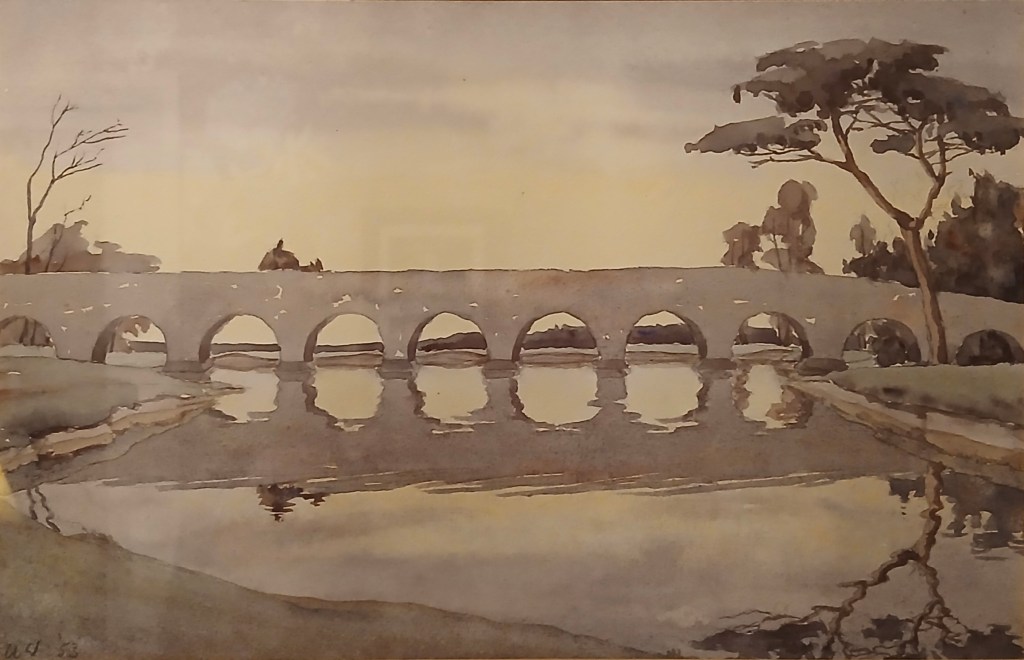
The second find is a watercolour, untitled, showing Ballyforan Bridge near Ballinasloe, which was completed in 1953. This was a favoured picnic site for the Watters family and a meeting point for fishing expeditions in the summer consisting of Eugene, Una, his brother Tom and wife Bridie, and their children. The watercolour is delicate in its rendering, serene in its mood showing the glassy River Suck on a still, mauve summer’s evening, while a man driving a hay cart is seen crossing the bridge. The arches of the bridge (bridges, again!) and the spindly trees either side are echoed in the water giving a shimmering, ethereal feel the work.

Categories
News

Una Watters’ Galway

What better way to mark International Women’s Day than to celebrate the life and work of Dublin artist Una Watters. I’ll be giving an illustrated talk on Una in Ballinasloe on March 8. Although she hailed from Finglas in Dublin, Una spent a great deal of time in Ballinasloe, the home town of her husband, Eugene Watters ( the writer Eoghan O Tuairisc).

The couple spent holidays in Galway, staying with family, fishing on the River Suck and engaged in artistic pursuits – painting for Una and writing for Eugene. In my talk, I’ll be concentrating on Una’s work featuring the town and environs, and discussing how her experiences there influenced her work.

As well as obvious influences, I’ll be looking at more subliminal connections e.g. the importance of the River Suck, where Una, an expert fisherwoman, spent many hours. While fishing there in the late 1950s, Una made a spectacular discovery – a ring-pommelled, single handed sword, dated to the 16th-century. Although the end of the blade was snapped off, it was a significant find, and was presented to the National Museum on July 13, 1962. The sword can be seen in the Kildare Street branch of the museum, in the Medieval Ireland 1150-1550 exhibition.

An image of the sword can be seen by following this link – the sword Una found is on the right: – https://www.reddit.com/r/ArtefactPorn/comments/6cax20/16th_century_irish_ring_pommel_sword_1024x3072/#lightbox

Is it fanciful to wonder if the rescue of this sword from the depths of the River Suck, in what seems like an echo of the Excalibur myth, might have come to the surface again when Una was designing the emblem for the 1966 Easter Rising Commemorative Year?

Her design, which won an open competition organised by the Arts Council, references the “Sword of Light”, connected in early literature with the first coming of the Gaels in Ireland and it occurs throughout later literature as symbolising intuitive knowledge, education and progress. It was taken up by scholars of the 19th century and was adopted by revolutionary thinkers to indicate their dual objectives – armed insurrection and an Irish cultural renaissance. (See the Design of Easter Rising Symbol page elsewhere on this site.)

The talk takes place at St John’s Church, Ballinasloe, Co Galway, on March 8. All welcome.

Categories
News

For your diary

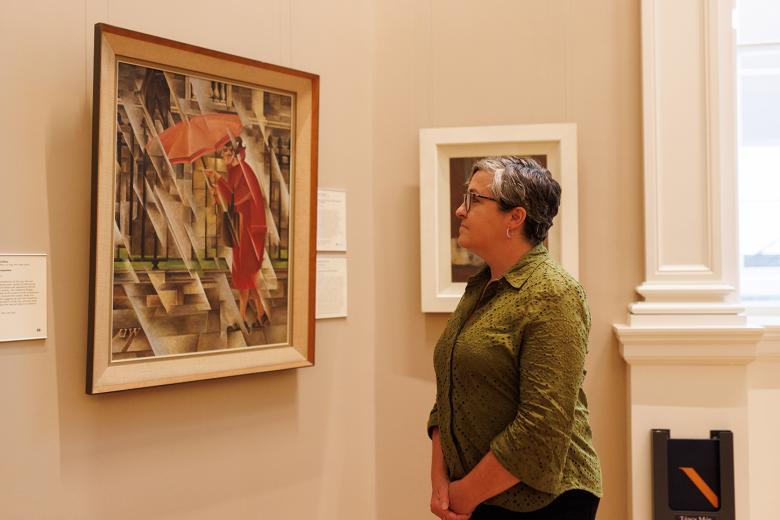
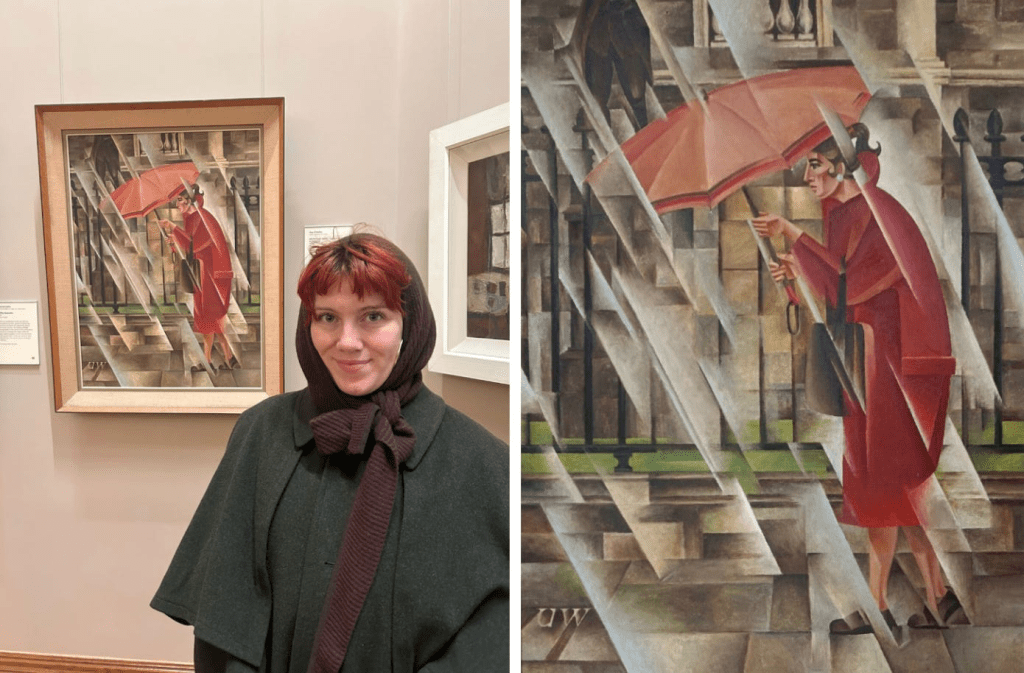
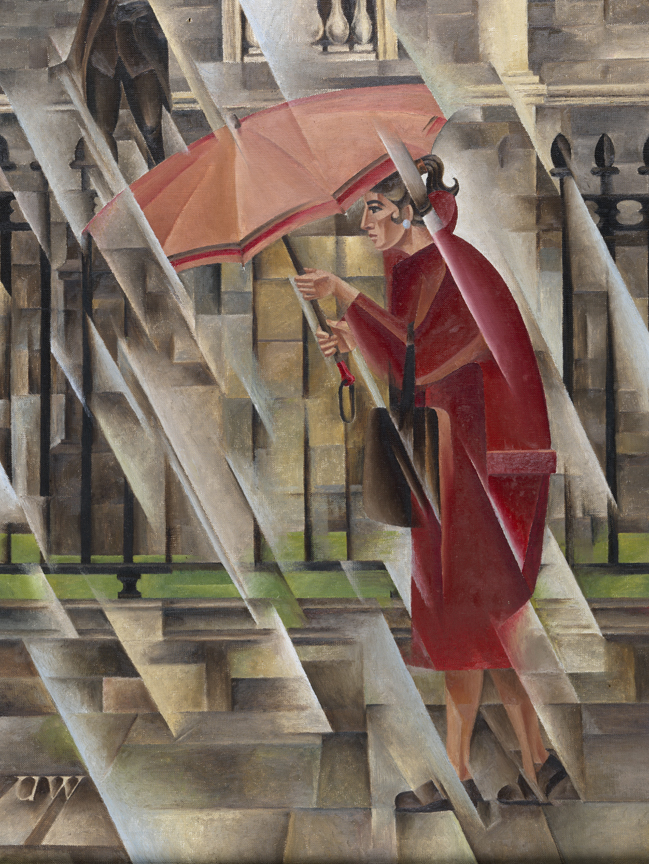
After the flurry of the presentation of Una’s Girl Going by Trinity in the Rain to the national collection by Colbert Kearney in 2023, things have been quiet on the Una Watters front.

However, this year will see more activity. It’s an anniversary year – 60 years on from her death in 1965 – and hopefully that may see an upswing in Una Watters-related activities.

First development this year is the inclusion of Girl Going by Trinity in the Rain in the National Gallery of Ireland’s diary. Always a beautiful production, this year is no different, and Una appears for the week of May 26, 2025.

The director of the gallery, Dr Caroline Campbell, remarks in the diary’s introduction that Una’s Girl has already become a” popular favourite” among gallery patrons. This makes a trifecta of images the NGI has used of Una’s signature painting – it appeared in last year’s calendar and is for sale in postcard form in the gallery shop. (Speaking of merch, I’m waiting for the gallery umbrella and tote bag!)

As Sara Donaldson author of the notes accompanying the image in the diary writes – “Watters’s awareness of Cubist forms is evident everywhere, while Futurist-inspired ‘lines of force’ represent the sheets of rain, evoking the atmosphere of a wet urban scene.”

Speaking of dates for the diary, I will be doing a lecture – “The Lost Reputation of Una Watters” as part of Ballinasloe & District Historical Society’s Town Talks series in March – more details to come closer to the time.

Meanwhile, I’m on work on a book on Una so if any of you out there have stories or memories of her or Eugene Watters, do contact me via the email on the blog.