Categories
News

Una’s Gardens go on loan

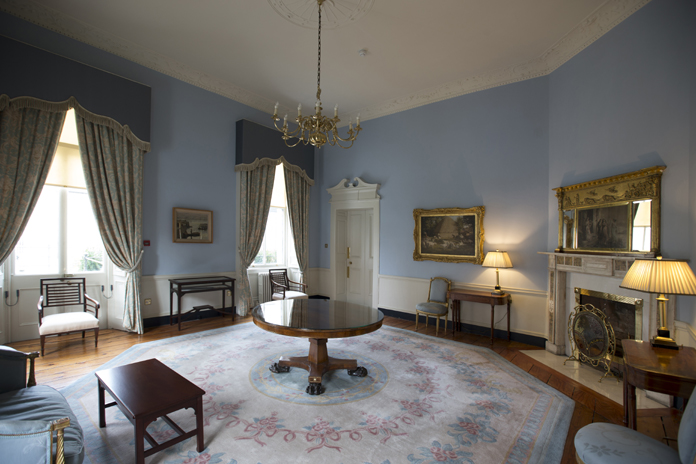
Una Watters’ The People’s Gardens (oil on canvas, 40.6 x 50.8 cms), which is part of the Hugh Lane City Gallery collection, has been given on long-term loan to the Mansion House in Dublin. It will hang in the Blue Room (or the Lady Mayoress’s Parlour) in the Mansion House where, traditionally, all the paintings have come from the city’s municipal’s collection at the Hugh Lane.

The outgoing Lord Mayor Councillor Caroline Conroy personally requested the painting before her term ended last month. Ms Conroy, who’s a Green Party councillor, represents the Ballymun and Finglas local electoral area. Perhaps the Finglas connection prompted her choice?

The People’s Gardens dating to 1963 was shown at the following year’s Royal Hibernian Academy Annual Exhibition and depicts a slice of Dublin’s public life in the gardens which are part of the Phoenix Park. The Thomas Haverty Trust bought the painting and lent it for Watters’ posthumous retrospective exhibition in 1966. The following year the Trust donated the work to the Hugh Lane.

The Haverty Trust was established following the death of the artist Thomas Haverty who left a sum of money for the purchase of paintings by Irish artists for public galleries and institutions. Between 1935 and 1966, the Trust donated over 40 works to the Hugh Lane including paintings by Swanzy, William Leech, Brigid Ganly and Maurice MacGonigal (who encouraged Watters in her art studies).

As Logan Sisley, Acting Head of Collections at the Hugh Lane, noted in a blog on this site (The People’s Gardens: May 6,2020) the painting is typical of Una’s work with the trees and figures pared down to angular forms. “This shows the influence of earlier modern art movements such as Cubism and Futurism, albeit interpreted in her own style. Her clever use of shadows adds depth – notably under the trees and in the figure of the girl kicking the ball, the man reading a paper and the duck taking off (or landing). These also demonstrate a keen observation of people and an eye for detail. The strong shadows and summer dresses suggest a warm sunny day, yet the elderly couple walking arm-in-arm on the path are still dressed in heavy coats and hats.” (See also The Gardens Revisited: April 12, 2022)

In concert with the recent acquisition of Girl Going by Trinity in the Rain (1959) by the National Gallery and now on public view in Room 15, it is very heartening to see Una’s work on show after many years in the stacks at the Hugh Lane.

The painting hasn’t been shown in Parnell Square since the 1970s although, according to gallery records, it was on loan to the City Hall between 1969 and 1974 and again in the 1980s. It was also hung in the ILAC Centre Library in 1987 along with a number of other works from the Hugh Lane, including Harry Kernoff, John Leech and Lizzie Stephens, all of them depicting scenes of Dublin.

However, the painting’s new home although public is limited in its access. The Mansion House is open to the public annually as part of the Culture Night and Open House initiatives and occasionally for open days but it’s not possible to walk in off the street and view the work. However, group tours of the Mansion House can be arranged by contacting the Office of the Lord Mayor at lordmayor@dublincity.ie.

Perhaps it’s time for a tour by Una Watters’ groupies?

The Blue Room: Photograph: Conor McCabe

Categories
News

A proud moment

After four years of campaigning to re-establish the reputation of Una Watters, we had a proud moment today when we went to view her work in its new (and rightful) home – the National Gallery of Ireland.

Girl Going by Trinity in the Rain now hangs in Room 15, alongside many of Una’s contemporaries – Louis le Brocquy, Mary Swanzy and Mainie Jellet – artists with whom she would have exhibited in the 1950s and 60s. Furthermore, it places her at the centre of the national visual stage and allows hundreds of new people to enjoy her work which has been hidden for so long.

The descriptive tag beside the painting notes its faceted surface which “demonstrates Watters’ awareness of Cubism and Futurism” as well as her depiction of the driving rain “as a novel means of distorting the picture plane”.

Marking the gallery’s acquisition of the work, Frank McNally writing in today’s Irish Times (8/06/23) under the heading “Watters Rising”, remarks that although it has taken Girl Going by Trinity in the Rain half a century to reach the NGI, the work has aged well. https://www.irishtimes.com/opinion/an-irish-diary/2023/06/07/watters-rising-frank-mcnally-on-the-campaign-to-revive-the-memory-of-a-forgotten-artist/

We have to agree with him. Shown in the gallery’s Irish rooms, the painting sits between Tony O’Malley ‘s Self-portrait, winter, Heavy Snowfall at Trevalyor (1962/63)and Patrick Collins’ Liffey Quaysides (1957). Una’s striking work is already proving popular with visitors, according to Donal Maguire, director of the gallery’s ESB Centre for the Study of Irish Art.

The 1959 oil on canvas which was donated by Colbert Kearney to the gallery earlier this year, was gifted to him by Una’s husband, Eugene Watters, following Una’s death in 1965.

The lasting legacy of his donation is that Una’s work is now free to be seen by everyone who visits the gallery.

Photograph: Left to right, Colbert Kearney, the director of the NGI, Dr Caroline Campbell and Mary Morrissy.

Categories
News

Watch this space!

May has been a great month for Una Watters news. As a result of an event at Phizzfest, Phibsboro’s community and arts festival, where I gave a talk on Una earlier in the month, a new painting has been discovered.

The watercolour of the River Suck, where Una and Eugene spent many happy hours fishing, is one of several Una made during the 1950s (we’re not yet sure of the date of this one) and its owner came along to the Phizzfest, having not known about last year’s exhibition, or been aware of the surrounding publicity. The owner of The Pine Wood ( oil on canvas, 1961) also came to the full-house event. We had an image of this work but hadn’t definitively identified its owner.

We’ve also discovered through contacts made at Phizzfest that Una made a banner for St Michael’s School, Finglas – again we’re not sure of the date – as a result of a request by her sister, Maureen, who was a Holy Faith nun ( Sister Mel) based in Glasnevin. Better still, the banner still exists. We’re hoping to see it in the coming weeks and take photographs of it. This is yet another testament to Una’s design skills and her range, as well as her embedded artistic presence in her own community.

Also present at Phizzfest was Gary Byrne, Una’s nephew, who brought along two samples of Una’s work – an early oil of The People’s Gardens (1943) and a pen and ink drawing – Old Woman – both of which you can find on this website under Uncatalogued Work.

Finally, and best of all, we’ve had word from the National Gallery that they plan to hang Girl Going by Trinity in the Rain “imminently” – perhaps as early as June. Watch this space – or should I say – watch that space on the walls of the NGI, where we’ve always felt Una rightly belongs.

Photograph: Marie Louise Halpenny

Categories
News

Phizzing for Una

Catch up on Una Watters at Phizzfest where I’ll be giving an illustrated lecture – “Una Watters: Total Eclipse”- which will look at her work in context and explore the reasons for her retreat into invisibility.

The event takes place on Saturday, May 13, at 3pm in @thebohemianbar in Phibsborough. Link here for tickets: https://www.eventbrite.ie/…/una-watters-total-eclipse…

Phizzfest takes place from May 12-14 and covers all thing cultural in the Phibsborough area. Details of all events at https://www.phizzfest.ie

Above: Cappagh Road ( 1960)

Categories
News

It’s raining at the National Gallery!

Raining Una Watters, that is. We’re delighted to be able to announce that the Una Watters’ painting, Girl Going by Trinity in the Rain (1959, oil on canvas, 61×81 cms), is now part of the National Gallery’s collection, thanks to the generosity of its owner, Colbert Kearney.

Colbert was gifted the work by Eugene Watters after Una’s posthumous exhibition in 1966. He was a pupil of Eugene’s at St Fergal’s National School in Finglas (see Colbert’s guest blog, “Portrait of E.R. Watters”, June 17, 2020) and they remained firm friends until Eugene’s death. It was always Colbert’s intention to pass the painting on but after last year’s retrospective (March 10 – April 2, 2022 @ the United Arts Club), the idea of donating to the NGI seemed like the logical next step.

Girl Going by Trinity is a quintessentially Dublin work – the Trinity College location makes it so – and the driving, sleety rain will be a familiar meteorological trope for anyone who has known winter in the city.

As Colbert’s partner, I’ve lived with this work for over 20 years, and it’s the work that inspired my quest to locate as much of Una’s work as possible, and the decision to mount Una’s retrospective last year with Sheila Smith, her niece. The idea was to bring Una to a wider audience and to the forefront of artistic attention. We hope that the NGI’s acquisition of her work will cement that progress.

The opportunity came at a reception for the Sarah Cecelia Harrison Inaugural Essay Prize sponsored by the gallery last November. My essay on Una reached the final three (See “Una takes her place”, November 25, 2022). At the reception Colbert had a conversation with the director of the ESB Centre for the Study of Irish Art, Donal Maguire, and enquired if the gallery would be interested in having an Una Watters in the collection. I think Donal wondered if it was the cheeky white wine talking, but once he was assured that Colbert was serious, the process only took a few months.

In late January we had to say goodbye to the painting, so it could go before an acquisitions committee. At that stage, we didn’t know if it would be accepted or if we would see it again (although of course we sincerely hope we will see it again on the walls of the National Gallery!) so we spent much of the early new year savouring our time with it.

We moved it to a new spot – hung lower than usual. (I got this idea from sculptor Corban Walker’s exhibition As Far As I can See at the Crawford Gallery (Oct 15, 2022 – Jan 15, 2023). Along with his own work, Walker chose 30 works from the Crawford Collection to show. Because of his restricted stature, Walker hung the works lower than normal and it afforded a much more intimate relationship with the paintings.)

Now at eye-level, there were still new things I was seeing in Girl Going by Trinity in the Rain – its complex treatment of light, the quivering rain drops (impasto dashes of white paint) on the tips of the umbrella, the life-like animation of the Goldsmith statue beside the flesh-and-blood young woman who appears paradoxically monumental, the misty illumination around the girl’s ponytail.

I’d never noticed before the proliferation of verticals in the work – the stick of the umbrella, the railings, the balustrades – and how the rain itself is architectural in its form like literal stair-rods. The patterned geometry of the stone work leans close to abstraction; even the half-belt on the girl’s coat looks solid, brick-like, as if she’s melding with the building, her face full of sharp architectural planes.

I could go on, but I won’t, or I’ll get lonesome for it! And there’s nothing really to mourn. The painting lives.

Girl Going by Trinity in the Rain joins its sister work – The People’s Gardens (1963, oil on canvas, 40.6 x 50.8 cms) – which is already in the Dublin City Hugh Lane Gallery collection (See Logan Sisley’s guest blog May 6, 2020). It means Una Watters’ name is enshrined in the national cultural memory, where it belongs.

Although the Hugh Lane organised private viewings of their Una to coincide with our retrospective last year, they wouldn’t lend The People’s Gardens, and it’s a very long time since it was on public display in Parnell Square.

Both of these works deserve to be widely seen. So next time you’re in either of these galleries, ask about their Una Watters works; it’s possible to see them by appointment. After all, they belong to all of us now.