
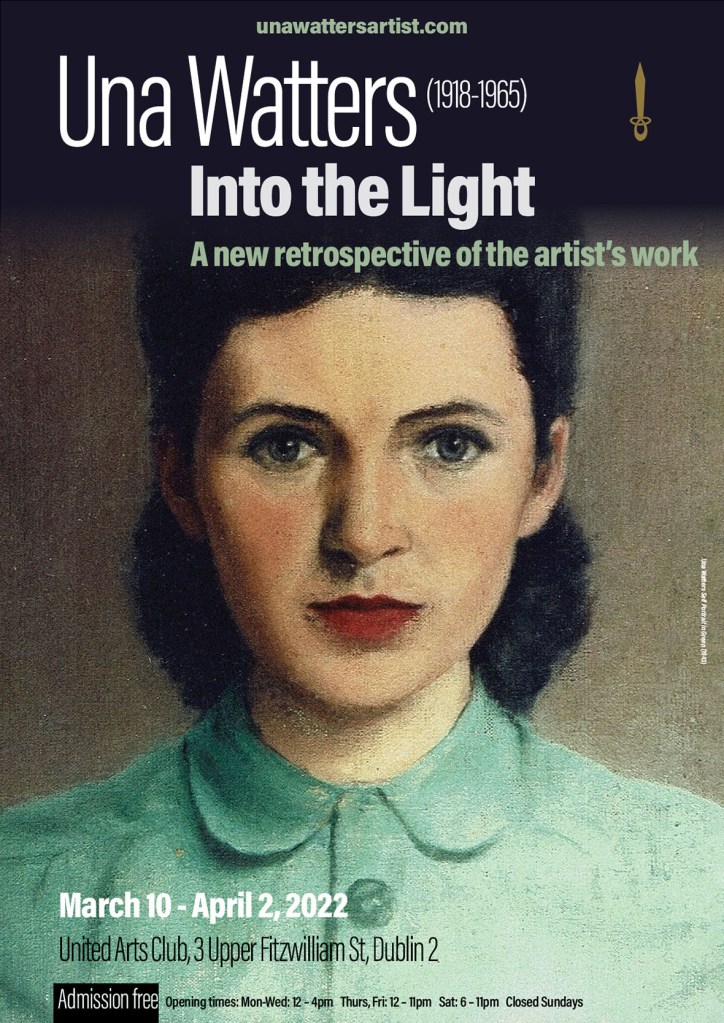
One of our hopes for the recent Una Watters retrospective, Into the Light (March 10 – April 2) was that more works from the original posthumous show of 1966 might turn up. (There are 8 of the 37 works from that show that we haven’t traced.) That didn’t happen, but what we did discover was that one of the works from the 1966 show, which we thought lost, might well have been hiding in plain sight.
Meditation (oil on canvas, undated, 61 x 70cms) has always been a bit of an outlier in terms of Una’s work. It seems like a quasi-religious work with its nun-like/madonna central figure sitting beside a source of fire, or perhaps a sacred illumination. (See blog August 16, 2020)
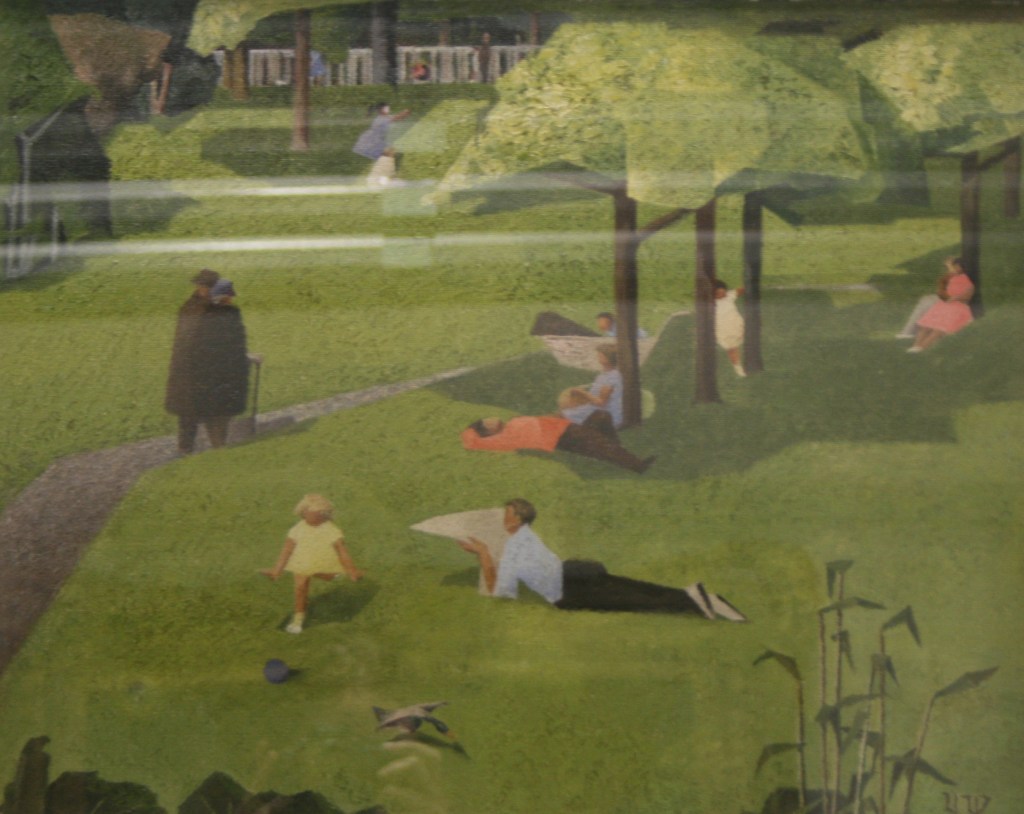
In comparison to Una’s other titles, Meditation is most untypical. Generally, she didn’t go for abstractions like this. She named her work with unstinting pragmatism – Malahide, The Ladies Committee, Thar an GPO, The Red Bridge. The other unusual detail about Meditation is that it’s the only work of hers that’s undated.
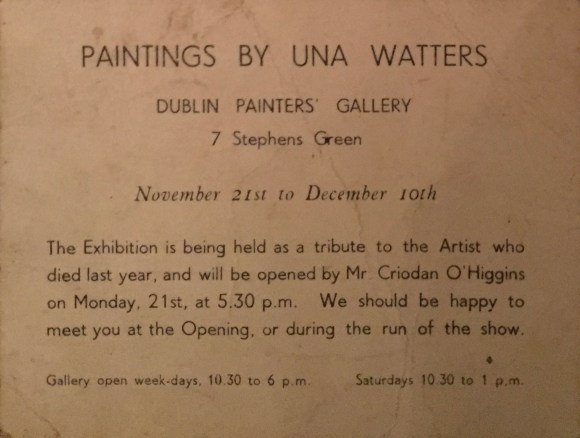
The biggest mystery, though, was why Meditation, a large and ambitious work in terms of its style and content, did not appear in the 1966 posthumous show organised by her husband, writer Eugene Watters, a year after her death.
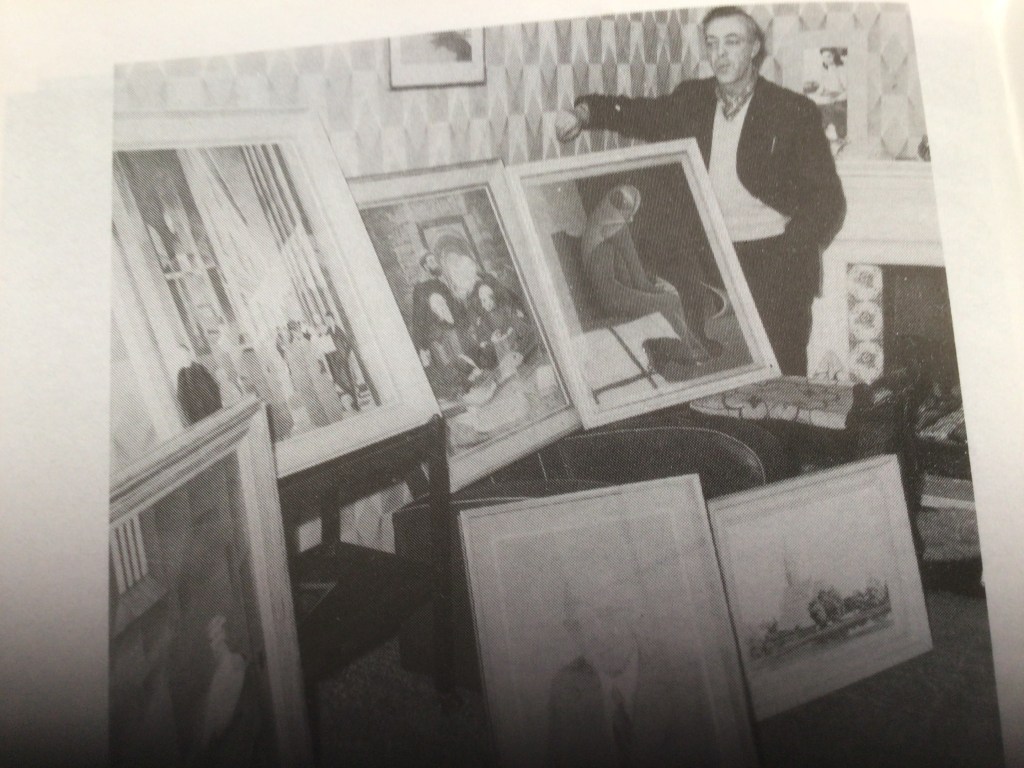
We know that Eugene had the painting in his possession in April 1966 because he was photographed with a group of Una’s paintings he had shipped to his native Ballinasloe for an Easter Rising commemorative lecture he gave – “The Spirit of Sixteen” – at the Town Hall.
The lecture was accompanied by a small show of Una’s “historical” paintings. Six are listed – Thar an GPO, The Four Masters, Silken Thomas in the Tower, Portrait of Brian O Higgins, St Michael’s Church and lastly, a work entitled Mise Eire – lent by S. E Allen Figgis. All of these paintings are identifiable in the photograph (see below) and Meditation is clearly visible as one of the six. So if Eugene had access to the work, why did it not appear in the 1966 show he organised for November of that year?
That mystery set Eugene’s niece, Georgina O’Donovan, a stalwart supporter of this site, thinking and she has come up with a theory.
In the 1966 show, there was a painting listed under the title Old Woman, lent by Allen Figgis (the same S. E. Allen Figgis mentioned previously). He was a publisher and proprietor of Hodges Figgis bookshop, a collector of art and a friend of Eugene Watters. (He published De Luain, Eugene’s Irish language novel about the Easter Rising, in 1966).
Old Woman was one of the 1966 paintings we didn’t manage to trace for the 2022 show.
Georgina wondered if this painting could, in fact, be Meditation. If so, Mediation/Old Woman would have been painted in 1951, according to the 1966 catalogue, giving the lie to our supposition that it was a late work.
If you depend on the 1966 show title, the work could be read as a depiction of an elderly woman crouched by a fire, rather than a Madonna-like figure contemplating a source of heavenly illumination. Georgina wondered if Meditation was a title appended to the painting afterwards and not by Una at all.
In a further twist, given the photographic evidence, it appears that the work could have had a third title.
The mysterious Mise Eire mentioned in the list of paintings used to illustrate Eugene’s lecture in Ballinasloe is a work we’ve never come across in Una’s portfolio. And there’s no work in the photograph that matches it, if you discount Meditation, which is not named at all. Could Mise Eire also be Meditation – perhaps renamed by Eugene for the purpose of the lecture? (It would be tempting to reinterpret the old woman/ madonna figure of the painting as Mother Ireland and the golden flame as the igniting fire of the rebellion.)
If this is so, it wouldn’t have been the first time that Eugene had a hand in naming Una’s work. We know he titled the Emerald Ballroom watercolours because Una hadn’t got around to naming them before her untimely death and, indeed, probably did not see them as finished pieces.
There’s also the possibility that he retitled the last oil Una worked on her before her death now known as Harvest. This depicts a small girl in red (Una’s alter-ego in much of her work) carrying a billy can of tea to workers bringing in the hay at Cappagh. (Her father, wearing a hat, is clearly identifiable in the painting.) However, among the family, this work was known as “Tea in the Fields” – a much more typical Una title, or perhaps it was just a working title.
Given its significance as the last oil Una worked on, could Eugene have given it a more valedictory name?
Another example of double-naming is The Fluteplayer (in the 1966 exhibition but not available for the 2022 retrospective) which was gifted by Eugene to a family who’ve always referred to it as “Pan”, the Greek god of music. Is this how Eugene described it to them?
All of this, of course, is mere speculation and in the case of Meditation, it may not have been Eugene who renamed it at all. The painting went under the hammer twice in the early Noughties, so an art dealer might have advised a less generic name than Old Woman for the market.
The amateur art lover might believe that the artist has last dibs on the naming of her work, but this is not necessarily so. Curators, dealers and patrons can all have a say in giving a painting a name.
In formalist doctrine, the words beyond the picture frame are not supposed to influence the understanding or appreciation of visual forms. However, for most of us, as art historian E.H Gombrich asserted, the title is a significant contextual factor in interpreting a piece of work. Titles tell us how to look at a work.
When a painting has three titles, then the interpretations proliferate.



 Una Watters (1918-1965)