Categories
Una in focus

Placed among her peers

Malahide (1964)

This year marks the 60th anniversary of Una Watters’ death (Nov 20, 1965) but it was also the year when her artistic powers were at an all-time high. She’d designed the winning logo for the Easter Rising Commemorations in an Arts Council open competition, she’d completed five major oil paintings plus a ground-breaking cycle of watercolours (see the Emerald Ballroom Watercolours page elsewhere on this site) which suggested a new artistic direction.

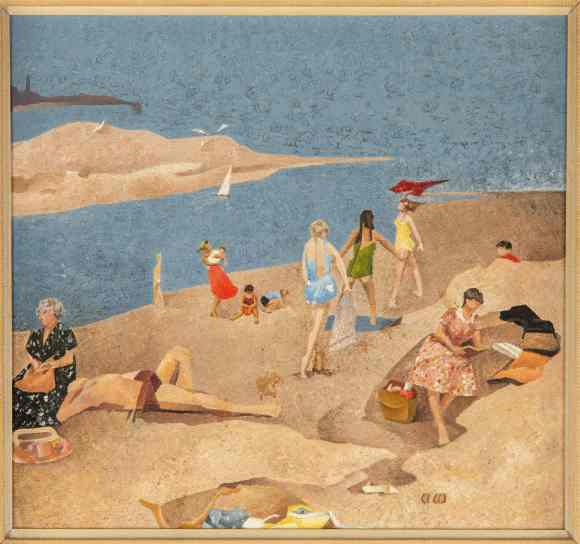
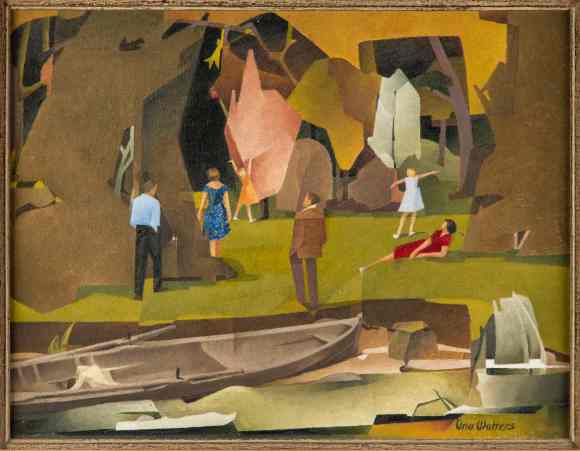
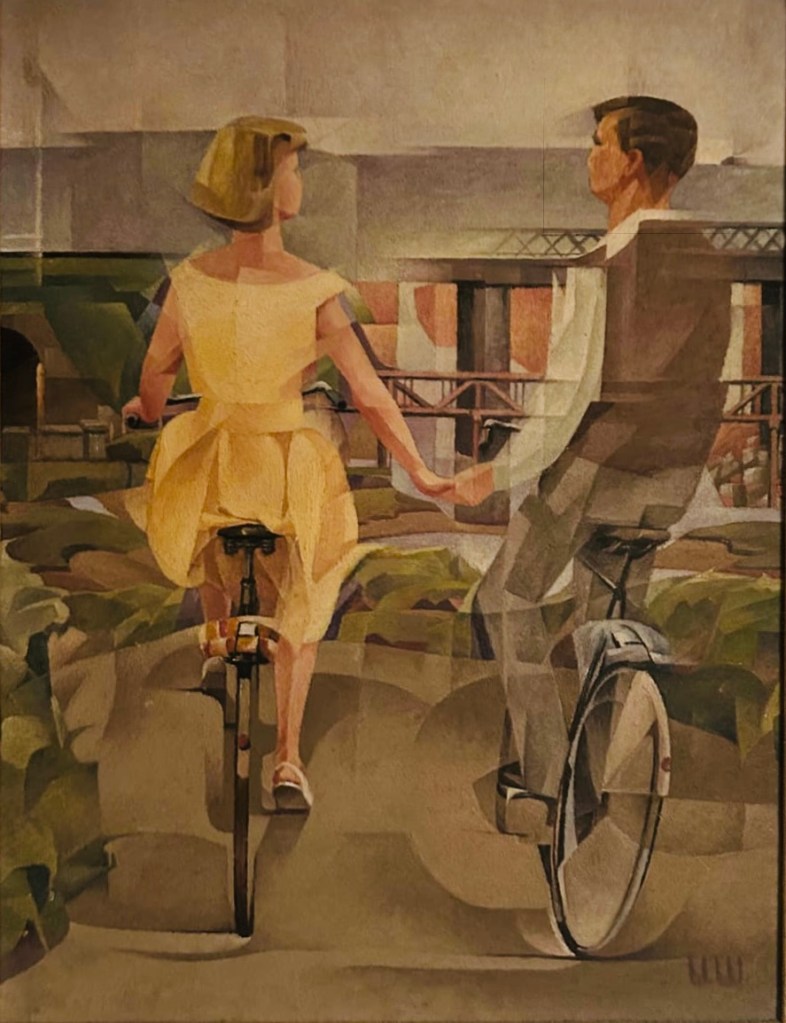
She’d also participated in the 25th Annual Waterford Art Exhibition, a major group show which places her firmly in context. Una exhibited two recently completed works – Wild Apples (oil on canvas, 56 x 43 cms) – https://unawattersartist.com/2020/06/24/wild-apples/ – which was sold for £30 and Malahide (oil on canvas, 37.5 x 35 cms) – https://unawattersartist.com/2020/07/22/the-three-graces-in-malahide/ – which featured in the show, but was not for sale.

The exhibition was a veritable who’s who of mid-century Irish art featuring Harry Kernoff, Anne Yeats, Patrick Pye, Gerard Dillon, George Campbell, Brigid Ganly, Norah McGuinness, Bea Orpen, George Collie, Walter Verling, Barrie Cooke, Camille Souter and Gerda Fromel, to name but 13 contributors to the show, which featured a total of 127 exhibits.

Seeing Una in this company is an eloquent reminder of her standing in the art world of the time. (It’s interesting to note that her works were in the higher price bracket among contributors. George Collie’s Industry and Commerce and National Museum from the Artist’s Studio was on sale for £100, but he was an elder statesman in the art world, a portraitist of note and a member of the RHA. Apart from Collie, prices for work ranged from £12 up to £45).

Una’s status among her contemporaries is sometimes forgotten because of the eclipse her reputation suffered immediately after her death, which we discuss elsewhere on this site. Only two of her works have come up for public auction in the past 20 years, so it’s easy to write her off as having a small output. In fact, however, although much of her work has flown under the radar, Una was a prolific artist as even a casual trawl through this site demonstrates.

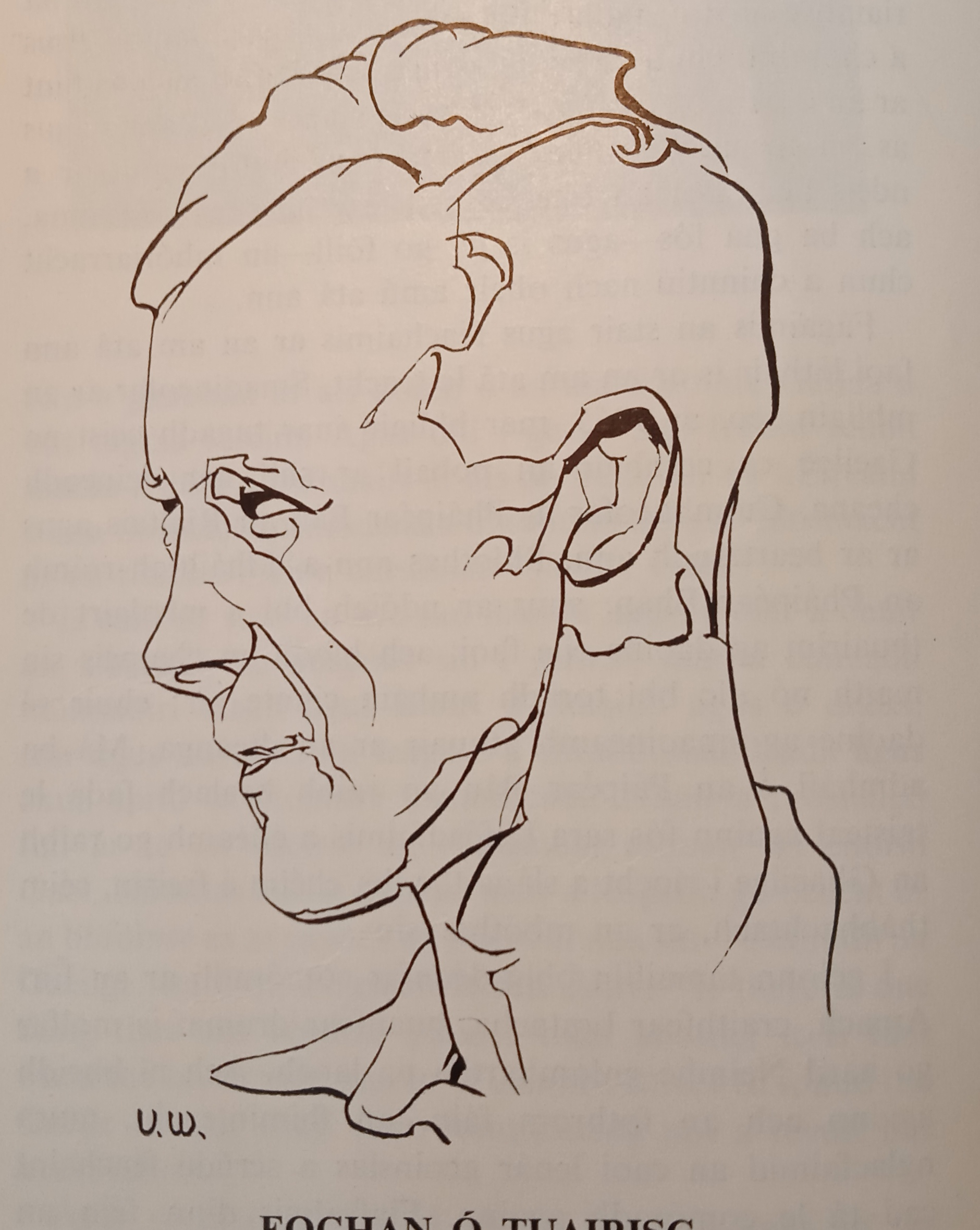
We’re still looking for seven known paintings of hers from the posthumous show organised by her husband, Eugene (Eoghan O Tuairsic) a year after her death. (See The 1966 Exhibition page) And who knows how many more paintings are out there that we don’t know about?

Poignantly, the Waterford show, which ran from November 6 to November 20, closed on the day of Una’s death.

Waterford still plays a significant role in the artistic scene boasting one of the most impressive regional collections in the south. The Waterford Municipal Gallery was founded by a group of public -spirited citizens in the late 1930s. The current Waterford Art Gallery which boasts a collection of 750 paintings, prints, photography and sculptures, is the direct descendant of the municipal gallery which, as historian Roy Foster has noted, formed a “cautious bridgehead” for art when it opened in hard times in 1939.

Wild Apples (1964)

Categories
News

Una in print

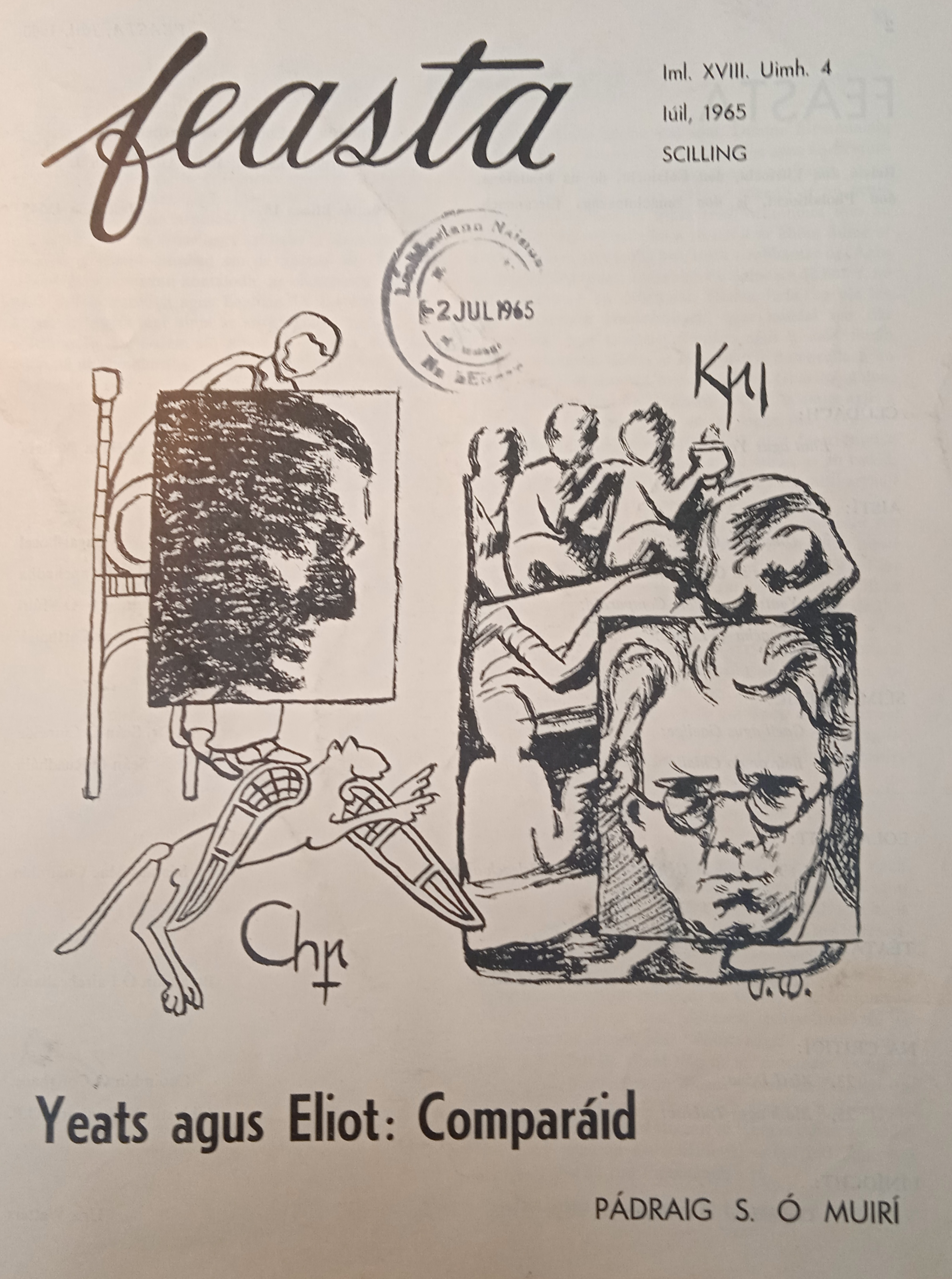
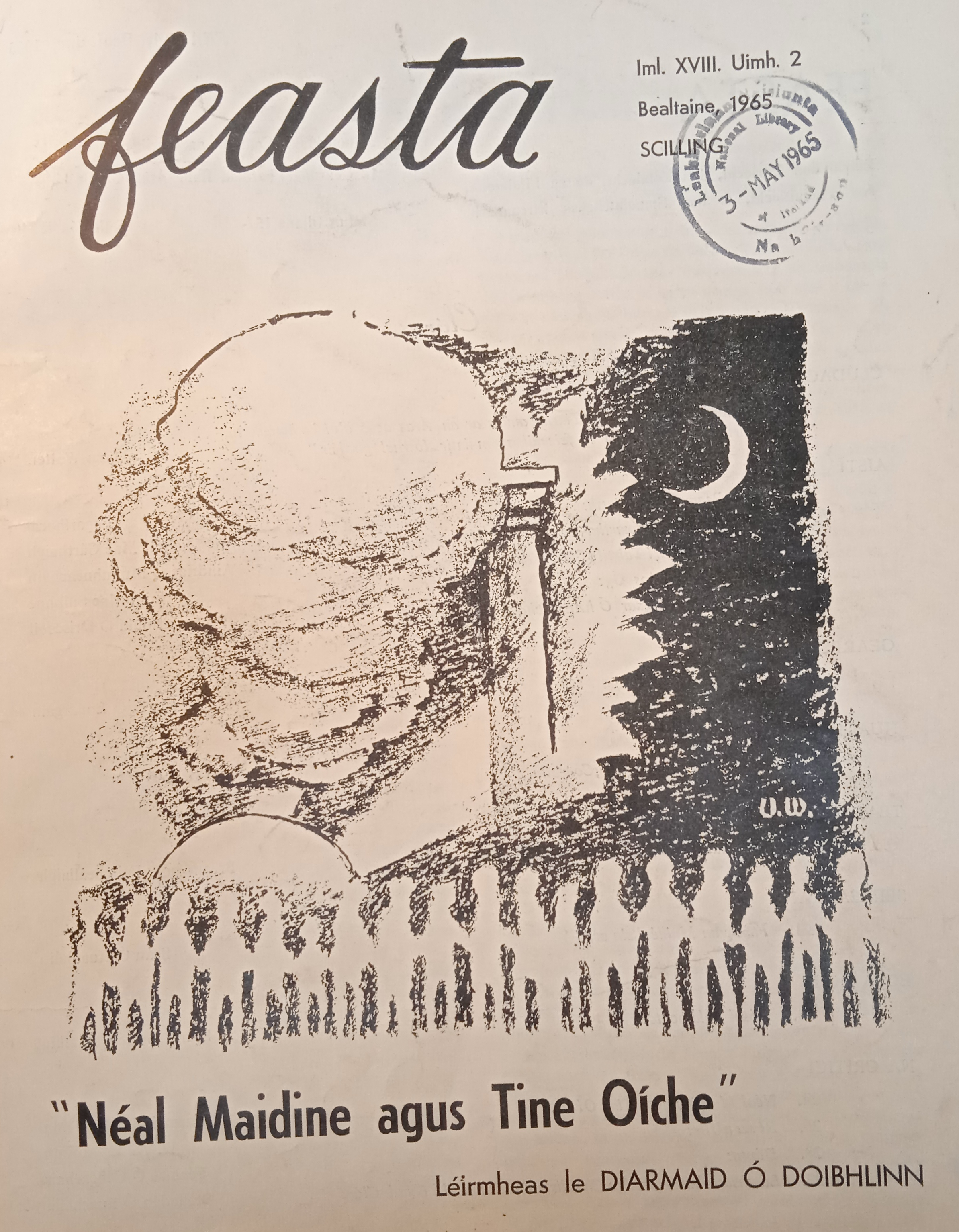
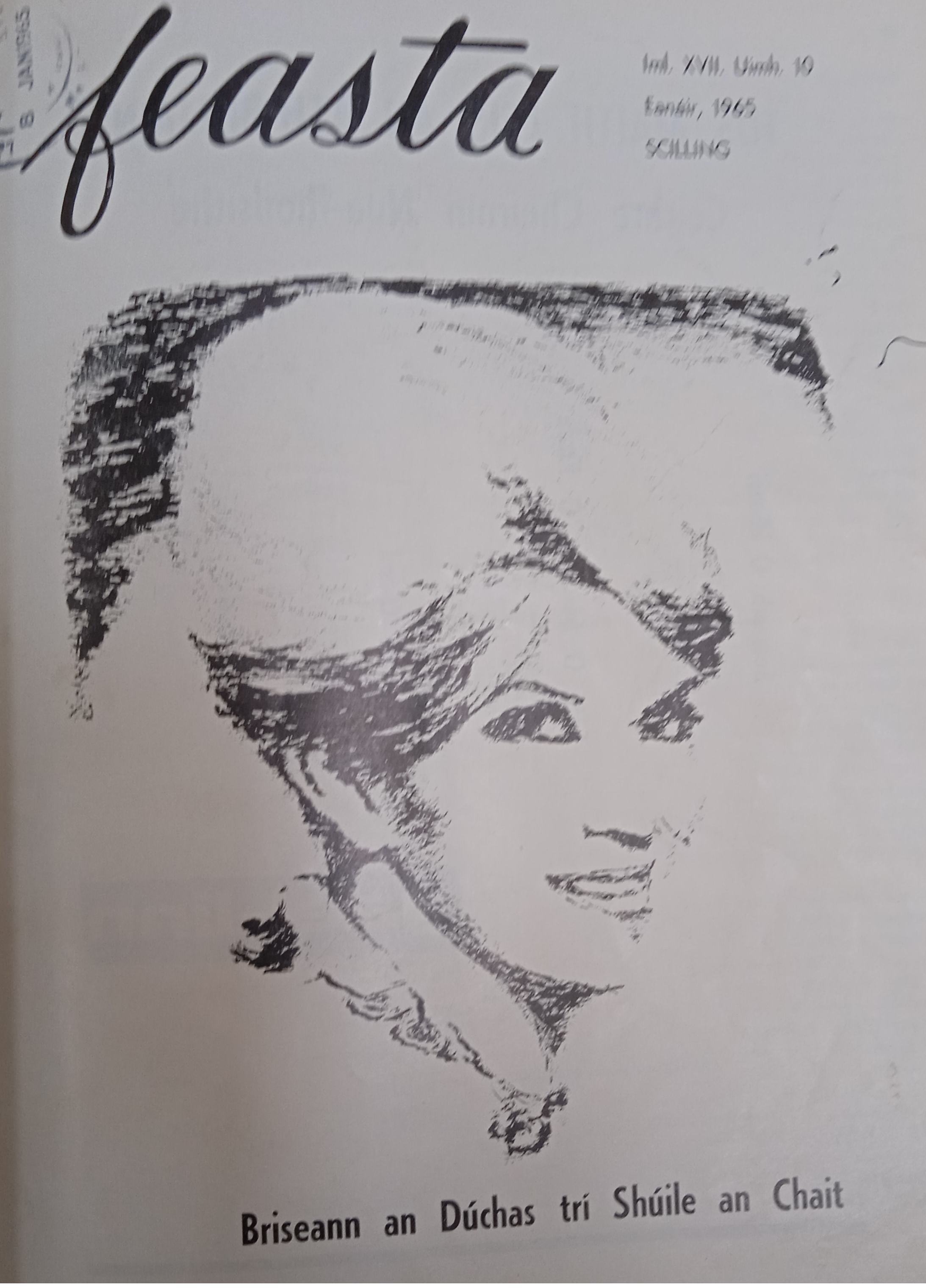
An under-considered facet of Una Watters’ work has been her illustrative and graphics work. We’ve seen elsewhere on this blog – https://unawattersartist.com/2023/02/18/unas-little-book-of-kells/ – that she did a great deal of commissioned art and calligraphic work for Brian O’Higgins’s publishing company, which produced Christmas cards and religious booklets for the commercial market. But she also did magazine illustration, most prominently with the Irish-language journal, Feasta.

Feasta was published monthly between 1948 and 2023 by Conradh na Gaeilge and became one of most significant literary magazines published in the Irish language. Una Watters became a regular contributor to Feasta after her husband, Eugene (writing as Eoghan Ó Tuairisc) took over the editorship of the journal in 1963.

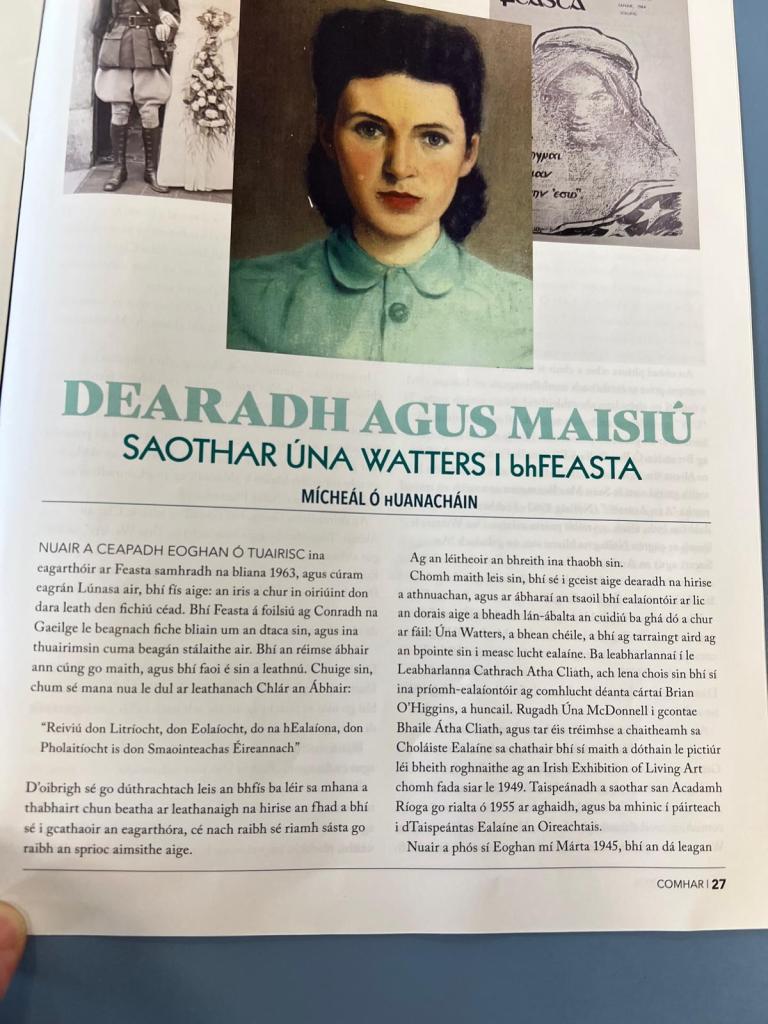
Her work for Feasta has been documented in an important article by broadcaster and Irish scholar Mícheál Ó hUanacháin, in the August issue of Comharhttps://comhar.ie/iris/85/8/dearadh-agus-maisiu/. Ó hUanacháin was heavily involved in the production of Feasta and saw Una’s work for the magazine at first-hand.

Because the article is in Irish, I will have to paraphrase the content and hope Mícheál will forgive me.

Eugene took over the editorship of Feasta in the summer of 1963. According to Ó hUanacháin, Eugene felt the magazine had a somewhat stale air with a narrow range of subject matter. He wanted to change all that. He immediately set to, rebranding it as a review “of literature, art, politics and Irish thought”. In keeping with this new motto, he also wanted to renew the appearance of the magazine. That was where Una came in.

Una’s first cover for Feasta appeared for the 1963 Christmas edition – An Sagart agus an Amharclann – about the influence of the clergy on the theatre. As well as the cover, her work was evident all over the Christmas 1963 edition – there was a card she’d designed for the O’Higgins company, a collage of portraits of actors in an Irish language production of “Roots”, a drama by English playwright Arnold Wesker at the Damer theatre, and a visual for a column on chess.

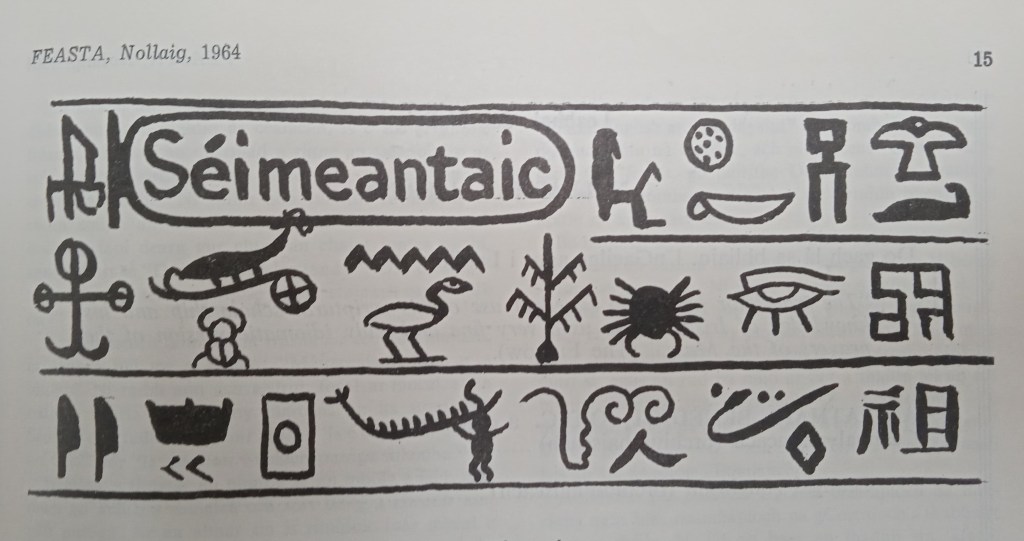
Between then and October 1965, Una completed 16 covers for the magazine. The subject matters varied widely – Jackie Kennedy, the singer Dusty Springfield, W B Yeats and T S Eliot, Roger Casement – as well as many incidental illustrations – graphics for a drama column, sketches of classical composers, and typographic symbols which were used as article dividers. She was an integral part of Eugene’s vision for and reshaping of the magazine as a lively publication engaged with cultural and current affairs.

Unfortunately, as Ó hUanacháin remarks, with Una’s death, that vision was halted in its tracks. Eugene gave up his editorship of the magazine, replaced temporarily by Ó hUanacháin himself. However, Una’s work lived on. For many years afterwards, her incidental graphics were still gracing the pages of Feasta.

Categories
News

Double take

On a recent visit to Australia, I rounded a corner in the National Gallery of Victoria in Melbourne and was stopped in my tracks by this work. Could an Una Watters’ landscape have possibly found its way into one of Australia’s premier galleries without my knowing?

Well. . . no.

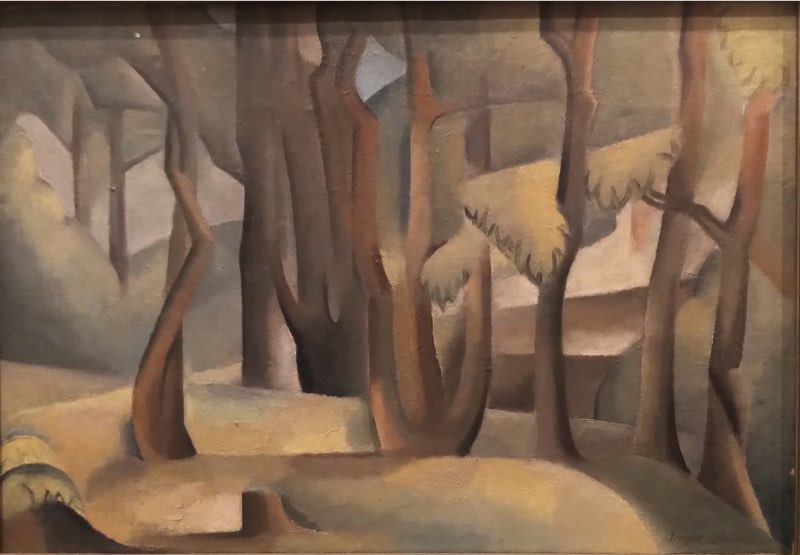
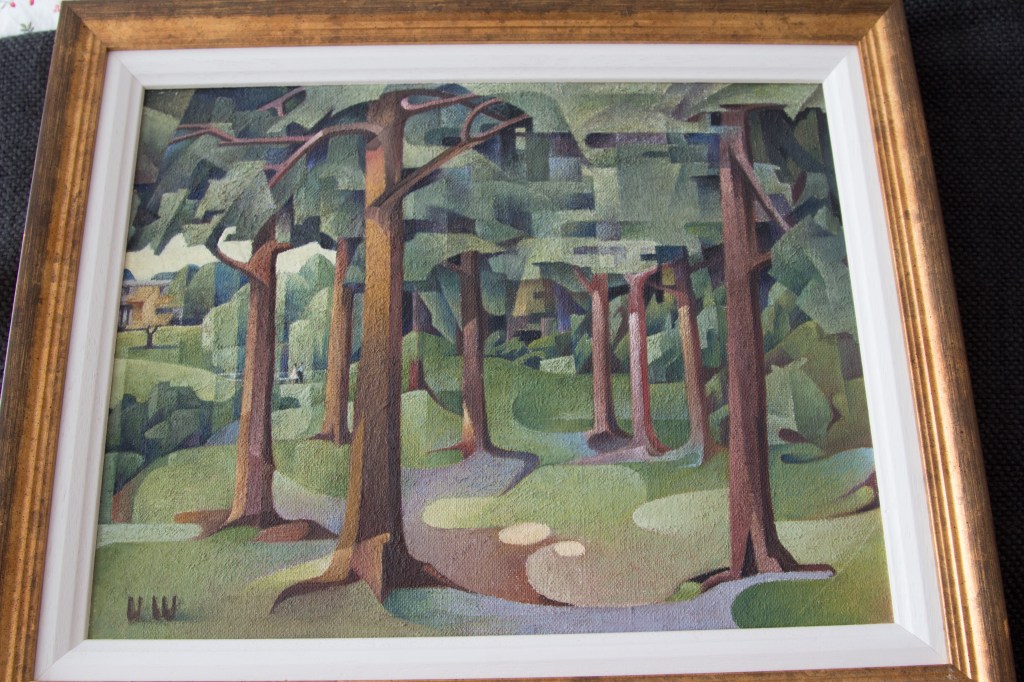
This is Gum Trees dated to 1933-35, by Dorrit Black (1891 – 1951), oil on canvas (42.0 x 59.8 cms), but it is so redolent of Una’s landscape work – the cubist influences, the undulating foreground, the stark geometry of the trees, the very deep recession of the work – that it could have been made by Una in another life. The techniques are similar to those in Wild Apples or The Pine Wood and the colour tones are reminiscent of the recently discovered To the Sea.

Clockwise: The Pine Wood, To the Sea, Wild Apples – Una Watters

Black had a huge impact on the development of modern art in Australia, according to Paul Finucane and Catherine Stuart in their beautiful and exhaustive compendium of Australian women artists – Odd Roads to be Walking: 156 Women who Shaped Australian Art – (Sheila Foundation Press.) She paid several visits to Europe in the 1920s and 30s and studied under André Lhote, the French painter, art critic and teacher who combined Cubism with a post-Impressionist palette. As a mentor he would influence a whole generation of late 19th/early 20th century Irish artists, who attended his studio classes, in Paris and in the south of France. It’s not too much of a stretch to imagine his influence indirectly on Una Watters, a generation later.

Ironically, one of the artists I was seeking out while in Australia was the tonalist painter Clarice Beckett (1887 – 1935) whose biography has echoes of Una Watters’ story, but on a larger and more heartbreaking scale. She died young (Beckett was 48) after which her work vanished from view and her artistic legacy disappeared with it. She was rediscovered by chance in the late 1960s by art curator Rosalind Hollinrake, who managed to trace a staggering 1600 of her canvases to a remote, open-sided shed in rural Victoria where they had been left to rot. Only 369 were salvageable; the rest were beyond repair.

The Gallery of South Australia in Adelaide now owns 21 of her works, all on view and part of Dr Hollinrake’s personal collection. It represents the largest single assemblage of Becketts in Australia, though her work also appears in state collections in Sydney and Melbourne. So a really satisfying end to a sad story of neglect.

Wet Evening ( 1927) – Clarice Beckett

While in Australia, I gave a talk on Una’s work to the Aisling Club, an association of ex-pats and enthusiasts of Irish culture and history, who meet in the spectacular 26th floor premises of the Irish Consulate on Market Street, Sydney.

So, I’ve been busy spreading the word. And who knows? If Una Watters’ work has made its way Down Under, there’s no excuse for anyone in that Sydney audience not to recognise an Una now if they see one!

Categories
News

For your diary

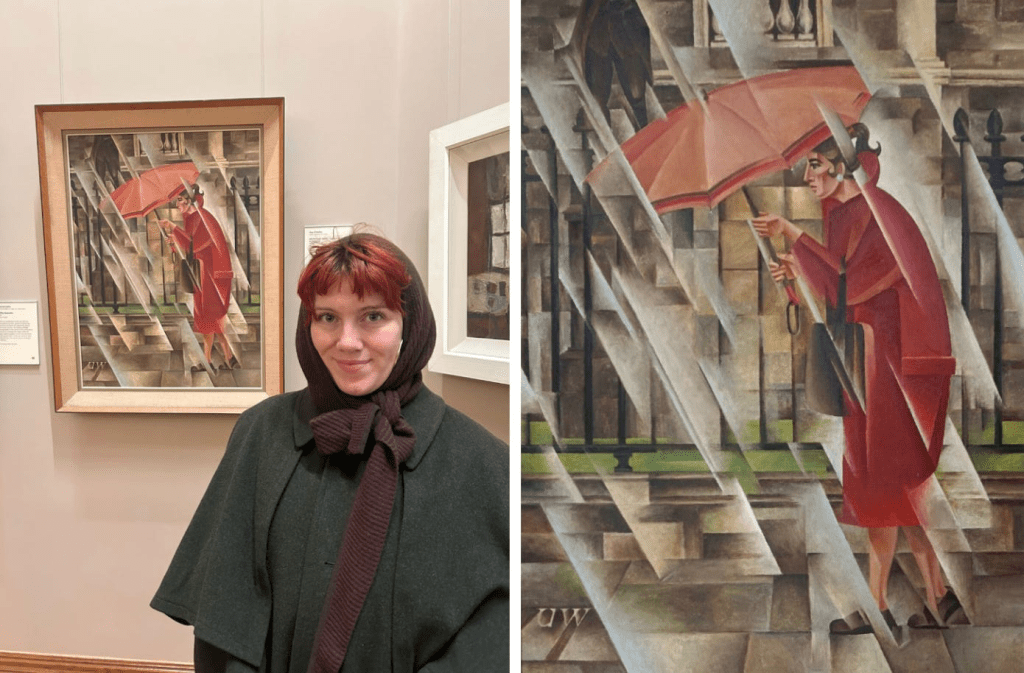
After the flurry of the presentation of Una’s Girl Going by Trinity in the Rain to the national collection by Colbert Kearney in 2023, things have been quiet on the Una Watters front.

However, this year will see more activity. It’s an anniversary year – 60 years on from her death in 1965 – and hopefully that may see an upswing in Una Watters-related activities.

First development this year is the inclusion of Girl Going by Trinity in the Rain in the National Gallery of Ireland’s diary. Always a beautiful production, this year is no different, and Una appears for the week of May 26, 2025.

The director of the gallery, Dr Caroline Campbell, remarks in the diary’s introduction that Una’s Girl has already become a” popular favourite” among gallery patrons. This makes a trifecta of images the NGI has used of Una’s signature painting – it appeared in last year’s calendar and is for sale in postcard form in the gallery shop. (Speaking of merch, I’m waiting for the gallery umbrella and tote bag!)

As Sara Donaldson author of the notes accompanying the image in the diary writes – “Watters’s awareness of Cubist forms is evident everywhere, while Futurist-inspired ‘lines of force’ represent the sheets of rain, evoking the atmosphere of a wet urban scene.”

Speaking of dates for the diary, I will be doing a lecture – “The Lost Reputation of Una Watters” as part of Ballinasloe & District Historical Society’s Town Talks series in March – more details to come closer to the time.

Meanwhile, I’m on work on a book on Una so if any of you out there have stories or memories of her or Eugene Watters, do contact me via the email on the blog.