Categories
Una in focus

Placed among her peers

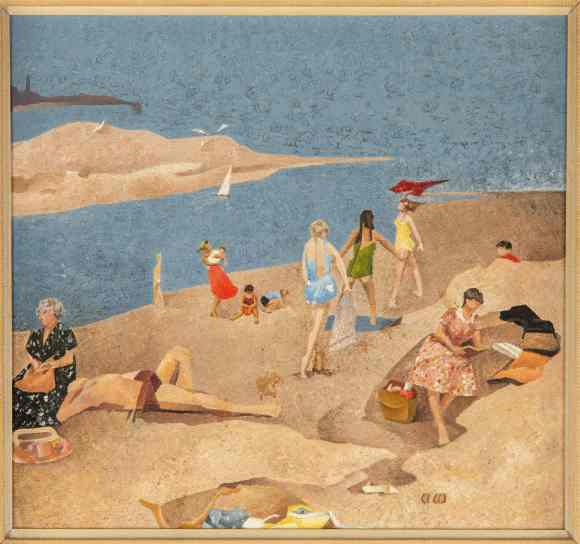
Malahide (1964)

This year marks the 60th anniversary of Una Watters’ death (Nov 20, 1965) but it was also the year when her artistic powers were at an all-time high. She’d designed the winning logo for the Easter Rising Commemorations in an Arts Council open competition, she’d completed five major oil paintings plus a ground-breaking cycle of watercolours (see the Emerald Ballroom Watercolours page elsewhere on this site) which suggested a new artistic direction.

She’d also participated in the 25th Annual Waterford Art Exhibition, a major group show which places her firmly in context. Una exhibited two recently completed works – Wild Apples (oil on canvas, 56 x 43 cms) – https://unawattersartist.com/2020/06/24/wild-apples/ – which was sold for £30 and Malahide (oil on canvas, 37.5 x 35 cms) – https://unawattersartist.com/2020/07/22/the-three-graces-in-malahide/ – which featured in the show, but was not for sale.

The exhibition was a veritable who’s who of mid-century Irish art featuring Harry Kernoff, Anne Yeats, Patrick Pye, Gerard Dillon, George Campbell, Brigid Ganly, Norah McGuinness, Bea Orpen, George Collie, Walter Verling, Barrie Cooke, Camille Souter and Gerda Fromel, to name but 13 contributors to the show, which featured a total of 127 exhibits.

Seeing Una in this company is an eloquent reminder of her standing in the art world of the time. (It’s interesting to note that her works were in the higher price bracket among contributors. George Collie’s Industry and Commerce and National Museum from the Artist’s Studio was on sale for £100, but he was an elder statesman in the art world, a portraitist of note and a member of the RHA. Apart from Collie, prices for work ranged from £12 up to £45).

Una’s status among her contemporaries is sometimes forgotten because of the eclipse her reputation suffered immediately after her death, which we discuss elsewhere on this site. Only two of her works have come up for public auction in the past 20 years, so it’s easy to write her off as having a small output. In fact, however, although much of her work has flown under the radar, Una was a prolific artist as even a casual trawl through this site demonstrates.

We’re still looking for seven known paintings of hers from the posthumous show organised by her husband, Eugene (Eoghan O Tuairsic) a year after her death. (See The 1966 Exhibition page) And who knows how many more paintings are out there that we don’t know about?

Poignantly, the Waterford show, which ran from November 6 to November 20, closed on the day of Una’s death.

Waterford still plays a significant role in the artistic scene boasting one of the most impressive regional collections in the south. The Waterford Municipal Gallery was founded by a group of public -spirited citizens in the late 1930s. The current Waterford Art Gallery which boasts a collection of 750 paintings, prints, photography and sculptures, is the direct descendant of the municipal gallery which, as historian Roy Foster has noted, formed a “cautious bridgehead” for art when it opened in hard times in 1939.
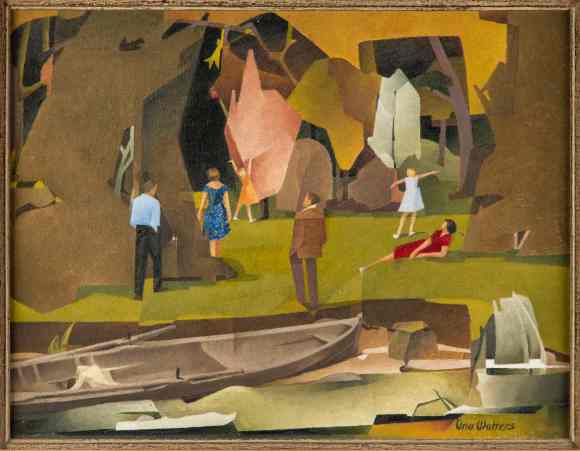
Wild Apples (1964)

Categories
News

The Gardens Revisited

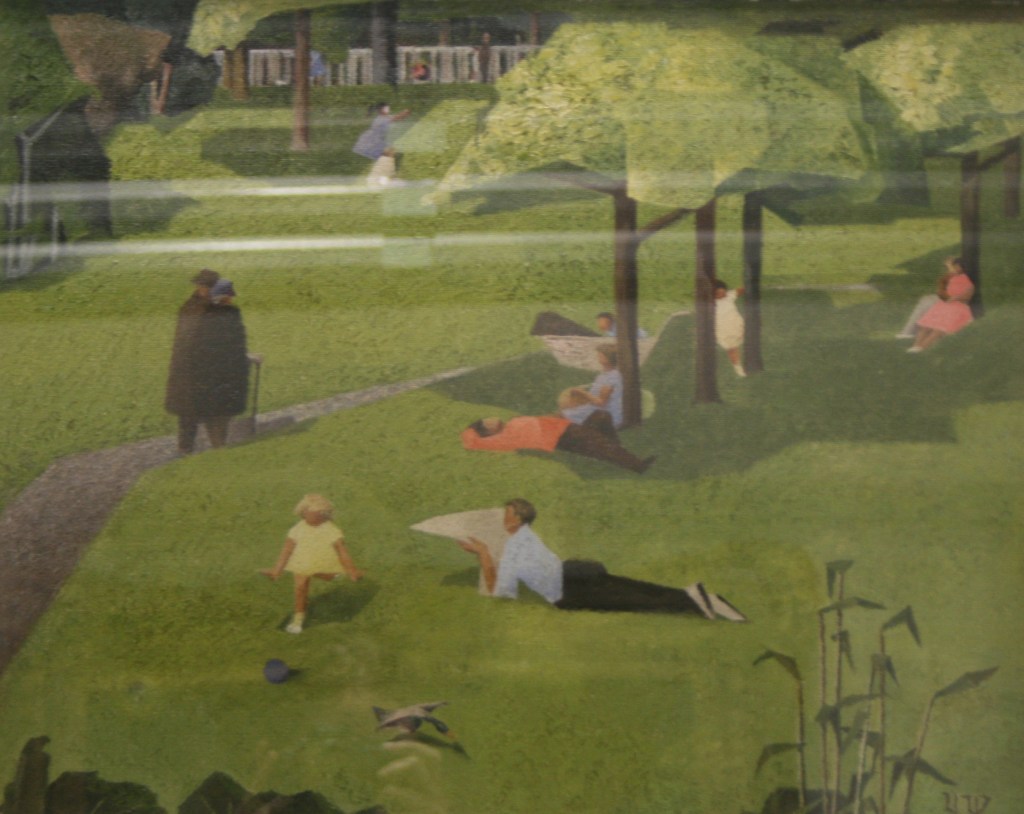
One of the legacies of the Una Watters: Into the Light retrospective at the United Arts Club, Dublin (March 10 – April 2, 2022) was that although the Hugh Lane Gallery didn’t lend us the The People’s Gardens (1963, oil on canvas, 40.6 x 50.8cm) for the show, they did agree to a public viewing of the painting on April 5.

The work has been in the Hugh Lane collection since 1967. It was shown at the Royal Hibernian Academy Annual Exhibition in 1964 after which the Thomas Haverty Trust bought the painting. The trust lent it for Una’s posthumous retrospective in 1966. The following year they donated it to the Hugh Lane.

The Haverty Trust was established following the death of the artist Thomas Haverty who left a sum of money for the purchase of paintings by Irish artists for public galleries and institutions. Between 1935 and 1966, the Trust gave the Hugh Lane Gallery over 40 works including paintings by Mary Swanzy, William Leech, Brigid Ganly and Maurice MacGonigal (who encouraged Watters in her art studies).

Although the gallery does not have pre-computerisation records of showings of the works in their collection, there is anecdotal evidence that The People’s Gardens was shown in the Hugh Lane in the 1970s – Una’s niece, Eva Byrne, remembers seeing it there as a child with her mother. But it hasn’t been exhibited in recent times.

However, that does not mean that it hasn’t been seen. According to gallery records, it was on loan to the City Hall between 1969 and 1974 and again in the 1980s where it hung in the office of Mr P O’ Muirgheasa (my namesake, but no relation!) Unfortunately, it sustained “biro damage” during this time which had to be repaired although the note in the gallery file says traces of the biro marks remained underneath the central figure.

It was also hung in the ILAC Centre library in 1987 along with a number of other works on loan from the Hugh Lane – including Harry Kernoff, John Leech and Lizzie Stephens – all of them depicting scenes of Dublin.

Acting Head of Collections Logan Sisley who facilitated the showing, and who has contributed to this blog, (May 6, 2020) was on hand to answer questions on the work. He pointed out the cubist renderings of the trees – (see also blog on Wild Apples, June 24, 2020) – and the application of a dabbing technique to create texture in the grassy area in the foreground.

But the gallery viewing also brought to light some more biographical information about the painting.

We already knew that the elderly couple on the path in the centre of the work are Una’s parents, but the other figures have also now been identified. Georgina O’Donovan, a niece of Eugene Watters, says the little girl in yellow in the foreground is her sister, Linda, and that the male figure reading the newspaper is Eugene. She herself can be glimpsed in a white dress behind a tree and the figures beside her are her parents and her baby brother in a pram. It’s also likely that Una is the woman sitting sheltering under the trees. Although she’s not wearing her trademark red, her pose is reminiscent of other works in which she places herself as an observer of the scene she is painting.

The presence of Eugene’s family from Ballinasloe in what is essentially a Dublin painting is surprising, though Georgina remembers several outings to the park on trips to Dublin, although she believes this may be a composite record of those expeditions, rather than one particular day.

Either way, without the public showing, we might never have learned the background to this work. The viewing of The People’s Gardens provided a focus for memories and connections to be made by those who knew Una and to shed light on her artistic practice and inspiration.

It also highlights Una’s work in the context of the city’s social history. As Dr Roisin Kennedy remarked at the opening of the exhibition many of Una’s paintings record the public life of Dubliners in the 50s and 60s, a life now vanished – see The Ladies Committee in the image gallery on this site ( 1966 Exhibition page) or Malahide (see blog of July 22, 2020).

One more good reason for the Hugh Lane to show Una Watters to the world.

Categories
Una in focus

The People’s Gardens

In the second of a series of  occasional blogs considering individual paintings of Una’s, Logan Sisley, Acting Head of Collections at the Hugh Lane Gallery, discusses “The People’s Gardens”.

Una Watters is represented by one painting in the Hugh Lane Gallery Collection, a charming Dublin scene painted in 1963 called The People’s Gardens (oil on canvas, 40.6 x 50.8 cm). It shows Watters’ distinctive angular modernist style with contrasts of light and shade and areas of pure colour.

It is one of a number of paintings by Watters depicting Dublin life. The People’s Gardens is a public garden within the Phoenix Park near the Parkgate Street entrance. It opened in the mid-1860s in order to address the lack of public recreational space in Dublin. It contains an ornamental lake, children’s playground, picnic areas and Victorian bedding schemes. Watters captures the undulating terrain of the gardens.

As is typical of her work, the trees and figures are pared down to angular forms. This shows the influence of earlier modern art movements such as Cubism and Futurism, albeit interpreted in her own style. Her clever use of shadows adds depth – notably under the trees and in the figure of the girl kicking the ball, the man reading a paper and the duck taking off (or landing). These also demonstrate a keen observation of people and an eye for detail. The strong shadows and summer dresses suggest a warm sunny day, yet the elderly couple walking arm-in-arm on the path are still dressed in heavy coats and hats.

Leisure scenes in outdoor settings such as this have been a popular subject for painters since the 19th century. Other examples at the Hugh Lane Gallery include Edouard Manet’s Music in the Tuileries Gardens (1865), Eugene Boudin’s Normandy beach scenes (1867 and 1893), Edgar Degas’ Beach Scene (c. 1876-1877), John Lavery’s river scene, Sutton Courtney (1917) and William Leech’s Beach, South of France (1921-6).

The People’s Gardens was shown at the 1964 Royal Hibernian Academy Annual Exhibition. The Thomas Haverty Trust bought the painting and lent it for Watters’ posthumous retrospective exhibition in 1966. The following year the Trust donated the work to Hugh Lane Gallery. The Haverty Trust was established following the death of the artist Thomas Haverty who left a sum of money for the purchase of paintings by Irish artists for public galleries and institutions. Between 1935 and 1966, the Trust gave the Hugh Lane Gallery over 40 works including paintings by Mary Swanzy, William Leech, Brigid Ganly and Maurice MacGonigal (who encouraged Watters in her art studies).

As an artist so intrinsically linked to the city, it is fitting that Watters’ work found a home in Dublin’s city gallery. She painted while working for Dublin Corporation’s libraries and met her husband Eugene at a dance at the Teachers’ Club, one of the gallery’s neighbours on Parnell Square.

Logan Sisley

nationwide1a

Logan Sisley and Bláthnaid Ní Chofaigh discuss The People’s Gardens at the Hugh Lane Gallery for RTE Nationwide programme  on March 6, 2020.