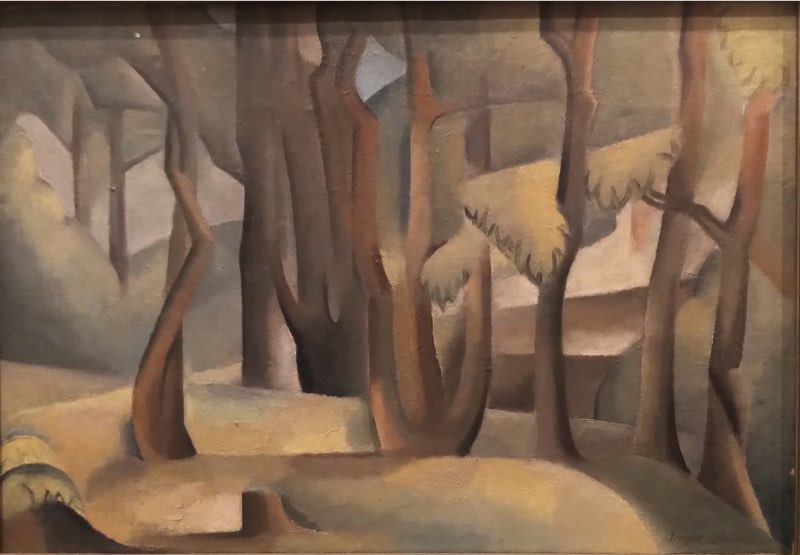
On a recent visit to Australia, I rounded a corner in the National Gallery of Victoria in Melbourne and was stopped in my tracks by this work. Could an Una Watters’ landscape have possibly found its way into one of Australia’s premier galleries without my knowing?
Well. . . no.
This is Gum Trees dated to 1933-35, by Dorrit Black (1891 – 1951), oil on canvas (42.0 x 59.8 cms), but it is so redolent of Una’s landscape work – the cubist influences, the undulating foreground, the stark geometry of the trees, the very deep recession of the work – that it could have been made by Una in another life. The techniques are similar to those in Wild Apples or The Pine Wood and the colour tones are reminiscent of the recently discovered To the Sea.
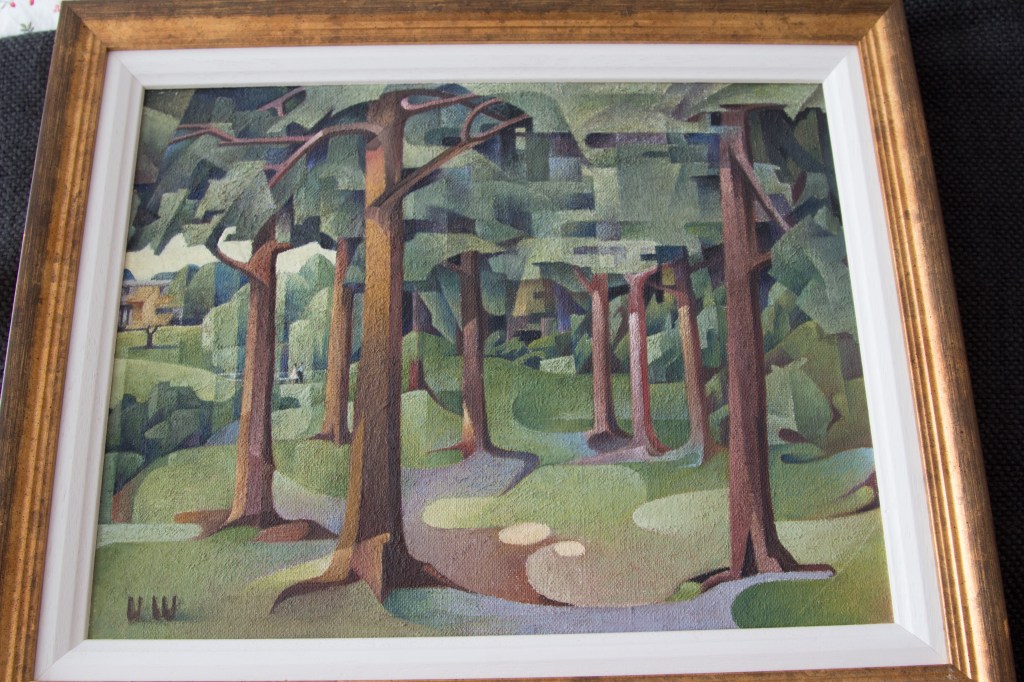
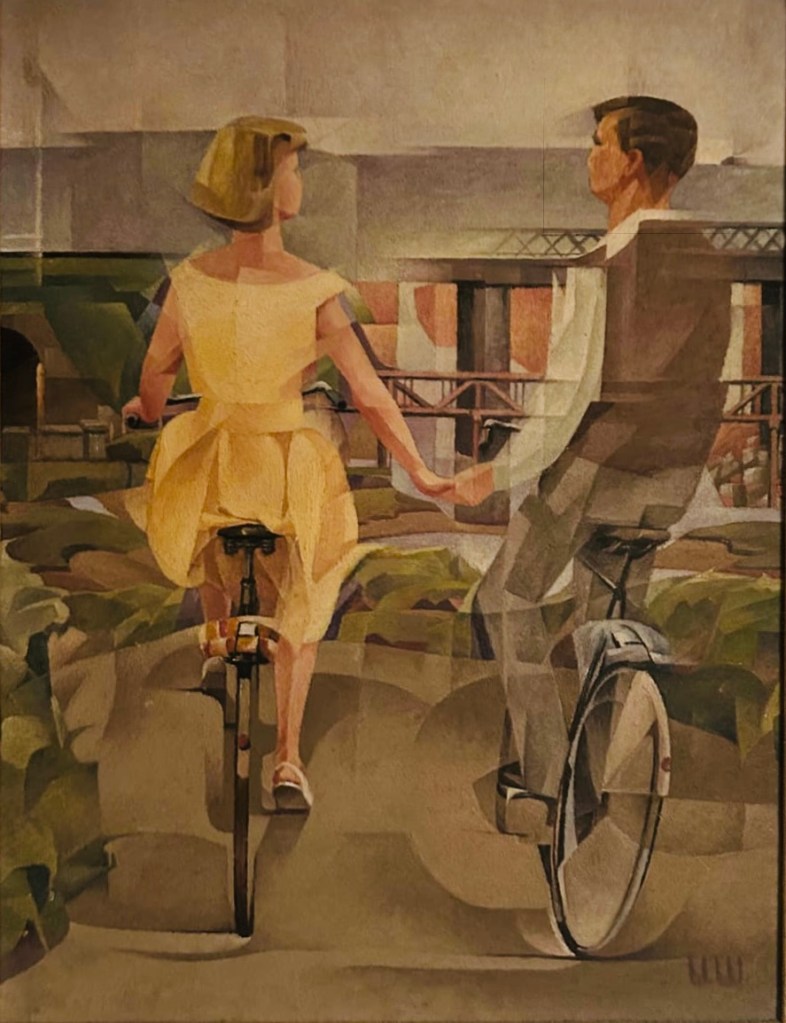

Black had a huge impact on the development of modern art in Australia, according to Paul Finucane and Catherine Stuart in their beautiful and exhaustive compendium of Australian women artists – Odd Roads to be Walking: 156 Women who Shaped Australian Art – (Sheila Foundation Press.) She paid several visits to Europe in the 1920s and 30s and studied under André Lhote, the French painter, art critic and teacher who combined Cubism with a post-Impressionist palette. As a mentor he would influence a whole generation of late 19th/early 20th century Irish artists, who attended his studio classes, in Paris and in the south of France. It’s not too much of a stretch to imagine his influence indirectly on Una Watters, a generation later.
Ironically, one of the artists I was seeking out while in Australia was the tonalist painter Clarice Beckett (1887 – 1935) whose biography has echoes of Una Watters’ story, but on a larger and more heartbreaking scale. She died young (Beckett was 48) after which her work vanished from view and her artistic legacy disappeared with it. She was rediscovered by chance in the late 1960s by art curator Rosalind Hollinrake, who managed to trace a staggering 1600 of her canvases to a remote, open-sided shed in rural Victoria where they had been left to rot. Only 369 were salvageable; the rest were beyond repair.
The Gallery of South Australia in Adelaide now owns 21 of her works, all on view and part of Dr Hollinrake’s personal collection. It represents the largest single assemblage of Becketts in Australia, though her work also appears in state collections in Sydney and Melbourne. So a really satisfying end to a sad story of neglect.

While in Australia, I gave a talk on Una’s work to the Aisling Club, an association of ex-pats and enthusiasts of Irish culture and history, who meet in the spectacular 26th floor premises of the Irish Consulate on Market Street, Sydney.
So, I’ve been busy spreading the word. And who knows? If Una Watters’ work has made its way Down Under, there’s no excuse for anyone in that Sydney audience not to recognise an Una now if they see one!
 Una Watters (1918-1965)