Categories
News

Banner Headline

This fine specimen of angelic manhood is a detail from another new Una Watters discovery – as a result of contacts made at an event at Phizzfest earlier this year. It’s an unusual find in that it’s not a painting but a banner made for St Michael’s School in Finglas.

The principal of the school was a Sister Philippa who knew Una’s sister, Maureen McDonnell ( Sister Mel) a fellow nun at the Holy Faith School in Glasnevin. She asked her to approach Una to design a banner for the school on Wellmount Road which had opened in 1959. Another sister, Sister Therese Kearney (95), remembers the request being made.

In the summer of 1960, she has written, the school pupils made their first appearance in Glasnevin grounds for sports day. “They had no banner to represent their school. Sister Philippa immediately asked Sister Mel McDonnell’s sister Una to paint a banner for the school.”

Because the work was done as a favour, rather than being officially commissioned, it has remained, like much of Una’s craft work, under the radar. Although not signed, the provenance is direct with Sister Mel’s involvement in the process and the surviving Sister Therese’s written testimony.

The banner measuring (121.92cm x 91.44cm) depicts the archangel St Michael in Celtic warrior mode, with blonde hair, muscled arms holding a golden spear and shield. His wings are a celestial blue but there’s nothing ethereal about them – they’re robust-looking and rendered in the geometric style that Una used later in her treatment of trees and foliage. There’s no doubt that this is St Michael triumphant – the expression on the archangel’s face is serenely confident – although there’s no sign of the dragon. Instead, Una’s St Michael appears to be standing on a chain, a nicely abstract rendition of his liberating powers.

As well as designing it, it’s probable that Una, an accomplished seamstress, also made the banner and trimmings herself. St Michael is painted on what looks like calico and backed with dark green silk. The border with a Celtic barley twist design runs all the way around with a golden fringe at the bottom. Five fabric hooks allow it to be attached to a mobile wooden frame, a neat combination of function and design.

The banner is not just decorative. The school principal, John Barry, explains that it is used regularly in school ceremonies – graduations, sports days and to mark the opening of the school year when the head girl hands it over to the incoming sixth year class. The school currently has 630 pupils.

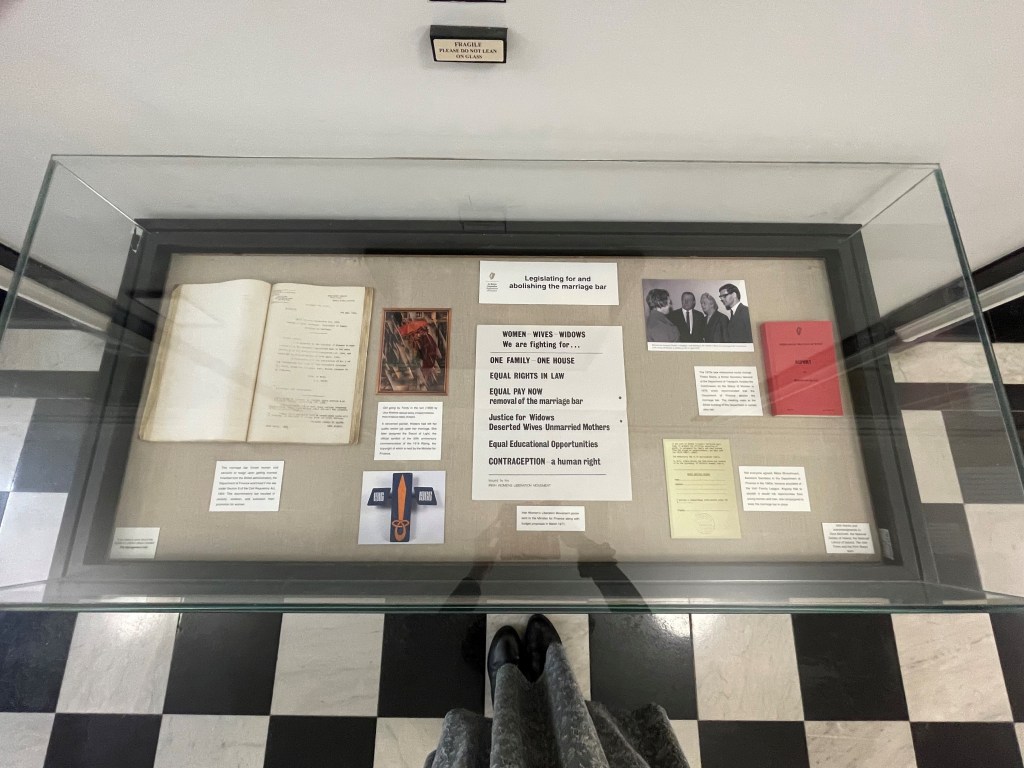
Meanwhile Una and her work is also referenced in a historical exhibition within the halls of the Department of Finance. Archivist Cliodhna Walsh was involved in organising it to mark the lifting of the marriage bar for female civil servants 50 years ago in 1973.

Like many women, Una was forced to leave her job in the library service when she married Eugene Watters in 1945. The ban on working probably gave Una more time to pursue her art, but it also meant she had to use her art to generate income, hence some of her illustrative and calligraphic work covered elsewhere on this site.

“As important as it is to remember how the marriage bar wrenched so many women away from public life, it is also lovely to acknowledge the vibrant artistry of a woman who contributed much to Irish culture,” Ms Walsh has observed about Una’s contribution to the exhibition.

A reproduction of Una’s Girl Going by Trinity in the Rain features in this private exhibition as well as images of her design for the 1966 Easter Rising emblem based on the Sword of Light. Because this was entered in a public competition, the design copyright rests with the Department.
Categories
News

Phizzing for Una

Catch up on Una Watters at Phizzfest where I’ll be giving an illustrated lecture – “Una Watters: Total Eclipse”- which will look at her work in context and explore the reasons for her retreat into invisibility.

The event takes place on Saturday, May 13, at 3pm in @thebohemianbar in Phibsborough. Link here for tickets: https://www.eventbrite.ie/…/una-watters-total-eclipse…

Phizzfest takes place from May 12-14 and covers all thing cultural in the Phibsborough area. Details of all events at https://www.phizzfest.ie

Above: Cappagh Road ( 1960)

Categories
News

It’s raining at the National Gallery!

Raining Una Watters, that is. We’re delighted to be able to announce that the Una Watters’ painting, Girl Going by Trinity in the Rain (1959, oil on canvas, 61×81 cms), is now part of the National Gallery’s collection, thanks to the generosity of its owner, Colbert Kearney.

Colbert was gifted the work by Eugene Watters after Una’s posthumous exhibition in 1966. He was a pupil of Eugene’s at St Fergal’s National School in Finglas (see Colbert’s guest blog, “Portrait of E.R. Watters”, June 17, 2020) and they remained firm friends until Eugene’s death. It was always Colbert’s intention to pass the painting on but after last year’s retrospective (March 10 – April 2, 2022 @ the United Arts Club), the idea of donating to the NGI seemed like the logical next step.

Girl Going by Trinity is a quintessentially Dublin work – the Trinity College location makes it so – and the driving, sleety rain will be a familiar meteorological trope for anyone who has known winter in the city.

As Colbert’s partner, I’ve lived with this work for over 20 years, and it’s the work that inspired my quest to locate as much of Una’s work as possible, and the decision to mount Una’s retrospective last year with Sheila Smith, her niece. The idea was to bring Una to a wider audience and to the forefront of artistic attention. We hope that the NGI’s acquisition of her work will cement that progress.

The opportunity came at a reception for the Sarah Cecelia Harrison Inaugural Essay Prize sponsored by the gallery last November. My essay on Una reached the final three (See “Una takes her place”, November 25, 2022). At the reception Colbert had a conversation with the director of the ESB Centre for the Study of Irish Art, Donal Maguire, and enquired if the gallery would be interested in having an Una Watters in the collection. I think Donal wondered if it was the cheeky white wine talking, but once he was assured that Colbert was serious, the process only took a few months.

In late January we had to say goodbye to the painting, so it could go before an acquisitions committee. At that stage, we didn’t know if it would be accepted or if we would see it again (although of course we sincerely hope we will see it again on the walls of the National Gallery!) so we spent much of the early new year savouring our time with it.

We moved it to a new spot – hung lower than usual. (I got this idea from sculptor Corban Walker’s exhibition As Far As I can See at the Crawford Gallery (Oct 15, 2022 – Jan 15, 2023). Along with his own work, Walker chose 30 works from the Crawford Collection to show. Because of his restricted stature, Walker hung the works lower than normal and it afforded a much more intimate relationship with the paintings.)

Now at eye-level, there were still new things I was seeing in Girl Going by Trinity in the Rain – its complex treatment of light, the quivering rain drops (impasto dashes of white paint) on the tips of the umbrella, the life-like animation of the Goldsmith statue beside the flesh-and-blood young woman who appears paradoxically monumental, the misty illumination around the girl’s ponytail.

I’d never noticed before the proliferation of verticals in the work – the stick of the umbrella, the railings, the balustrades – and how the rain itself is architectural in its form like literal stair-rods. The patterned geometry of the stone work leans close to abstraction; even the half-belt on the girl’s coat looks solid, brick-like, as if she’s melding with the building, her face full of sharp architectural planes.

I could go on, but I won’t, or I’ll get lonesome for it! And there’s nothing really to mourn. The painting lives.

Girl Going by Trinity in the Rain joins its sister work – The People’s Gardens (1963, oil on canvas, 40.6 x 50.8 cms) – which is already in the Dublin City Hugh Lane Gallery collection (See Logan Sisley’s guest blog May 6, 2020). It means Una Watters’ name is enshrined in the national cultural memory, where it belongs.

Although the Hugh Lane organised private viewings of their Una to coincide with our retrospective last year, they wouldn’t lend The People’s Gardens, and it’s a very long time since it was on public display in Parnell Square.

Both of these works deserve to be widely seen. So next time you’re in either of these galleries, ask about their Una Watters works; it’s possible to see them by appointment. After all, they belong to all of us now.

Categories
Una in focus

Crowning glories

Today we mark the birth of Una Watters on this day 104 years ago. We thought we’d mark the occasion with a quick survey of one of her crowning glories – her depiction of trees. Una’s eloquent rendering of them was constantly evolving, from naturalistic to abstract to minimalistic, as our “tree of life” gallery demonstrates.

1 .Dha Chrann (1943)
2 .The People’s Park (1943)
3.The Doghole (1950s)
4. The Red Bridge (1956)
6. Wild Apples (1964)
7. Untitled watercolour (Emerald Ballroom series) Copy – (1965)

First in our gallery is the very early Dha Chrann (oil on canvas, 56 x43 cm) where a pair of what look like oak trees are depicted in a tonally soft naturalism reminiscent of Corot. The day is gently cloudy and the trees are in full leaf. A visitor to Una’s retrospective earlier this year remarked that this work seemed less like a study of trees than of relationship, the two giant oaks reaching out to embrace one another.

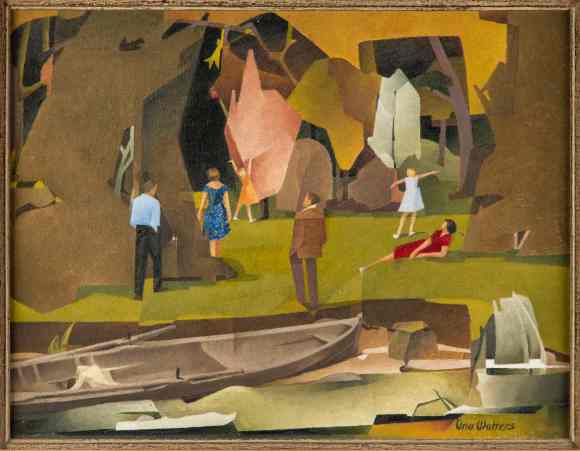
The autumnal hues of The People’s Park completed in the same year (oil on canvas, dimensions unavailable) with its shimmering golden leaves and delicate, balletic branches is a joyful, light-filled composition. This was a place (in Dublin) Una was fond of and she returned to it in 1963 with The People’s Gardens, acquired by the Haverty Trust and now in the Dublin City Hugh Lane Gallery collection. (See blogs May 6 and June 2,2020 and April 12, 2022.)

Next is the luminous moonlit scene in watercolour featuring a lake site near Ballinasloe. Una’s husband, Eugene, claimed The Doghole (dimensions unavailable), completed some time in the mid-1950s, was considered to be the finest of all Una’s river watercolours.  “The picture was quickly blocked in one night as we drifted home downstream after a long fishing trip, & coloured afterwards,” he wrote.

“It is an early picture. . . but it already shows in perfect miniature the style she later developed on her own & which critics found unique.  Briefly, the essence of that style is that a painting should have (at least) two meanings: that. . .while remaining true to the mood and shape of the natural scene, it should have other suggestions built into it – e.g. if you look closely, from a distance, any of the moonlit trees on the left, you will begin to see that they suggest the shape of a dog, with his tail towards the river.  This gives a humorous & dreamlike quality to the whole concept. . .”

The Red Bridge (oil on canvas, 51 x 66cm), depicting a spot on the River Suck, also in Ballinsaloe, is an oil dating from around the same time (1956), in which the river-bank growth is rendered with brush strokes reminiscent of Mary Swanzy and tending towards cubist abstraction. The treatment of the foliage gives the Galway scene an exotic, jungle-like feel, “othering” what might be regarded as traditional subject matter.

The Pine Wood ( oil on canvas, 1961, dimensions unavailable), which appeared in the original 1966 exhibition but didn’t make it into our retrospective, shows Una at her most expressive. Another Ballinasloe location – Garbally Park – the umbrella-like crowns of the trees shimmer in a blurry haze as if the wood itself was on the march, and coupled with the sensuous dips and hollows of the ground, plunges the viewer into a mysterious verdant realm.

In Wild Apples, (oil on canvas, 1964, 56 x 43 cm), which featured in the retrospective earlier this year, the trees have been reduced to sharp-edged geometric impressions, almost like maps of colour on the canvas. (For a more detailed exploration of this work see our blog, June 24, 2020)

Finally, a rare chance to see one of the Emerald Ballroom watercolours that has unfortunately been lost. (See separate page on this site dedicated to the series.) This untitled piece featured on the reverse of one of the watercolours reframed for the 2022 retrospective and so could not be saved. However, the digital image of this and four other reverse images remain. These are another example of Una’s very late work, completed in the first weeks of November 1965 before her death on the 20th of the month.

Here the trees are bare and the outstretched branches have a vaguely supplicant air. Once again, as in her earliest work, there are two trees visible, but unlike Dha Chrann they’re not reaching out, but separated in a washed-out, grey landscape, lending the work a bleak, mid-winter mood and suggesting, perhaps, an eerie sense of premonition.

Mary Morrissy

Categories
News

Una soars with Finglas ravens

Another reason to celebrate Una Watters’ birthday month, is a new sculpture to be launched in Kildonan Park, Finglas, this week that pays homage to Una’s work

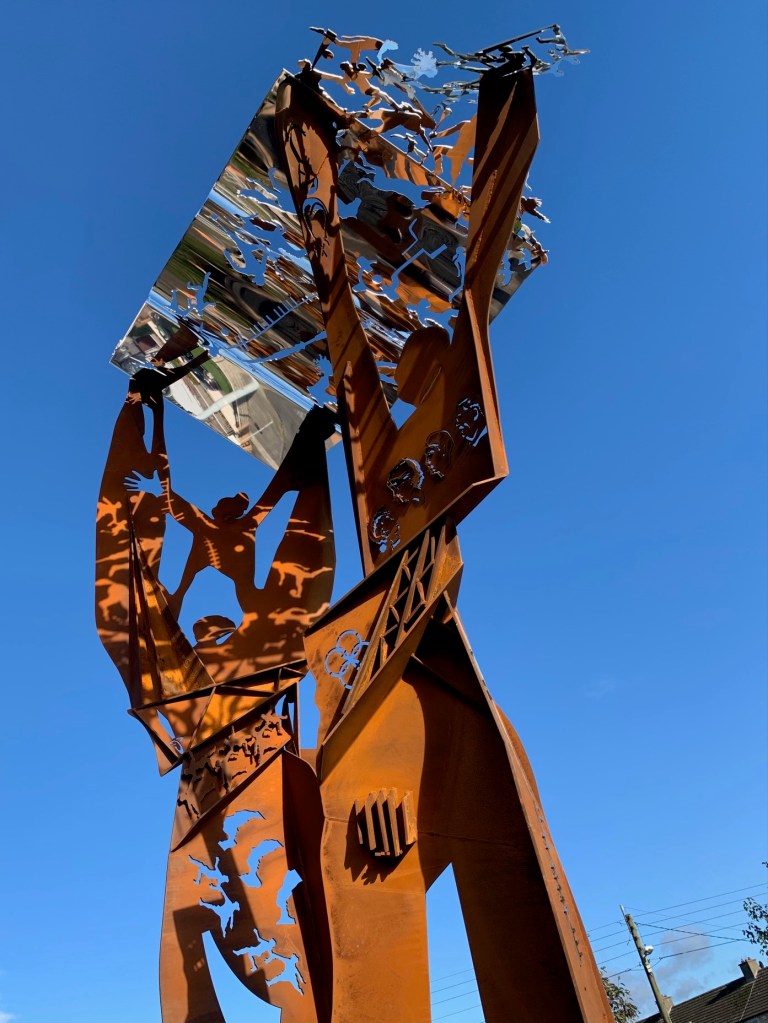
The Bridge: Finglas Ravens Soar, is a seven-metre-tall steel sculpture by Sara Cunningham-Bell, commissioned by Dublin City Council/Sculpture Dublin, for the 20-acre public park comprising two figures with arms raised holding high a mirrored steel ‘river rug’.

The sculpture is a compendium piece, threaded through with symbols and motifs reflecting the artistic and cultural life of the locality – including the figures of running schoolboys from Una Watters’ seminal painting, Cappagh Road, and representations of An Claidheamh Soluis (Sword of Light), the symbol she designed to mark the 50th anniversary of the Easter Rising in 1966 – see elsewhere on this site.

Coincidentally, the sculpture was installed on November 4, Una’s 103th birthday.

Inspired by the Irish translation of Finglas – ‘Fionnghlas’ (clear streamlet) – the sculpture draws on other influential figures associated with the area, such as Sophie Pierce-Healy, an aviatrix who flew her plane, “The Silver Lining”, from Kildonan Aerodrome, Ireland’s first commercial airport in the 1920s, along with celebrated uileann piper Séamus Ennis.

The Kildonan Park work was a ‘participative’ commission. Over the past year, hundreds of local residents have engaged with Sculpture Dublin by taking part in over 40 creative workshops, focus groups, public meetings and other engagement activities related to the installation.

The Bridge: Fiacha Dhubha Fhionglaise ar Foluain’ will have a public launch on site at Kildonan Park on Saturday, November 13, at 2pm.