After the flurry of the presentation of Una’s Girl Going by Trinity in the Rain to the national collection by Colbert Kearney in 2023, things have been quiet on the Una Watters front.
However, this year will see more activity. It’s an anniversary year – 60 years on from her death in 1965 – and hopefully that may see an upswing in Una Watters-related activities.
First development this year is the inclusion of Girl Going by Trinity in the Rain in the National Gallery of Ireland’s diary. Always a beautiful production, this year is no different, and Una appears for the week of May 26, 2025.
The director of the gallery, Dr Caroline Campbell, remarks in the diary’s introduction that Una’s Girl has already become a” popular favourite” among gallery patrons. This makes a trifecta of images the NGI has used of Una’s signature painting – it appeared in last year’s calendar and is for sale in postcard form in the gallery shop. (Speaking of merch, I’m waiting for the gallery umbrella and tote bag!)
As Sara Donaldson author of the notes accompanying the image in the diary writes – “Watters’s awareness of Cubist forms is evident everywhere, while Futurist-inspired ‘lines of force’ represent the sheets of rain, evoking the atmosphere of a wet urban scene.”
Speaking of dates for the diary, I will be doing a lecture – “The Lost Reputation of Una Watters” as part of Ballinasloe & District Historical Society’s Town Talks series in March – more details to come closer to the time.
Meanwhile, I’m on work on a book on Una so if any of you out there have stories or memories of her or Eugene Watters, do contact me via the email on the blog.
First the painting, now the postcard! Una’s Girl Going by Trinity in the Rain, now proudly part of the national collection, got another boost this month with the news that there’s now a postcard of the painting on sale at the National Gallery of Ireland shop.
This fine postcard reproduction also gives the painting the potential of reaching a mass audience.
I’m a sucker for a postcard memento so I’m delighted to know that Una’s striking image has a chance to reach gallery visitors who, like me, enjoy extending the memory of standing in front of the real thing with a pocket-sized reproduction.
Speaking of the real thing, Girl Going by Trinity hangs in Room 15 of NGI, along with several of Una’s contemporaries, Mainie Jellet, Mary Swanzy and Louis le Brocquy.
November is both Una Watters’ birth and death month (born this day, November 4, 1918 – died November 20, 1965). The Dublin weather she depicts here is distinctly Novembrian. Perfect for a calendar!
What about it, National Gallery? Una Watters as November’s calendar girl?
This fine specimen of angelic manhood is a detail from another new Una Watters discovery – as a result of contacts made at an event at Phizzfest earlier this year. It’s an unusual find in that it’s not a painting but a banner made for St Michael’s School in Finglas.
The principal of the school was a Sister Philippa who knew Una’s sister, Maureen McDonnell ( Sister Mel) a fellow nun at the Holy Faith School in Glasnevin. She asked her to approach Una to design a banner for the school on Wellmount Road which had opened in 1959. Another sister, Sister Therese Kearney (95), remembers the request being made.
In the summer of 1960, she has written, the school pupils made their first appearance in Glasnevin grounds for sports day. “They had no banner to represent their school. Sister Philippa immediately asked Sister Mel McDonnell’s sister Una to paint a banner for the school.”
Because the work was done as a favour, rather than being officially commissioned, it has remained, like much of Una’s craft work, under the radar. Although not signed, the provenance is direct with Sister Mel’s involvement in the process and the surviving Sister Therese’s written testimony.
The banner measuring (121.92cm x 91.44cm) depicts the archangel St Michael in Celtic warrior mode, with blonde hair, muscled arms holding a golden spear and shield. His wings are a celestial blue but there’s nothing ethereal about them – they’re robust-looking and rendered in the geometric style that Una used later in her treatment of trees and foliage. There’s no doubt that this is St Michael triumphant – the expression on the archangel’s face is serenely confident – although there’s no sign of the dragon. Instead, Una’s St Michael appears to be standing on a chain, a nicely abstract rendition of his liberating powers.
As well as designing it, it’s probable that Una, an accomplished seamstress, also made the banner and trimmings herself. St Michael is painted on what looks like calico and backed with dark green silk. The border with a Celtic barley twist design runs all the way around with a golden fringe at the bottom. Five fabric hooks allow it to be attached to a mobile wooden frame, a neat combination of function and design.
The banner is not just decorative. The school principal, John Barry, explains that it is used regularly in school ceremonies – graduations, sports days and to mark the opening of the school year when the head girl hands it over to the incoming sixth year class. The school currently has 630 pupils.
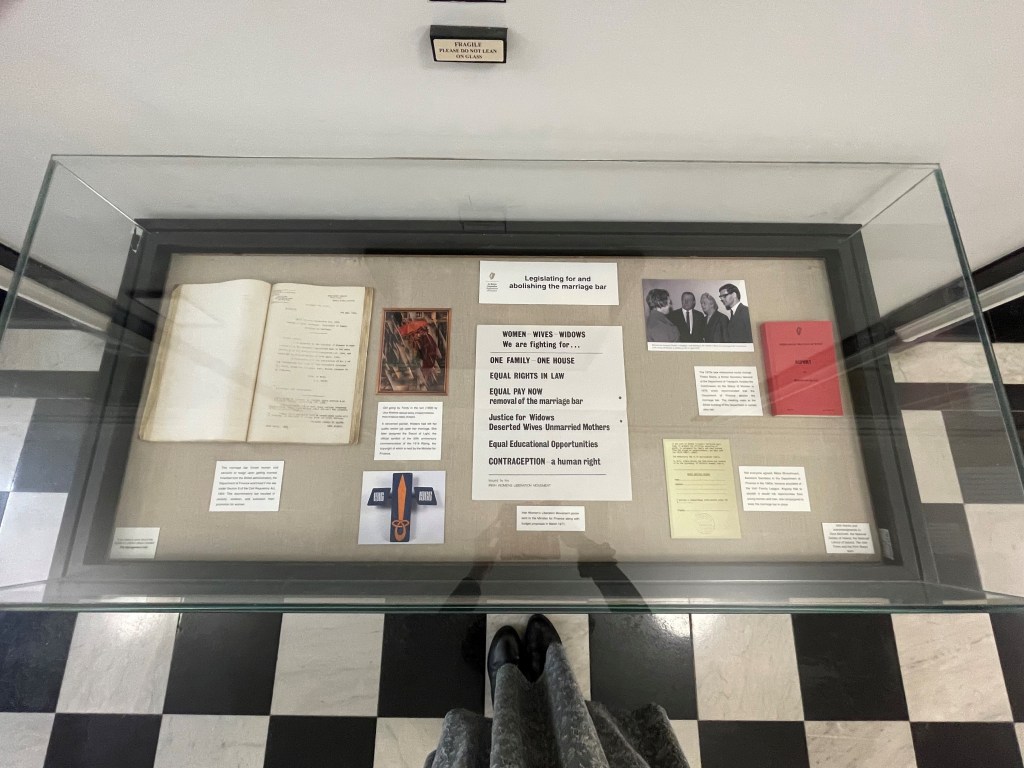
Meanwhile Una and her work is also referenced in a historical exhibition within the halls of the Department of Finance. Archivist Cliodhna Walsh was involved in organising it to mark the lifting of the marriage bar for female civil servants 50 years ago in 1973.
Like many women, Una was forced to leave her job in the library service when she married Eugene Watters in 1945. The ban on working probably gave Una more time to pursue her art, but it also meant she had to use her art to generate income, hence some of her illustrative and calligraphic work covered elsewhere on this site.
“As important as it is to remember how the marriage bar wrenched so many women away from public life, it is also lovely to acknowledge the vibrant artistry of a woman who contributed much to Irish culture,” Ms Walsh has observed about Una’s contribution to the exhibition.
A reproduction of Una’s Girl Going by Trinity in the Rain features in this private exhibition as well as images of her design for the 1966 Easter Rising emblem based on the Sword of Light. Because this was entered in a public competition, the design copyright rests with the Department.
Catch up on Una Watters at Phizzfest where I’ll be giving an illustrated lecture – “Una Watters: Total Eclipse”- which will look at her work in context and explore the reasons for her retreat into invisibility.
Raining Una Watters, that is. We’re delighted to be able to announce that the Una Watters’ painting, Girl Going by Trinity in the Rain (1959, oil on canvas, 61×81 cms), is now part of the National Gallery’s collection, thanks to the generosity of its owner, Colbert Kearney.
Colbert was gifted the work by Eugene Watters after Una’s posthumous exhibition in 1966. He was a pupil of Eugene’s at St Fergal’s National School in Finglas (see Colbert’s guest blog, “Portrait of E.R. Watters”, June 17, 2020) and they remained firm friends until Eugene’s death. It was always Colbert’s intention to pass the painting on but after last year’s retrospective (March 10 – April 2, 2022 @ the United Arts Club), the idea of donating to the NGI seemed like the logical next step.
Girl Going by Trinity is a quintessentially Dublin work – the Trinity College location makes it so – and the driving, sleety rain will be a familiar meteorological trope for anyone who has known winter in the city.
As Colbert’s partner, I’ve lived with this work for over 20 years, and it’s the work that inspired my quest to locate as much of Una’s work as possible, and the decision to mount Una’s retrospective last year with Sheila Smith, her niece. The idea was to bring Una to a wider audience and to the forefront of artistic attention. We hope that the NGI’s acquisition of her work will cement that progress.
The opportunity came at a reception for the Sarah Cecelia Harrison Inaugural Essay Prize sponsored by the gallery last November. My essay on Una reached the final three (See “Una takes her place”, November 25, 2022). At the reception Colbert had a conversation with the director of the ESB Centre for the Study of Irish Art, Donal Maguire, and enquired if the gallery would be interested in having an Una Watters in the collection. I think Donal wondered if it was the cheeky white wine talking, but once he was assured that Colbert was serious, the process only took a few months.
In late January we had to say goodbye to the painting, so it could go before an acquisitions committee. At that stage, we didn’t know if it would be accepted or if we would see it again (although of course we sincerely hope we will see it again on the walls of the National Gallery!) so we spent much of the early new year savouring our time with it.
We moved it to a new spot – hung lower than usual. (I got this idea from sculptor Corban Walker’s exhibition As Far As I can See at the Crawford Gallery (Oct 15, 2022 – Jan 15, 2023). Along with his own work, Walker chose 30 works from the Crawford Collection to show. Because of his restricted stature, Walker hung the works lower than normal and it afforded a much more intimate relationship with the paintings.)
Now at eye-level, there were still new things I was seeing in Girl Going by Trinity in the Rain – its complex treatment of light, the quivering rain drops (impasto dashes of white paint) on the tips of the umbrella, the life-like animation of the Goldsmith statue beside the flesh-and-blood young woman who appears paradoxically monumental, the misty illumination around the girl’s ponytail.
I’d never noticed before the proliferation of verticals in the work – the stick of the umbrella, the railings, the balustrades – and how the rain itself is architectural in its form like literal stair-rods. The patterned geometry of the stone work leans close to abstraction; even the half-belt on the girl’s coat looks solid, brick-like, as if she’s melding with the building, her face full of sharp architectural planes.
I could go on, but I won’t, or I’ll get lonesome for it! And there’s nothing really to mourn. The painting lives.
Girl Going by Trinity in the Rain joins its sister work – The People’s Gardens (1963, oil on canvas, 40.6 x 50.8 cms) – which is already in the Dublin City Hugh Lane Gallery collection (See Logan Sisley’s guest blog May 6, 2020). It means Una Watters’ name is enshrined in the national cultural memory, where it belongs.
Although the Hugh Lane organised private viewings of their Una to coincide with our retrospective last year, they wouldn’t lend The People’s Gardens, and it’s a very long time since it was on public display in Parnell Square.
Both of these works deserve to be widely seen. So next time you’re in either of these galleries, ask about their Una Watters works; it’s possible to see them by appointment. After all, they belong to all of us now.




 Una Watters (1918-1965)