Categories
Una in focus

The Three Graces in Malahide

una-watters-malahide

Mary Morrissy considers the joint imaginative territory that Una Watters shared with her poet husband, Eugene, epitomised by today’s featured painting, Malahide. 

Malahide, Saturday.  Clouds come

Henna with heat.  Salt and sun

Leave all flesh lazarous –

So wrote Eugene Watters  (Eoghan O’Tuairisc)  in “Smithson’s Glimpse of the Three Graces” a long poem published in PEN magazine in September 1961.

It’s almost a perfect transcription of his wife Una’s painting, above, Malahide (oil on canvas, dimensions unknown) except that Una’s painting was not completed until 1964, three years after Eugene’s poem was published.

Smithson, the speaker of the poem, a barber, is on his afternoon off at the beach “within the shadow of his wife stretched” – very much as the horizontal figure on the left of the painting.  “Drowses with one leg in the sun/Lazily like Italy on a warm day,”.  While his wife knits – see the grey-haired woman in the black-and-white patterned dress with her knitting bag clearly visible on the sand – Smithson fantasises about the three young women who pass by loudly chatting – “Calling Freda for Christsake to hurry”.  He imagines them as the three Graces, Alglaia (elegance) Thalia (youthful beauty) and Euphrosyne (mirth).

When two artists live and work side-by-side as Eugene and Una Watters did for over 20 years, it’s inevitable that their creative impulses would become entwined. And nowhere is this seen more clearly than in Malahide.

Eugene’s work often drew on classical allusions – the poem’s epigraph is from Ovid and Smithson equates his own sense of isolation with the Roman poet’s lifelong exile. He also references the “lacrimae rerum” line from Virgil’s Aeneid (Book 1, verse 462)  –  “sunt lacrimae rerum et mentum mortalia tangunt” translated by Séamus Heaney as “there are tears at the heart of things”.

This melancholy imbues the poem  – “Drowning is as lonely an experience as living” – as does Smithson’s sense of being at odds with the mundane world around him.  That said, the Three Graces Smithson spies (or conjures up)  on the beach at Malahide seem to spring fully-formed from Una’s joyous painting.

Typists like graces coming together,

From the Four Courts, the King’s Inns,

Loosed and let go.  Towels trailing,

Uncertain and half-naked go

The great mothers of mankind. 

Look at the three girls in their bathing costumes who draw the eye deep into the painting, towels aloft or trailing, tiptoeing on the hot sand. Don’t they fit the description of  Eugene’s Graces? However, Una’s expressive use of movement seems intent on giving us the character of these girls as girls, rather than as metaphors. The sprawled “Smithson” figure, likewise, or the young mother in red who cradles a white-clad baby trying to pacify it.  Or the  two children at her feet who are bent to the serious work of building  sandcastles.  Although each “character” seems to invite a story, their features, as in many of Una’s paintings, are effaced.

Perhaps they are inspired by real people as Una’s other group compositions in public spaces have been? Una might well have played with the dramatis personae of Eugene’s poem and inserted herself into the painting, as she often did, in the figure of the woman in the sand-coloured dress reading, while the dreaming, outstretched man might be Eugene – just as Smithson stands in for him in the poem.

Either way, Una’s painterly concern here seems to be the thing itself.  (The pragmatic titling of her paintings shows us that  –  The People’s Gardens, Woman Sewing, The Flute Player, The Game of Chess.  They do exactly what they say on the tin.)  Here it’s the depiction of a summer’s day at the beach.  There’s the saturated blue of the sea, the white sailboat, the tossed flecks of gulls (“birds rise to the life of the wind changing”), the cratered, undulating dunes scattered with towels and discarded clothes. And peeping from the reading woman’s brown satchel, a flask and maybe sandwiches for later?

Although not completed till 1964, Una’s Malahide could have been several years in the making, sitting on the easel in the kitchen at Cappagh Cross, providing a subconscious terrain as Eugene wrote the poem. Or conversely, perhaps Una created on canvas the Malahide backdrop Eugene suggested in his Ovid-inspired modernist lament, and then peopled it with the characters he described after reading the poem?

Or is this a re-enactment of an actual day they shared at Malahide, a day enshrined in memory and responded to by each of them in their own individual way?  For Una, a day of simple pleasures at the seaside, harmonious, full of recognisable types and some familiar faces: for Eugene, a springboard for the classical fugues of a brooding, mid-century man alienated from the world.

Generations go by shouldering death,

Time winks like cuts of scissors,

He lies on the backbone and suspects a sky.

The medium is crisscrossed with dawn and evening,

Complex tranquility;”

Mary Morrissy

Categories
Una in focus

Wild Apples

wild-apples

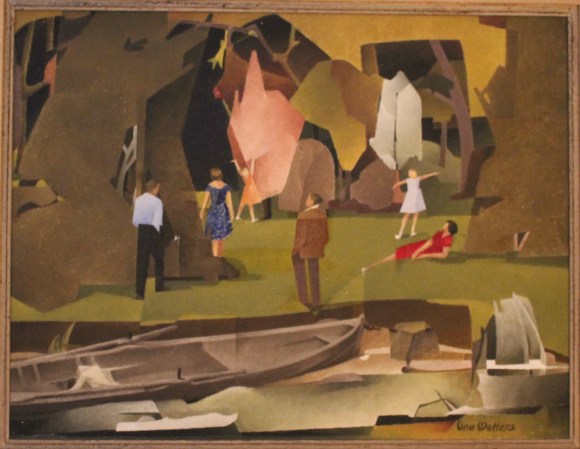
Today’s featured painting is Wild Apples completed by Una in the autumn of 1964, which  records an idyllic time in the artist’s life, writes Mary Morrissy

Like much of Una’s work, Wild Apples (oil on canvas, 56 cms x 43 cms) depicts a place that was important to her – the banks of the River Suck near Ballinasloe.  Una spent many summers on the river, where along with finding inspiration for her work, she did a great deal of fishing.  She was, by all accounts, an expert fisherwoman, one of her many practical skills.

This is also very much a family painting. Una often placed herself in her own works and here she is the reclining figure in red in the mid-ground of the painting. Her husband, Eugene Watters – discussed in last week’s blog by Colbert Kearney – is on the left in the white shirt.  His brother, Tom, is in the front foreground dressed in brown and with his back to the viewer. Tom’s wife, Bridie, and their two daughters, Georgina and Linda, complete the scene.

Georgina Donovan, Eugene’s niece, has been in touch to correct my initial mistake in wrongly identifying Eugene and Tom in the painting.

“The stances, the head shapes and indeed the clothes suggest to me that the man in brown is my father. Una used family as subjects so often in her paintings and it is just the angle of the head, the curve of a spine, a gesture caught with her brush that reminds one of the subject,” Georgina writes.

“I remember very vividly the day we discovered the crab apple tree beside the river, gathering the apples and taking them home to make crab apple jelly.”

The depiction of nature, and in particular the rendering of the trees, has much in common with The People’s Gardens discussed elsewhere on this site – see Logan Sisley, May 6. Here the angularity melds into abstraction, the trees becoming structural  impressions of colour.  These and the use of shadow lend a mysterious depth to the orchard or woods in the background.

The pink tree towards which the eye is drawn, hosting the wild apples of the title, is no more than a geometric block.  Its sharp apex mirrors the delighted gesture of the girl in the apricot dress who has spotted the apples.  We’ve spoken before about Una’s gift for expressive gesture which animates the figures in her paintings.  Their faces are often not visible or are not depicted in detail, but their characters are communicated through their physical stances.  We see it here again in the gambolling of the second child in the white dress – whom Georgina Donovan identifies as herself.

Because Eugene was a writer, we can get some notion of Una’s process from his correspondence. He was an inveterate letter-writer and he described the inspiration for this painting in a letter of October 1966, written a year after Una’s death.  The idyllic symbolism of the place for both of them is clear.

Wild Apples. . . represents any river, any landing, any discovery: but it is a real river, our Suck; an actual landing and landing place, in a grove of bog-ash and hazel in the wilderness near the mouth of the Killeglin river; and an actual discovery, the flush of crab-apples among the leaves and the delight of the children.  A real moment in time and place.  Moments, in fact.  Our river-years.  Recollected in tranquillity.  And understood, by the dreaming brush, in paint.

The colour-construct, and the grouping, convey the thematic design; a sestet of apperceptions of the apple-flush – 6 real people transmuted; the two children, the father and mother, the artist (reclining, in red), and myself . . .  The boat in the picture is a real boat.  Ours.  But it is transmuted, the anatomy misted over in the dream of composition, till it emerges as a long thin nose pushed into the secluded creek.  Base of the picture, the Archetype, in dream-grey.

 “Above, the children stretch their arms in delight and desire of the wild-ripe fruit: And ye shall be as Gods.  The adults, farther back, stand half-attenuated, stilled by some stir of memory, dimly aware they are on the verge of some revelation, the dress and drab riverclothes are half-transfigured, on holy ground, glimpsing the merest tinge of the quintessential red.  But the real red of the picture, the Artist reclining, entranced by the remembered scene – Look! – draws the whole composition together, and (unknown to herself) forms the colour-climax and heart of the Aisling.”

Eugene’s letter also provides us with a pen picture of Una’s personality.  She was, he says, very beautiful, hard-working, humorous, humble and sincere.  “She knew about boats: she could pull one, patch one, cut out thwarts and knee-pieces. . . She had trained hands, could handle a trowel or an electric saw as well as a paintbrush or a pair of oars.”  

This gifted pragmatism extended to, and informed, her approach to painting:

“Una never set out to paint symbols, or archetypes.  These are abstract formulations, fashionable and useful terms for criticism and psychology, which had little meaning for her, and bear about the same relation to practical art-work as Theology does to the Creation.  She thought sensuously, in terms of real people and common objects, actual streets and river-reaches, forms, textures, colour-tones, and transitions of light.  Her sketchbooks and studies over the years reveal the wealth of observation and hard work which lies behind her wonderful last paintings.”

Una’s varied professional background  – her work as a commercial illustrator and a set designer  – also gave her, according to Eugene,  “the discipline of abstraction and the functional aspects of design.  It is all this that makes the poetry of Wild Apples possible”.

Wild Apples was sold at exhibition in late 1965.  Like the Arts Council award for her winning design of the Easter Rising Jubilee symbol, the cheque from the buyer arrived after Una’s death.

Mary Morrissy


Categories
Una in focus

Portrait of Eugene

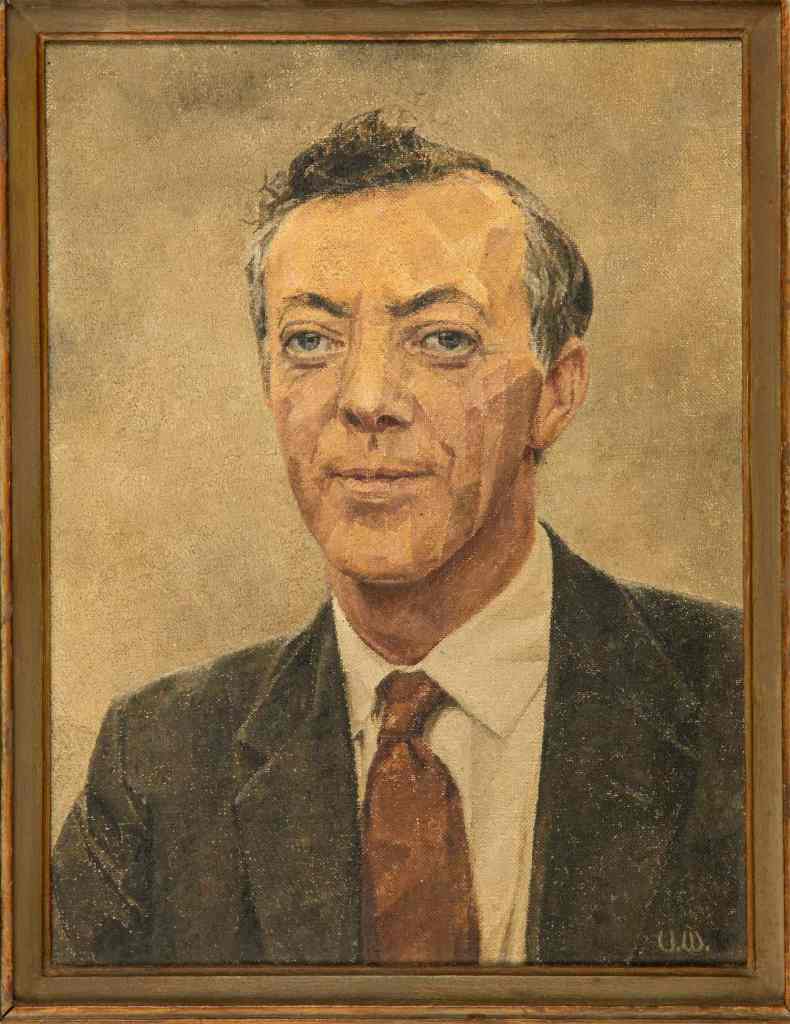
Colbert Kearney, a pupil and a long-time friend of Eugene Watters, remembers seeing Una’s portrait of her husband in the making when he visited their home in the early 1960s.

I remember this portrait, E. R. Watters (oil on canvas, 1965, 33 x 43 cms) emerging on Una’s easel in Cappagh Cross and admiring her ability to conjure up such a convincing image of a man I had been familiar with since—some seven years earlier—he had taught me during my final year in St Fergal’s Boys National School on the Cappagh Road in Finglas.

Seeing it again more than half a century later was a Pygmalion moment: I expected the image in the frame to turn and talk to me, so miraculously had the artist captured not only the appearance but also the essence of the man at a crucial stage in his career.

Una had been married to Eugene for 20 years and probably knew him better than he knew himself.  Not having children of their own, they spent most of those years in the Arcadian tranquility of her native place in the countryside beyond Finglas, the remainder in and around Eugene’s native Ballinasloe.  Otherwise they lived quietly and for each other.  And for their respective art – his writing and her painting.

Teaching had not been Eugene’s chosen profession.  An obviously brilliant student, he had won a scholarship to University College Galway and must have thought his dream of studying his beloved languages—Greek and Latin, English and Irish—at the highest level had come true.  But his family could not afford to maintain him in Galway and he had to settle for teacher training in Drumcondra.  He never forgot the heartbreak of the scholarship forgone, never lost his love of learning, could never conceal a degree of disdain for academics.

A consolation during these years of Emergency, (1939-1945), was his service as  a commissioned officer in the National Army.  He was immensely proud of this role and was married in his uniform.  For boys who were eager to learn he was a wonderful teacher; the others kept their heads down in order to avoid military discipline Lieutenant Watters was not above imposing in the classroom.

He could never forgive teaching for taking the time he wanted to devote to writing.  His first major success had been as Eoghan Ó Tuarisc in the Oireachtas literary competitions but soon this was matched by the work of Eugene Watters.  While working away, Eugene and Una shared a relatively secluded life, avoiding the pubs and cliques of Bohemian Dublin, but this changed when Alan Figgis published first Eugene’s novel,  Murder in Three Moves in 1960, and in 1964, his long poem The Week-End of Dermot and Grace and his Irish collection Lux Aeterna.

He had emerged on to the main stage and could contemplate to bidding farewell to the  classroom.  Many cautioned him against trading his permanent pensionable post for the vicissitudes of full-time writing but Una, knowing his mind better than anybody else, was a solitary voice of support.

And that is when she has caught him in this portrait, dated to 1965.  At 46 he’s conscious of being close to the height of his powers, knowing that the poems published in the previous year constituted an unprecedented, bilingual achievement.   Nor is there anything amateur about this man of letters.  His demeanour, especially his eyes, are those of a soldier whose discipline has seen him through a long campaign, of a Platonist who has seen into the life of things.

But not even he could see what a happy chance it was that Una had seized the moment when she did.  Within a year she was dead and Eugene—soon unrecognisable from the confident figure of the portrait—was about to spend some grim years in the wilderness, an Orpheus search of his Eurydice, repeating with a new conviction a favourite quotation from Herodotus:  to theion esti phthoneron.  The gods are envious.

eugene-and-una-wedding

Eugene and Una on their wedding day, March 10, 1945

Categories
Una in focus

The Bridge of Time

It’s always exciting to come across a “new” Una Watters – at least new to us, particularly almost a year-and-a-half into our quest to trace  Una’s extant work.

The original call we ran for Una’s paintings in an article in the Irish Times in July 2019 produced quite a flurry of work; similarly, the March 2020 edition of the RTE Nationwide programme and the Liveline radio programme around the same time, but since the COVID-19 pandemic, everything had gone very quiet.

Then, last week, just when we thought the 10 untraced works from Una’s 1966 exhibition – see elsewhere on this site – were going to remain stubbornly elusive – one of them, miraculously,  turned up.

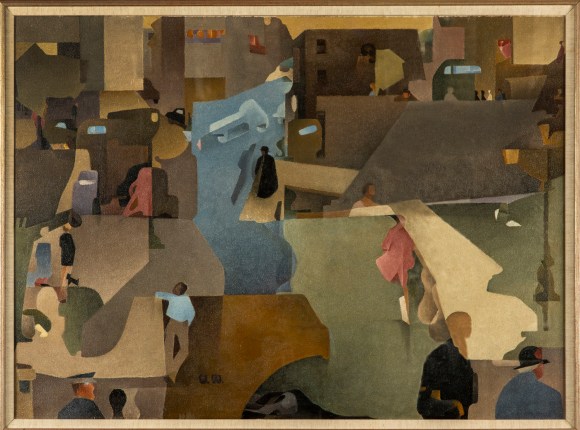
City Bridge (oil on canvas, 55 x 75cm ) was painted some time in 1965, the year of Una’s untimely death.  It was a very prolific year for Una as it turned out.  She completed five major oil paintings that we know of, as well as designing the Easter Rising Jubilee symbol after winning an Arts Council competition for the commission.  (Poignantly, Una’s sister, Sheila Byrne, recalls that the award and prize money arrived on the day her funeral cortege left for Ballinasloe for burial.)  In the weeks immediately before her death she also completed a set of experimental watercolours – see “The Emerald Ballroom Watercolours” page on this site.

City Bridge was exhibited in the Oireachtas exhibition of 1965 with a price tag of £35.  Whether it was sold then or not is not clear, but it’s unlikely. The painting appeared in the 1966 memorial exhibition organised by Una’s husband, Eugene, a year after her death.  There was no owner attribution in the catalogue, so it’s likely it was gifted, like much of Una’s work, to a friend or acquaintance after the 1966 show.

Where it’s been since then is a matter of speculation but we now know that it was acquired in the early 2000s by the late art dealer Seán O’Criadain, along with another of Una’s paintings, Meditation (not featured in the 1966 exhibition).  Meditation was subsequently sold at auction but O’Criadain held on to City Bridge.

O’Criadain was a legendary figure in the Irish art world (as well as being a poet, literary editor and Harvard lecturer) who championed, in particular, artists of the late 19th and early 20th centuries such as William John Leech, Harry Clarke and Roderic O’Connor, long before it was fashionable. Una’s painting has remained in O’Criadain’s collection and we’re grateful to David Britton and Peter Lamb for alerting us to the fact.

Having not seen the painting itself, due to current circumstances, it’s probably not fair to comment on it, but from the image it’s certainly one of Una’s more complex and enigmatic works. The bridge motif  is clear in the jigsaw-like quadrants of colour she employs  – dove-greys, moss greens and various shades of blue.  This geometric patterning was a feature of her later work, but here it’s used in a much more abstract way. In its style and colour palette, Una seems to be harking back to a kind of fluid pre-cubism.

The bridge of the title is fragmented, broken-up, dismembered. The shafts of shadow – or is it stone? – seem to be in balustrade shapes, and the river seems to dive into the layered grey city that crowds the background in shortened perspective.

Una’s characterful figures animate the painting as usual  – the idling, dark-skinned boy in the left foreground lolling against the bridge parapet, the policeman – or lockhard? – in his peaked cap in the left foreground, the white-haired matron with the serious hat on the far right.  But there are other more enigmatic figures.  Who is the jaunty man in a pink coat with flying tails and the hint of a tricorn hat who looks like a refugee from the  regency city?  The figure in the black bowler hat and cloak in the centre of the canvas also looks distinctly anachronistic.

The blocky curvature of the upper-decks of buses suggests this has to be Dublin, as does the street furniture – look at that lamp standard. But which bridge is it?  Or is it an amalgam of all the city’s  bridges?  Or is it none of them?

Or is this the bridge of time itself linking the city of the present to the past?

The thoughts of Leopold Bloom in Joyce’s Ulysses at the funeral of Paddy Dignam in Glasnevin cemetery come to mind: – ‘How many! All these here once walked around Dublin. Faithful departed’.

Mary Morrissy

Categories
Una in focus

Social distancing in the park

la grande jatte

harry-kernoff-the-peoples-garden,-phoenix-park-dublin

Mary Morrissy, curator of this site, takes a wander in the park and sees influences of Seurat and Kernoff in Una Watters’ The People’s Gardens (1963)  

Three park views, three different painters.  Una Watters painted the third of the sequence here, The People’s Gardens (oil on canvas, 40.6 x 50.8 cm) in 1963 but as a keen student of art,  it seems inevitable she was familiar with the other two – Georges Seurat’s Sunday Afternoon on La Grand Jatte (1886) and Harry Kernoff‘s People’s Gardens (1945).

Harry Kernoff  (1900-1974) was a near contemporary of Una’s and The People’s Garden, Phoenix Park Dublin (oil on board ,13.5 x 19.5 cm) was painted on the same site in 1945, nearly 20 years before Una’s.  Apart from the location it’s possible to see other influences, particularly in the animation of the figures and the way the shadows are rendered.  Kernoff and Una would certainly have known one another’s work through RHA exhibitions.  They showed together at least once in an Oireachtas exhibition in October 1965, where Una’s Sean Tithe (see in Uncatalogued Work on this site) appeared alongside work by Kernoff and two of  Una’s mentors,  Maurice McGonigal and Sean O’Sullivan. harry kernoff - st stephen's green

O’Sullivan was Una’s cousin, and would have been another link between her and Harry Kernoff.  (It’s recorded that Kernoff painted his 1936 St Stephens’ Green,  from a perch at the window of O’Sullivan’s studio at 126 St Stephen’s Green; see right.)

As well as a shared colour palette, Una’s and Kernoff’s paintings of the People’s Gardens  seem similarly motivated. Here are ordinary people observed in leisure, although Una’s rendering keeps its distance and is more stylised than Kernoff’s up-close, jaunty realism.  Artist Michael Kane writing in the Irish Arts Review described Kernoff as painting “the world around him as a kind of earthy, egalitarian paradise, and celebrated its gaiety and diversity with unapologetic optimism”.

That description would not be out of place when looking at Una’s urban work such as The People’s Gardens or Cappagh Road, discussed in an earlier blog on this site.

But Una’s The People’s Gardens also owes a major debt to Seurat’s 1886 pointillist masterpiece, A Sunday Afternoon on La Grande Jatte. In this work, now housed at the Art Institute of Chicago,  Seurat depicted the haute-bourgeoisie of Paris, statuesque matrons with their bonnets, bustles and brollies, accompanied by their prosperous, top-hatted gents and polite children, taking the air on the fashionable side of the Seine, dressed in their Sunday best.  The figures in Seurat’s painting stand, as one critic has described it, with the “solemnity of sculptures of the Parthenon”.

bathersCompare them with the figures in Seurat’s  Bathers at Asnières (1884) on the left here  – at the National Gallery London – which the painter saw as a companion piece to La Grande Jatte.  He imagined the two works  hanging side by side almost in a dialogue with one another. The male figures in the Bathers are working-class labourers lounging on the bank or immersing themselves in the waters of the Seine on a white hot muggy day,  with the chimneys of factories smoking in the background. All of the figures are gazing towards their right – at the more fashionable side of the river where the viewer can imagine the posher denizens of La Grande Jatte are strolling. The little boy on the extreme right waist-deep in the water with the red hat could even be cat-calling at his “betters” on the other bank.

The democratic spirit in Una’s The People’s Gardens depicting everyday people enjoying a day of leisure at a municipal facility, are more akin to Seurat’s Bathers. But there are definite painterly echoes of La Grande Jatte in Una’s composition.  Look at that sturdy little girl in yellow chasing a ball in the left foreground of Una’s painting; isn’t there an echo of the more sylph-like girl in red, skipping in the mid-ground of Seurat’s master-work?  The kite-flying figure in blue in full flight in the background of Una’s work is mirrored by the man in Seurat’s mid-ground left,  dressed in a rust-coloured suit with his spy glass raised. There are those pooled shadows again, and Una’s trees, with their solid angularity, have something of the same abstraction as Seurat brought to the pointillist cushions of foliage crowning his trees.

Sheila Smith, Una’s niece, has observed that Una liked to place people she knew – and sometimes herself – into her paintings.  In The People’s Gardens, Sheila has identified the elderly couple on the path, one of them leaning on a walking stick, as Una’s parents.

The location of both Una’s and Kernoff’s painting is an area of the Phoenix Park in Dublin originally called the Victorian People’s Flower Gardens. It was a site Una had already painted in The People’s Park, below, a watercolour from 1943 and she returned to it in 1963 with The People’s Gardens, now housed in the Hugh Lane Gallery.  (Logan Sisley, acting head of collections at the Hugh Lane Gallery,  has written elsewhere on this blog about the painting.)

The Gardens were initially established in 1840 as the Promenade Grounds and consist of about 22 acres.  They were set up to display Victorian horticulture at its best with ornamental lakes, a children’s playground, a picnic area and formal bedding schemes. The statue that’s visible in Una’s watercolour, below, may well be the bust of executed 1916 leader Seán Heuston, a memorial in stone executed by sculptor and painter Laurence Campbell and erected in the park in 1943.


The People’s Park (1943) Una Watters; Statue of Sean Heuston (credit William Murphy); early 20th century postcard of the People’s Gardens, Phoenix Park.