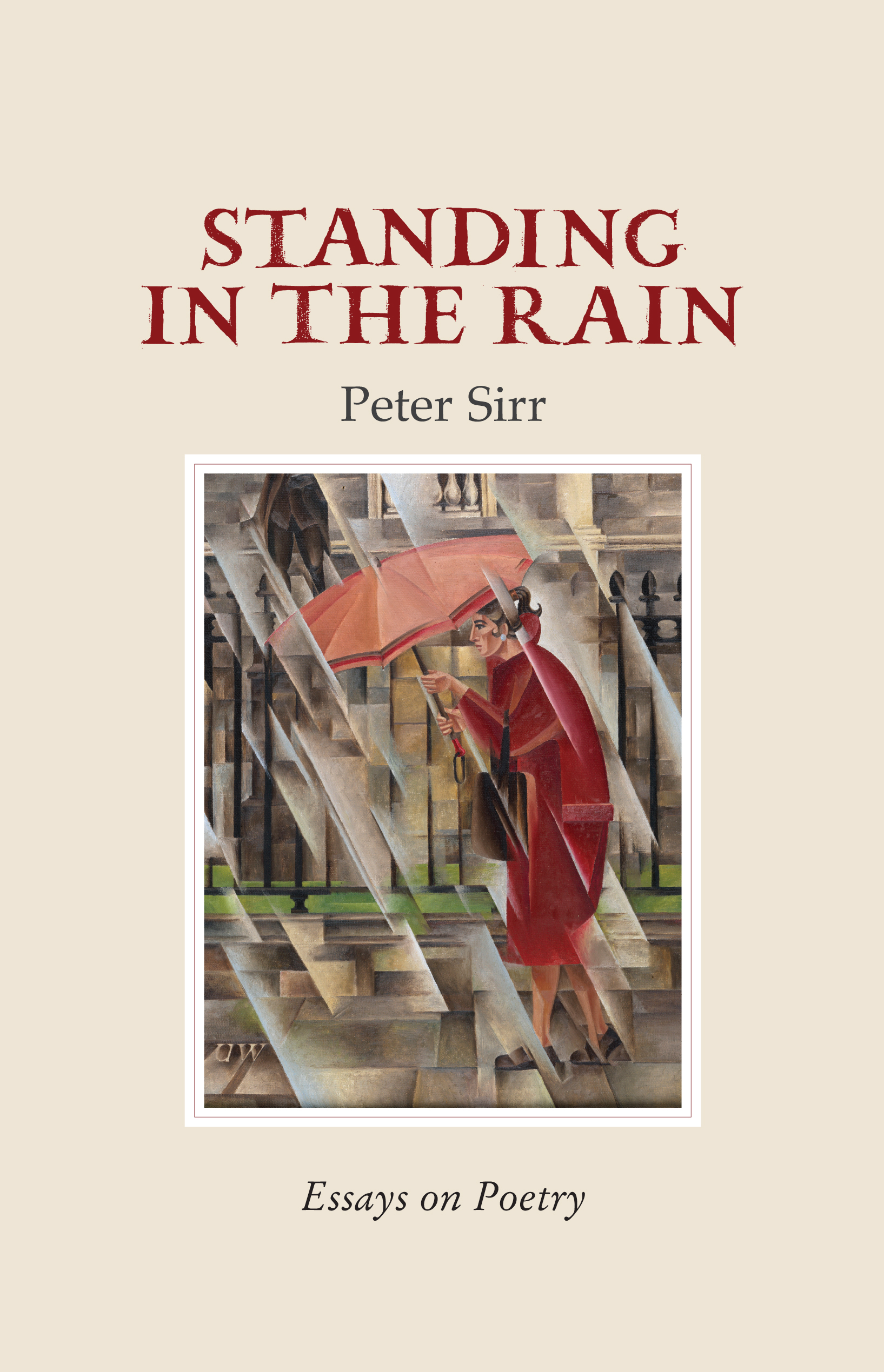
Una Watters’s Girl Going by Trinity in the Rain features on the cover of poet Peter Sirr’s latest book of essays, called appropriately enough, Standing in the Rain. It’s a perfect marriage of content and image. Sirr’s reflections on poetry includes Randall Jarrell’s observation that a good poet ‘is someone who manages, in a lifetime of standing out in thunderstorms, to be struck by lightning five or six times’. Una’s “Girl” is undergoing such an immersive experience set against Trinity’s landmark facade, under the gaze of the Anglo-Irish poet Oliver Goldsmith and, of course, being unmercifully rained upon. The lightning bolts may be missing, but they’re in the artistic gaze.
Thanks to Peter, a Dubliner like Una, and Gallery Press for choosing the painting – now happily part of the national collection but not on show at the NGI at the moment. It’s a gentle reminder of what a striking work it is.
Peter’s book, along with John Banville’s play, The Gold Standard, and Kevin Graham’s poetry collection, Daylight Mystery, will be launched at Notre Dame Dublin, 58 Merrion Square, Dublin on Thursday September 24 @ 6pm.
Meanwhile, lucky Culture Night vultures got a chance to see Una’ Watters’ The People’s Gardens last Friday night when the Mansion House threw its doors open for impromptu tours. The painting is on loan from the Hugh Lane City Gallery – currently closed for renovation – and hangs in the Blue Room/The Lady Mayoress’s parlour. This is a room not generally open to the public which means it’s only accessible on occasions like Culture Night.
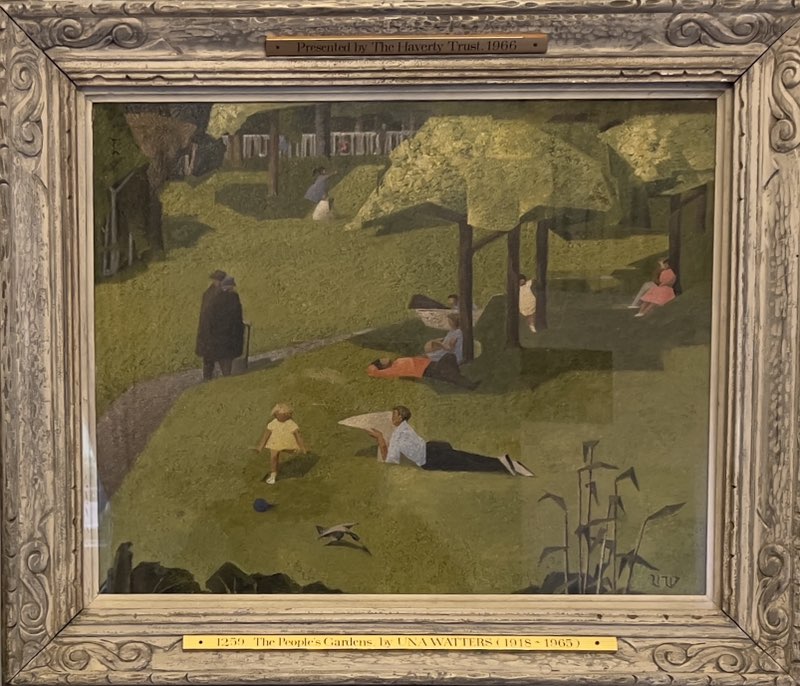
The People’s Gardens dating to 1963 depicts a slice of Dublin’s public life in the gardens which are part of the Phoenix Park demesne. It was subsequently acquired by the Thomas Haverty Trust and donated to the Hugh Lane. The Trust was established to facilitate the purchase of paintings by Irish artists for public galleries and institutions. Between 1935 and 1966, it donated over 40 works to the Hugh Lane including paintings by Swanzy, William Leech, Brigid Ganly and Maurice MacGonigal (who encouraged Watters in her art studies).
As Logan Sisley, Acting Head of Collections at the Hugh Lane, noted in a blog on this site (The People’s Gardens: May 6,2020) the painting is typical of Una’s work with the trees and figures pared down to angular forms. “This shows the influence of earlier modern art movements such as Cubism and Futurism, albeit interpreted in her own style. Her clever use of shadows adds depth – notably under the trees and in the figure of the girl kicking the ball, the man reading a paper and the duck taking off (or landing). These also demonstrate a keen observation of people and an eye for detail. The strong shadows and summer dresses suggest a warm sunny day, yet the elderly couple walking arm-in-arm on the path are still dressed in heavy coats and hats.”
The painting hasn’t been shown in Parnell Square since the 1970s although, according to gallery records, it was on loan to the City Hall between 1969 and 1974 and again in the 1980s. It was also hung in the ILAC Centre Library in 1987 along with a number of other works from the Hugh Lane, including Harry Kernoff, John Leech and Lizzie Stephens, all of them depicting scenes of Dublin.
It was given on long-term loan to the Mansion House in 2023 on the request of the then Lord Mayor. However, its present home is only semi-public. It’s not possible to walk in off the street and view the work as you could if it were in a public gallery. So it’s hiding in plain sight.
Now that Una has four paintings in the national collection, thanks to generous donations, it would be great to see this one being shown alongside the others recently acquired by the NGI as a showcase of Una Watters’ growing body of recognised work.