Categories
Una in focus

Una’s underworld

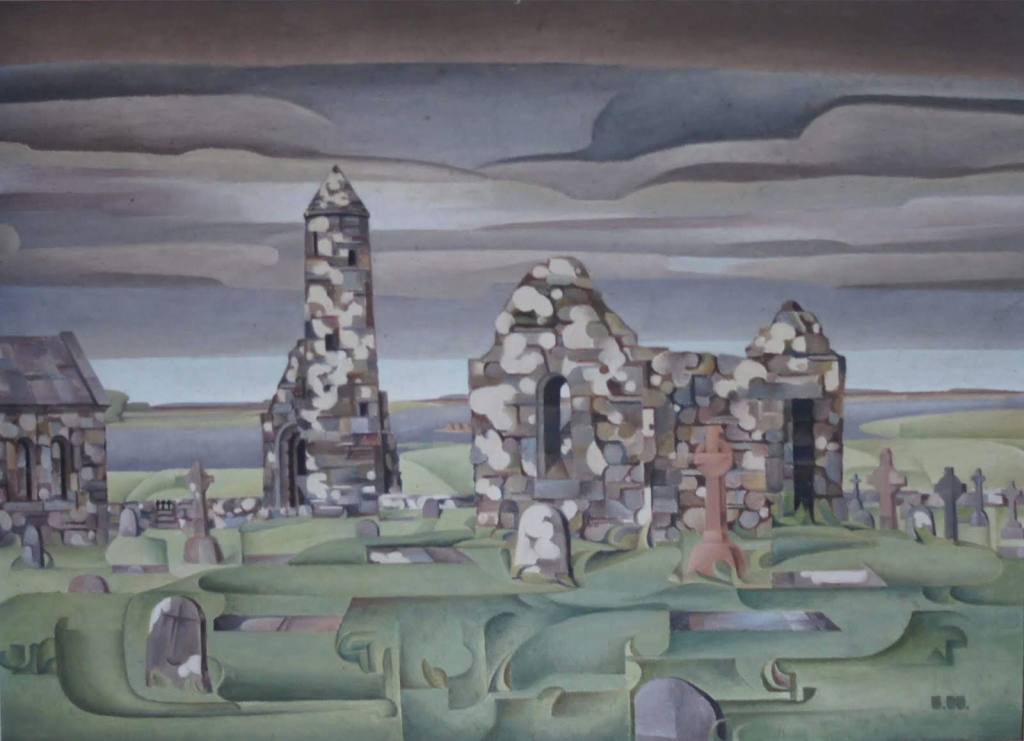
At first sight, Una’s 1958 depiction of the sixth century monastic site Clonmacnoise (oil on canvas, dimensions not known) seems straightforward enough. It’s a partial view of this seven-acre heritage site that comprises a relict monastic city with two round towers, a cathedral and nunnery, nine churches and 700 early Christian grave slabs.

It boasts several original High Crosses, including the magnificent 10th century Cross of Scriptures (914 A.D.)

St Ciaran founded Clonmacnoise in 544 A.D. Like most monastic settlements it was established in a strategic spot on the banks of the Shannon where the river meets the Esker Ridge, a pilgrim route that ran through central Ireland.

There’s a serenity in Una’s rendering of Clonmacnoise, notwithstanding the layered and brooding sky. The buildings sweep up from the grass looking, for all the world, as if they grew there. The viewer gets less of a notion of something in ruin, as of something organic still in process. The limestone buildings are illuminated with splashes of white, perhaps lichen? It can’t be from reflected sun given the thunderous clouds overhead.

Una was interested in the physicality of stone – see Girl Going by Trinity in the Rain (1959) or Silken Thomas in the Tower (1956). Her city paintings show a materialistic exactitude about the built environment, evident in Cappagh Road (1960) or City Bridge (1965), both discussed elsewhere on this blog. But even though Clonmacnoise is a static scene, and is, unusually for Una, not animated by human figures, there is a great deal of movement and emotion in the painting.

It’s expressed in the louring sky and in the mobile rendering of the earth beneath the gravestones. It’s as if the ground is a green pool lapping up against the stone and reflecting what’s going on above the surface. Inevitably, there are dips and hollows in any graveyard where the earth subsides and where there is footfall. Una’s sensuous brushstrokes capture the surface undulations, while at the same time, creating a sense of depth, as if she’s also giving us a glimpse of an underworld that is as mobile and moody as the sky.

The first time I saw this painting I was reminded of Máirtín Ó Cadhain’s 1950 Irish language masterpiece, Cré na Cille. There was a copy of the novel in the bookshelves when I was growing up, and as a child, I was fascinated by the cover which shows a jumble of graveyards on a stoney hillside in Connemara. There’s no doubt that there would have been a copy of Cré na Cille in Eugene and Una’s cottage in Finglas, and that Una would have been familiar with the painter behind the cover.

Armagh-born painter Charles Lamb (1893-1964) designed the book jacket and also provided drawings of all the main characters in the story in the first edition of the novel from publishers Sairséal agus Dill.
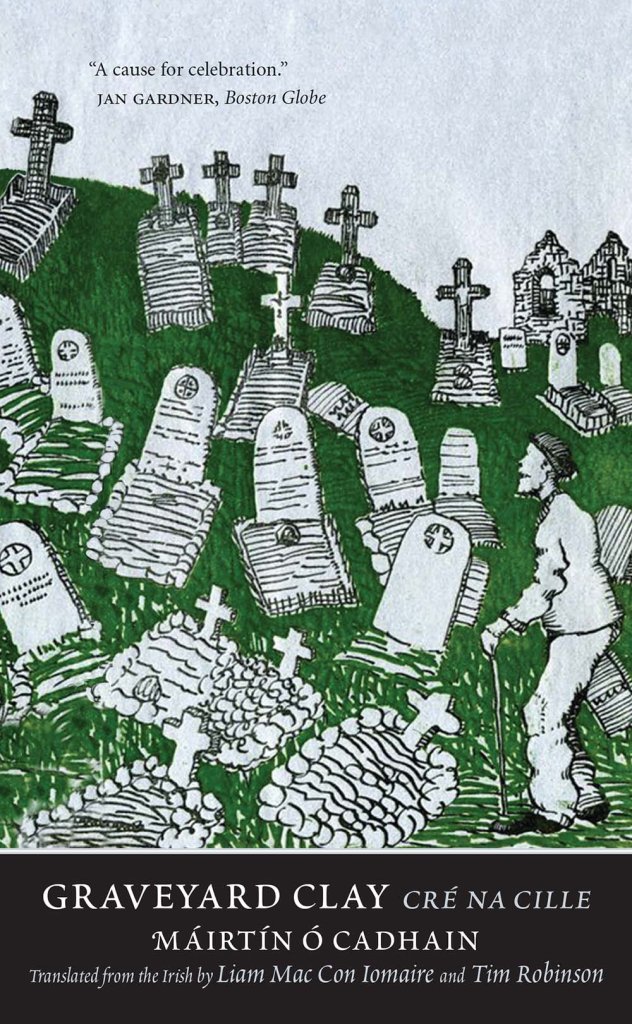
The comic twist in the plot of Ó Cadhain’s novel is that all of the characters in Cré na Cille are dead. They are not ethereal ghosts but loud coffin-bound corpses who bitch and moan, boast and gossip about one another incessantly in a raucous chorus.

Una’s underworld may be a more dreamy and abstracted location, but like Máirtín Ó Cadhain’s graveyard, it’s very lively. Whatever it is, it’s certainly not dead. The buildings, as Una paints them, seem solid and stalwart, despite the turbulence overhead and underground. They stand as a symbol of faith – the painter’s own, perhaps, since she was a believer? – in an unstable world.

Eugene Watters described this duality as the essence of Una’s style i.e that her work had at least two meanings. “While remaining true to the mood and shape of the natural scene, it should have other suggestions built into it.” 

Some of Una’s early work was of religious subject matter and there is a meditative, harmonious quality to even her most social of paintings. A year later, in 1959, she would return to monastic Ireland with The Four Masters, which hangs in Phibsborough library where she worked as a librarian before her marriage.

Categories
Una in focus

Venus de Dublino?

It’s June and despite the poor weather, Una’s 1950 painting, Girl in Sand (oil on canvas, dimensions unknown) seems an appropriately seasonal choice for this month.

This is an early work and perhaps her first foray into a more stylised technique that she developed later. The first question to ask is, is it a self-portrait? Una often smuggled surrogates of herself into group paintings – see The Ladies Committee, Wild Apples and Malahide – where the figure of a young woman, often in a red dress, stands in for Una.

(Her oeuvre also includes several traditional portraits in oil of others, including her husband Eugene, and her uncle, Brian O’Higgins, as well as many informal sketches of family and friends.)

The figure of the bather here is more enigmatic. Her downcast eye is all that’s visible. The rest of her features are eclipsed by a curtain of black hair, and her rather chunky figure doesn’t look like Una’s, although she is wearing Una’s traditional red. Perhaps she’s an archetypal figure – like the young woman in Girl walking by Trinity in the Rain (1959).

The body is rendered in broad brush strokes and the contours of the bather’s athletic figure are suggested by shadows on the limbs. The background, too, is impressionistic. The sand seems as fluid as a river-bed and rises up behind the young woman in large, swirling patterns that tend towards abstraction.

Una often presents nature in a semi-abstract fashion. Her trees are often more geometric shape than branch and leaf realistically rendered. Her fields can often be flat blocks of colour (see the gilted pasture of The Farm, 1964), or surreal as in Clonmacnoise (1958), where we get a striated view of an underworld beneath the surface.

The bather’s hand gestures in Girl in Sand are arresting. She holds back her hair with forked delicate fingers. Is she combing her wet hair? If so, it’s hard to make out the comb in her right hand, which points, delicately reminiscent of God’s hand in the Creation of Adam in Michelangelo’s Sistine Chapel fresco. Either way, she’s lost in a kind of trance that keeps the viewer at bay.

Her mystery, of course, may be that she’s not a real girl at all, but someone who’s sprung from her surroundings, a nymph or a selkie, an elemental creature, parting her hair to view this strange new world she’s landed in.

There’s something tossed and sea-weedy about the background, and the murky, churned-up sand seems to morph into a giant cloud or wave, as if in the aftermath of turbulence. (However, I should add, I haven’t actually seen this painting in the flesh and am working from an old photograph so the colours may well not be true.) A typical day at the Irish seaside, you might say.

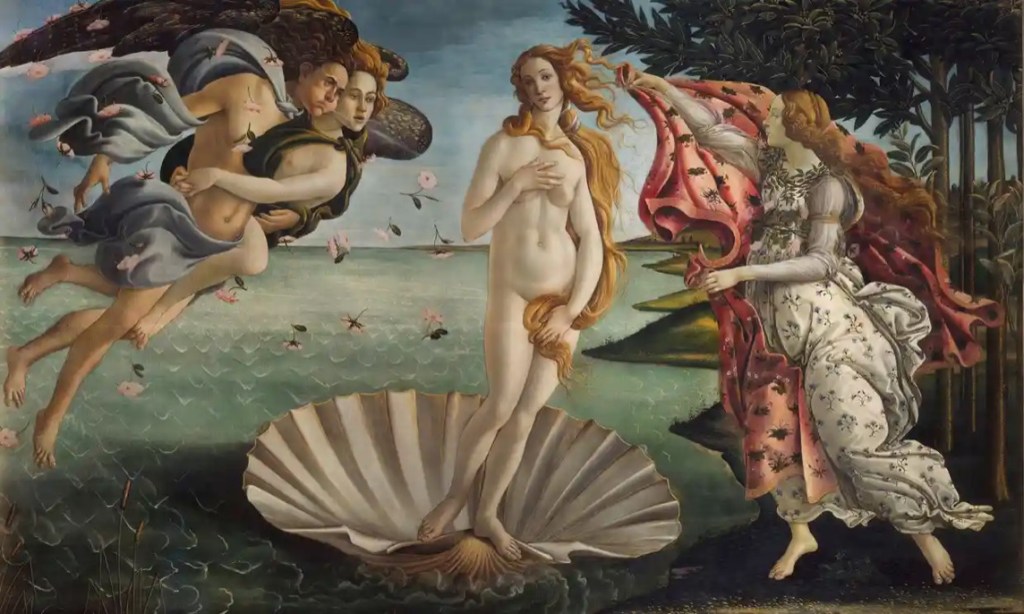
But is it a stretch to see echoes of Sandro Botticelli’s Renaissance masterpiece, The Birth of Venus (c 1480) here? Contrary to its title, Botticelli depicts the moment the goddess Venus arrives at the shore after her birth in which she emerged from the sea fully-formed.

Remember those beautifully delicate fingers of Una’s bather and compare them to the gestures of Botticelli’s Venus. Perhaps it’s the same mythical scene and we’re looking at a Venus de Dublino?

Mary Morrissy

Categories
Una in focus

A Game of Chess

Two men face one another across a chessboard in this 1955 painting of Una’s (oil on canvas, 51 x 41.5cm).  It’s probable one of them is Una’s husband, Eugene, who was an inveterate and expert chess player.  According to family sources, the other player may be his brother, Tom.  

Both figures in the painting look like one another.  The same widow’s peaks and bushy eyebrows, similar indistinct mouths. Gesturally, they adopt the same pose, feet planted firmly apart, hands thoughtfully on chin, mirroring the doubleness of the game they play. They sport similar suits of clothes, though the player on the right goes tieless.

He looks like he’s just made a significant move – check? – while the player on the left is deep in thought, considering what to do next. Although they are static, the tension of the moment is implied in the set of their faces and in the hang of their clothes.   

If it’s not the two brothers, perhaps it’s a portrait of Eugene playing himself, something which keen players often do. Eugene was a frequent correspondent to the chess column in the British Catholic weekly magazine, the Tablet, which set problems for aficionados.  

His first novel, Murder in Three Moves (Allen Figgis, 1960) – under the barely disguised pseudoynm Rutherford Watters – featured Gadarene Blake “the most brilliant problemist (chess) in England” and was  dedicated to D. M. Davey, the Tablet’s chess editor “master of many enigmas”.

The form of Una’s work mirrors the content –  a concentrated study of concentration. The figures are crowded into the pictorial space; indeed, they seem barely to fit in, their backs hunched under the frame of the painting.    

Such airlessness echoes the domestic interiors of the French painter Édouard Vuillard (1868 – 1940) who often crushed the women in his paintings (his mother and sister) into bent and uncomfortable positions, as if their house was literally bearing down on them.

In Interior: Mother and Sister of the Artist (1893), Vuillard’s sister is described in the MoMA catalogue, where the painting is held, as “pressing herself awkwardly against the wall, she bends her head and shoulders, apparently greeting a visitor but also, it seems, forced to bow if she is to fit in the picture’s frame”.https://images.app.goo.gl/NaGcWhUSzUxTqKoU8

The Game of Chess is, similarly, a psychological study. The players’ eyes are fixed on the board. Their identity and personal characteristics are not as important as the concentration they exhibit, and Una applies her artistic concentration to theirs.  The colours are sombre and echo the duochromatic palette of the chess pieces (except for the pale blue collar of the tieless player). The floor is rendered in indistinct grid-like squares – a technique Una often used – mimicking very faintly the squares on the board.  Otherwise, domestic detailing is at a minimum. The players sit on a pair of solid-looking, mid-century kitchen chairs at a small wooden table.

In this painting, the game’s the thing.  The players’ closed-off expressions suggest it’s no game for them, but a serious intellectual challenge that is fully absorbing them. 

Mary Morrissy

Categories
Una in focus

The Whistleblower

C583D398-DF6F-4DEF-A62F-5A1A09FCF1BB

C583D398-DF6F-4DEF-A62F-5A1A09FCF1BB

The Greek god Pan, or a close study of a musician? Either way, it’s the colour that enchants in this 1953 work.

Una Watters’ Flute Player (oil on canvas, dimensions unknown) is another of those works that has travelled in the world under an alias. Listed in the 1966 posthumous exhibition catalogue as Fluteplayer,  the painting is known as Pan by the family to whom Eugene donated the work after Una’s untimely death

This may have been Eugene’s title for it, but either way the allusion is clear; the subject of the painting is a whistleblower. (The pencil-thin instrument he plays seems too small to be a standard flute; it looks more like a piccolo.) This is one of Una’s most elegant compositions and it’s easy to see why this idealised figure might have been mistaken for a Greek god, although Pan’s reputation is distinctly hedonistic whereas this young man is much more refined.

To the Greeks, Pan – god of the natural world – was a shepherd, half-goat, half-man. He played the pipes and was lusty in his appetites. He was, apparently, the favourite god of the Greek people. In Una’s work the flute player seems to be placed outside – rather than in a smoke-filled bar – perhaps a nod to the god of nature? This “Pan” is standing on what seems to be a wide open strand with only the far distant and very low horizon (or shoreline?) to give us our bearings. (See also Una’s Girl Walking by Trinity in the Rain for a similar low viewpoint.)

Fluteplayer is a three-quarter, highly stylised portrait, in which the body is viewed straight on but the head is seen in profile, catching the typical sideways stance of a flute player. There is little suggestion of effort in this graceful portrait bar the thin pale band sweeping from the musician’s sideburn to his chin and seeming to meld with his very balletic fingers. This application of paint to supply gesture is a technique Una used often.

His prominent upper lip clamped to the flute’s tone holes is the only other evidence of exertion. Otherwise, the musician’s face is quite bland and impassive – neat hair carefully combed, an unexpressive eye. So perhaps it’s not a particular player Una has in mind but a generic portrait of a man who’s defined by his instrument, someone who has become one with the music.

If his personality is communicated at all it’s by his clothes. At first glance, this reads as a static portrait of a stylish traditional musician sporting a three piece suit, collar and tie. However, on closer scrutiny, we see that the rendering of the clothes is full of movement.

Here is where the musician’s personality resides. His jacket is actually fluid, the tails literally dancing. The lapels are serpentine and the jacket seems to morph into a waistcoat, or is he wearing a sleeveless jumper underneath? Or is it the lining of his jacket that appears to swing to the music being played? This cubist-style capturing of overlapping actions and the subtle use of shadow give the work a subterranean energy, while the surface is preternaturally calm.

The colour palette is delightful – a mix of delicate blues, a heathery purple and dove grey. Details such as his slicked-back hair, the trio of buttons on his jacket sleeve and his tie are picked out in a rich brown. But the overall tone is cool, Zen-like, an almost meditational serenity.

Mary Morrissy

Categories
Una in focus

The Three Graces in Malahide

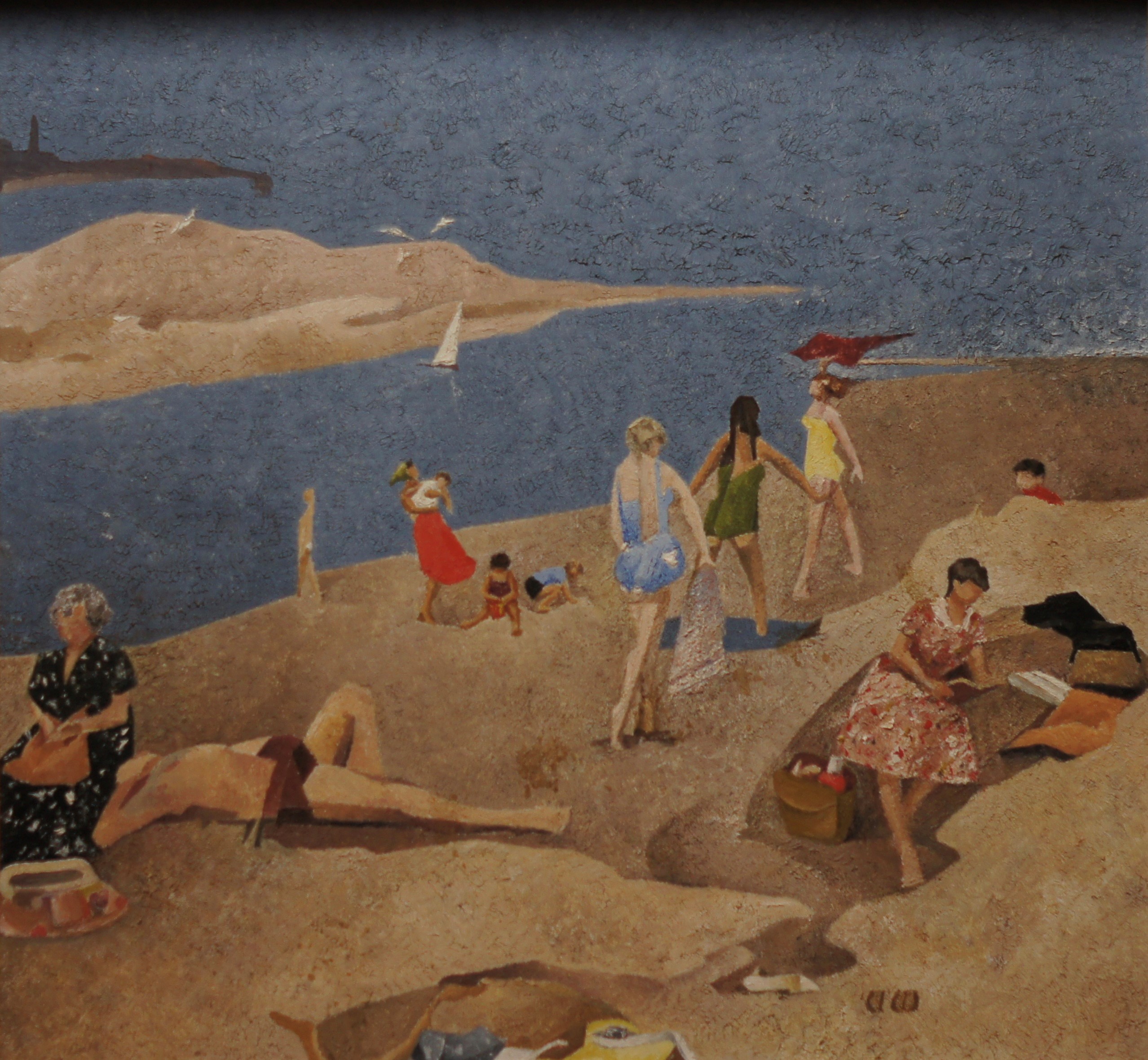
una-watters-malahide

Mary Morrissy considers the joint imaginative territory that Una Watters shared with her poet husband, Eugene, epitomised by today’s featured painting, Malahide. 

Malahide, Saturday.  Clouds come

Henna with heat.  Salt and sun

Leave all flesh lazarous –

So wrote Eugene Watters  (Eoghan O’Tuairisc)  in “Smithson’s Glimpse of the Three Graces” a long poem published in PEN magazine in September 1961.

It’s almost a perfect transcription of his wife Una’s painting, above, Malahide (oil on canvas, dimensions unknown) except that Una’s painting was not completed until 1964, three years after Eugene’s poem was published.

Smithson, the speaker of the poem, a barber, is on his afternoon off at the beach “within the shadow of his wife stretched” – very much as the horizontal figure on the left of the painting.  “Drowses with one leg in the sun/Lazily like Italy on a warm day,”.  While his wife knits – see the grey-haired woman in the black-and-white patterned dress with her knitting bag clearly visible on the sand – Smithson fantasises about the three young women who pass by loudly chatting – “Calling Freda for Christsake to hurry”.  He imagines them as the three Graces, Alglaia (elegance) Thalia (youthful beauty) and Euphrosyne (mirth).

When two artists live and work side-by-side as Eugene and Una Watters did for over 20 years, it’s inevitable that their creative impulses would become entwined. And nowhere is this seen more clearly than in Malahide.

Eugene’s work often drew on classical allusions – the poem’s epigraph is from Ovid and Smithson equates his own sense of isolation with the Roman poet’s lifelong exile. He also references the “lacrimae rerum” line from Virgil’s Aeneid (Book 1, verse 462)  –  “sunt lacrimae rerum et mentum mortalia tangunt” translated by Séamus Heaney as “there are tears at the heart of things”.

This melancholy imbues the poem  – “Drowning is as lonely an experience as living” – as does Smithson’s sense of being at odds with the mundane world around him.  That said, the Three Graces Smithson spies (or conjures up)  on the beach at Malahide seem to spring fully-formed from Una’s joyous painting.

Typists like graces coming together,

From the Four Courts, the King’s Inns,

Loosed and let go.  Towels trailing,

Uncertain and half-naked go

The great mothers of mankind. 

Look at the three girls in their bathing costumes who draw the eye deep into the painting, towels aloft or trailing, tiptoeing on the hot sand. Don’t they fit the description of  Eugene’s Graces? However, Una’s expressive use of movement seems intent on giving us the character of these girls as girls, rather than as metaphors. The sprawled “Smithson” figure, likewise, or the young mother in red who cradles a white-clad baby trying to pacify it.  Or the  two children at her feet who are bent to the serious work of building  sandcastles.  Although each “character” seems to invite a story, their features, as in many of Una’s paintings, are effaced.

Perhaps they are inspired by real people as Una’s other group compositions in public spaces have been? Una might well have played with the dramatis personae of Eugene’s poem and inserted herself into the painting, as she often did, in the figure of the woman in the sand-coloured dress reading, while the dreaming, outstretched man might be Eugene – just as Smithson stands in for him in the poem.

Either way, Una’s painterly concern here seems to be the thing itself.  (The pragmatic titling of her paintings shows us that  –  The People’s Gardens, Woman Sewing, The Flute Player, The Game of Chess.  They do exactly what they say on the tin.)  Here it’s the depiction of a summer’s day at the beach.  There’s the saturated blue of the sea, the white sailboat, the tossed flecks of gulls (“birds rise to the life of the wind changing”), the cratered, undulating dunes scattered with towels and discarded clothes. And peeping from the reading woman’s brown satchel, a flask and maybe sandwiches for later?

Although not completed till 1964, Una’s Malahide could have been several years in the making, sitting on the easel in the kitchen at Cappagh Cross, providing a subconscious terrain as Eugene wrote the poem. Or conversely, perhaps Una created on canvas the Malahide backdrop Eugene suggested in his Ovid-inspired modernist lament, and then peopled it with the characters he described after reading the poem?

Or is this a re-enactment of an actual day they shared at Malahide, a day enshrined in memory and responded to by each of them in their own individual way?  For Una, a day of simple pleasures at the seaside, harmonious, full of recognisable types and some familiar faces: for Eugene, a springboard for the classical fugues of a brooding, mid-century man alienated from the world.

Generations go by shouldering death,

Time winks like cuts of scissors,

He lies on the backbone and suspects a sky.

The medium is crisscrossed with dawn and evening,

Complex tranquility;”

Mary Morrissy