Categories
News

Wheels within wheels

It’s always a triumph when a lost Una Watters comes to light. It’s a red-letter occasion when two are unearthed in the same week. As an indirect result of my recent talk in Ballinasloe about Una’s Galway-inspired work, an owner of one of her untraced oils from the 1966 posthumous exhibition has come forward.

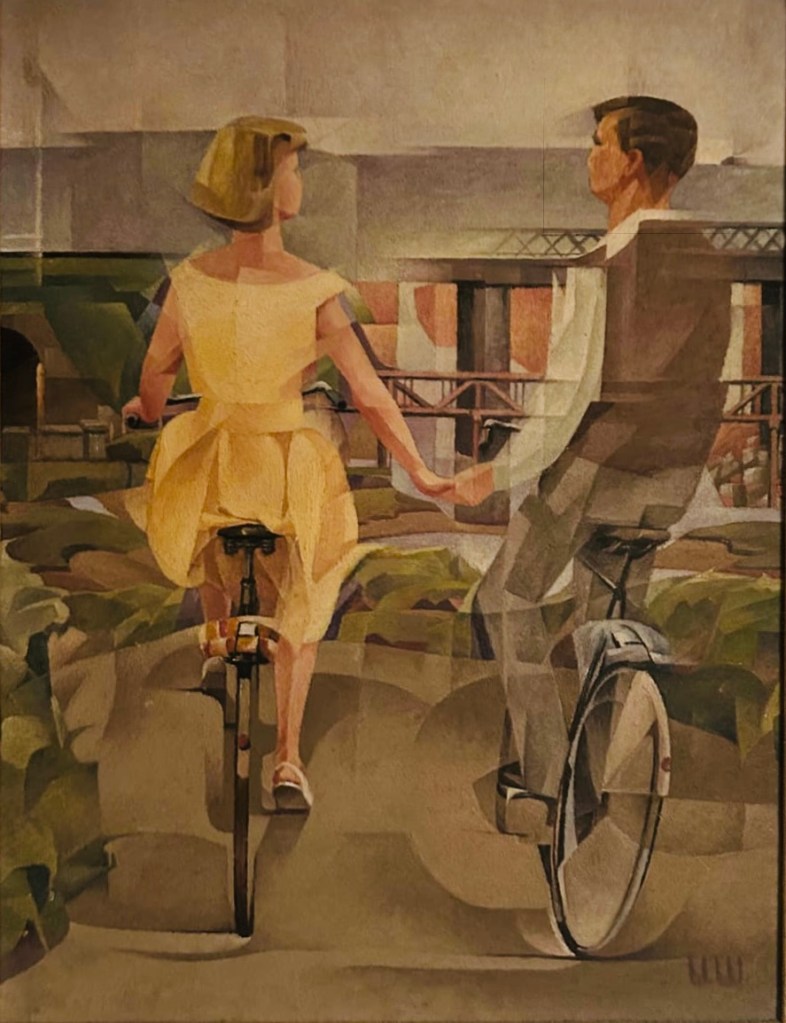
With the help of Eugene Watters’ niece, Georgina O’Donovan, we’ve identified the new find as To the Sea (oil on canvas, 43.1 x 54.6 cms) dated to 1962. It depicts a couple on bicycles, viewed from the back, as they cycle towards the sea, their swimming gear rolled up in towels on the back carriers.

I presumed, at first, this was a Galway scene, but on further investigation, it seems this is an east coast painting, more specifically, we think, Laytown, Co Meath. Una’s naming of paintings is always a help in this regard, being plain and informative. To the Sea suggests proximity; cycling to the sea from Ballinasloe would have been quite a trip.

The bridges in the background also led me to believe it might have been Ballinasloe and its environs. (Una had a weakness for bridges) There seems to be several bridges in evidence here – a railway bridge, an iron footbridge, and on the left a stone arch. The railway bridge could be the Laytown Viaduct and the stone arch could belong to the Boyne Valley Viaduct. Geographically, these might not be visible in the same frame but Una often used this composite approach to her cityscapes – see my earlier blog on City Bridgehttps://unawattersartist.com/2020/06/09/the-bridge-of-time/ – where several stone landmarks of Dublin are impressionistically viewed together, jigsaw-like, on the same plane.

The horizon of the painting is quite high – note the perspective of the road winding away behind the bridge, and the sea – typical of an uncertain Irish summer – is the opaque grey expanse at eye-level for the figures. A steamer puffing smoke ploughs away on the high horizon mark above the male cyclist’s head.

Una would have known this area very well from holidays there as a child and Georgina O’Donovan remembers her parents and Eugene and Una taking several cycling holidays together. “There is an innocence about it all,” she says about this painting. “The couple holding hands, the swimming gear on the carriers and the possibility of catching that boat to new lands and adventures.”  

Georgina has identified her father, Tom Watters, (Eugene’s brother) as the model for the man in the painting – see Tom Watters also in Wild Apples – see https://unawattersartist.com/2020/06/24/wild-apples/ and The Game of Chess. https://unawattersartist.com/2021/04/10/a-game-of-chess/

Una often depicted herself in her work as a dark woman in red, so this blonde woman in her sunny yellow dress is definitely not her. However, Georgina believes she bears a passing likeness to the mother of the painting’s present owner, who was gifted To the Sea after Una’s death.

In this work Una’s interest is also in the dynamic movement of the bicycles. The whir of the wheels, the tensing of the woman’s calves, the folds of her dress are depicted in strong physical strokes so speed and movement are made manifest on the canvas. This dynamism is mirrored in the foreground of the painting. The vegetation looks turbulent, tossed-looking, and the very ground underfoot unstable.

Una’s rendering of physical gestures often hints at emotional drama. The woman’s back is to us so she remains mysterious, but we see the man sketchily in profile as he holds her hand and turns to her. A beam of weak misted light from an unseen source grazes her shoulder, but it mirrors the slant of his gaze. She’s cycling in a straight line, but the front wheel of his bike is not evident, merely suggested by a series of veering circles. The implication is he’s having a slight wobble. Is he about to fall in more ways than one?

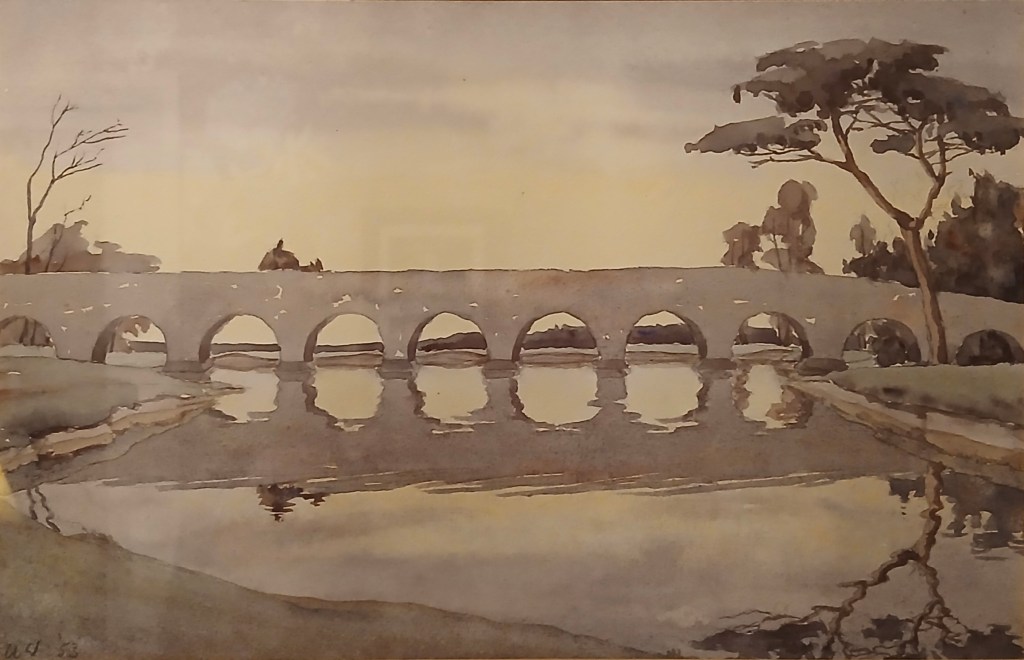
The second find is a watercolour, untitled, showing Ballyforan Bridge near Ballinasloe, which was completed in 1953. This was a favoured picnic site for the Watters family and a meeting point for fishing expeditions in the summer consisting of Eugene, Una, his brother Tom and wife Bridie, and their children. The watercolour is delicate in its rendering, serene in its mood showing the glassy River Suck on a still, mauve summer’s evening, while a man driving a hay cart is seen crossing the bridge. The arches of the bridge (bridges, again!) and the spindly trees either side are echoed in the water giving a shimmering, ethereal feel the work.

Categories
News

Una Watters’ Galway

What better way to mark International Women’s Day than to celebrate the life and work of Dublin artist Una Watters. I’ll be giving an illustrated talk on Una in Ballinasloe on March 8. Although she hailed from Finglas in Dublin, Una spent a great deal of time in Ballinasloe, the home town of her husband, Eugene Watters ( the writer Eoghan O Tuairisc).

The couple spent holidays in Galway, staying with family, fishing on the River Suck and engaged in artistic pursuits – painting for Una and writing for Eugene. In my talk, I’ll be concentrating on Una’s work featuring the town and environs, and discussing how her experiences there influenced her work.

As well as obvious influences, I’ll be looking at more subliminal connections e.g. the importance of the River Suck, where Una, an expert fisherwoman, spent many hours. While fishing there in the late 1950s, Una made a spectacular discovery – a ring-pommelled, single handed sword, dated to the 16th-century. Although the end of the blade was snapped off, it was a significant find, and was presented to the National Museum on July 13, 1962. The sword can be seen in the Kildare Street branch of the museum, in the Medieval Ireland 1150-1550 exhibition.

An image of the sword can be seen by following this link – the sword Una found is on the right: – https://www.reddit.com/r/ArtefactPorn/comments/6cax20/16th_century_irish_ring_pommel_sword_1024x3072/#lightbox

Is it fanciful to wonder if the rescue of this sword from the depths of the River Suck, in what seems like an echo of the Excalibur myth, might have come to the surface again when Una was designing the emblem for the 1966 Easter Rising Commemorative Year?

Her design, which won an open competition organised by the Arts Council, references the “Sword of Light”, connected in early literature with the first coming of the Gaels in Ireland and it occurs throughout later literature as symbolising intuitive knowledge, education and progress. It was taken up by scholars of the 19th century and was adopted by revolutionary thinkers to indicate their dual objectives – armed insurrection and an Irish cultural renaissance. (See the Design of Easter Rising Symbol page elsewhere on this site.)

The talk takes place at St John’s Church, Ballinasloe, Co Galway, on March 8. All welcome.

Categories
News

For your diary

After the flurry of the presentation of Una’s Girl Going by Trinity in the Rain to the national collection by Colbert Kearney in 2023, things have been quiet on the Una Watters front.

However, this year will see more activity. It’s an anniversary year – 60 years on from her death in 1965 – and hopefully that may see an upswing in Una Watters-related activities.

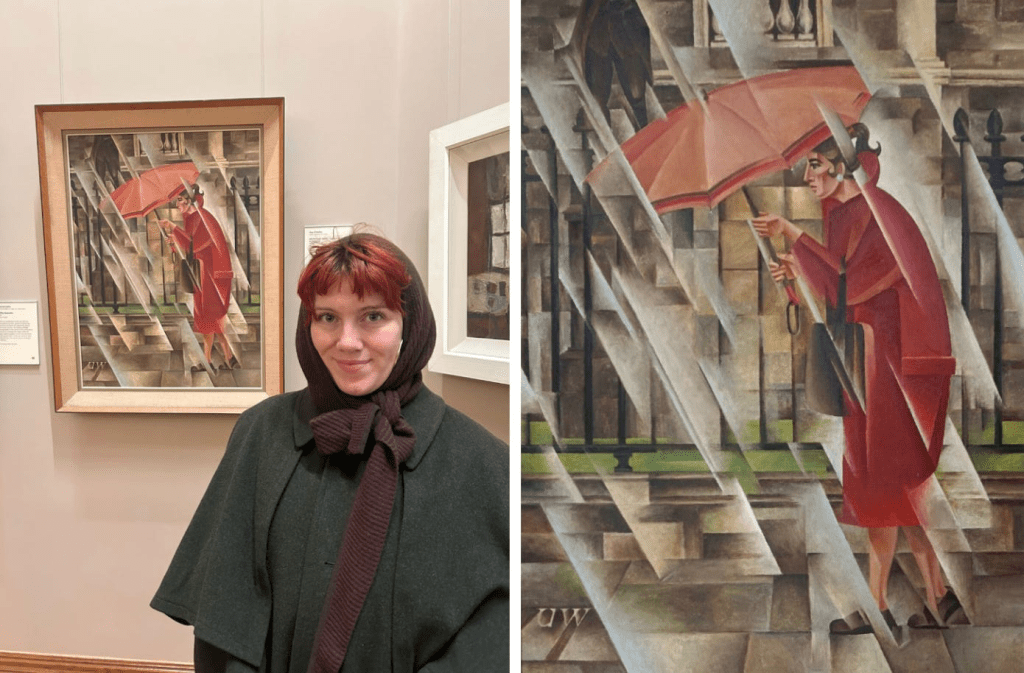
First development this year is the inclusion of Girl Going by Trinity in the Rain in the National Gallery of Ireland’s diary. Always a beautiful production, this year is no different, and Una appears for the week of May 26, 2025.

The director of the gallery, Dr Caroline Campbell, remarks in the diary’s introduction that Una’s Girl has already become a” popular favourite” among gallery patrons. This makes a trifecta of images the NGI has used of Una’s signature painting – it appeared in last year’s calendar and is for sale in postcard form in the gallery shop. (Speaking of merch, I’m waiting for the gallery umbrella and tote bag!)

As Sara Donaldson author of the notes accompanying the image in the diary writes – “Watters’s awareness of Cubist forms is evident everywhere, while Futurist-inspired ‘lines of force’ represent the sheets of rain, evoking the atmosphere of a wet urban scene.”

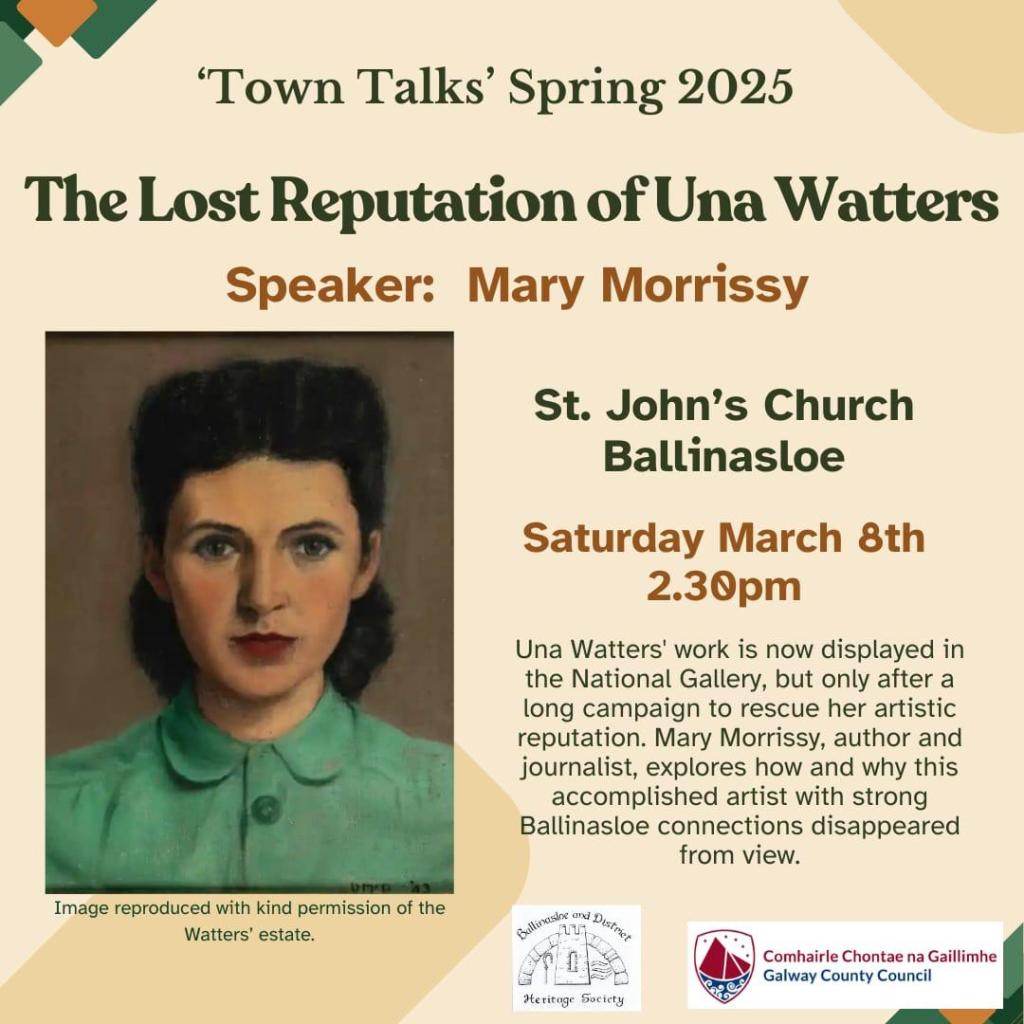
Speaking of dates for the diary, I will be doing a lecture – “The Lost Reputation of Una Watters” as part of Ballinasloe & District Historical Society’s Town Talks series in March – more details to come closer to the time.

Meanwhile, I’m on work on a book on Una so if any of you out there have stories or memories of her or Eugene Watters, do contact me via the email on the blog.

Categories
News

Picture Postcard

First the painting, now the postcard! Una’s Girl Going by Trinity in the Rain, now proudly part of the national collection, got another boost this month with the news that there’s now a postcard of the painting on sale at the National Gallery of Ireland shop.

This fine postcard reproduction also gives the painting the potential of reaching a mass audience.

I’m a sucker for a postcard memento so I’m delighted to know that Una’s striking image has a chance to reach gallery visitors who, like me, enjoy extending the memory of standing in front of the real thing with a pocket-sized reproduction.

Speaking of the real thing, Girl Going by Trinity hangs in Room 15 of NGI, along with several of Una’s contemporaries, Mainie Jellet, Mary Swanzy and Louis le Brocquy.

November is both Una Watters’ birth and death month (born this day, November 4, 1918 – died November 20, 1965). The Dublin weather she depicts here is distinctly Novembrian. Perfect for a calendar!

What about it, National Gallery? Una Watters as November’s calendar girl?

Categories
News

Banner Headline

This fine specimen of angelic manhood is a detail from another new Una Watters discovery – as a result of contacts made at an event at Phizzfest earlier this year. It’s an unusual find in that it’s not a painting but a banner made for St Michael’s School in Finglas.

The principal of the school was a Sister Philippa who knew Una’s sister, Maureen McDonnell ( Sister Mel) a fellow nun at the Holy Faith School in Glasnevin. She asked her to approach Una to design a banner for the school on Wellmount Road which had opened in 1959. Another sister, Sister Therese Kearney (95), remembers the request being made.

In the summer of 1960, she has written, the school pupils made their first appearance in Glasnevin grounds for sports day. “They had no banner to represent their school. Sister Philippa immediately asked Sister Mel McDonnell’s sister Una to paint a banner for the school.”

Because the work was done as a favour, rather than being officially commissioned, it has remained, like much of Una’s craft work, under the radar. Although not signed, the provenance is direct with Sister Mel’s involvement in the process and the surviving Sister Therese’s written testimony.

The banner measuring (121.92cm x 91.44cm) depicts the archangel St Michael in Celtic warrior mode, with blonde hair, muscled arms holding a golden spear and shield. His wings are a celestial blue but there’s nothing ethereal about them – they’re robust-looking and rendered in the geometric style that Una used later in her treatment of trees and foliage. There’s no doubt that this is St Michael triumphant – the expression on the archangel’s face is serenely confident – although there’s no sign of the dragon. Instead, Una’s St Michael appears to be standing on a chain, a nicely abstract rendition of his liberating powers.

As well as designing it, it’s probable that Una, an accomplished seamstress, also made the banner and trimmings herself. St Michael is painted on what looks like calico and backed with dark green silk. The border with a Celtic barley twist design runs all the way around with a golden fringe at the bottom. Five fabric hooks allow it to be attached to a mobile wooden frame, a neat combination of function and design.

The banner is not just decorative. The school principal, John Barry, explains that it is used regularly in school ceremonies – graduations, sports days and to mark the opening of the school year when the head girl hands it over to the incoming sixth year class. The school currently has 630 pupils.

Meanwhile Una and her work is also referenced in a historical exhibition within the halls of the Department of Finance. Archivist Cliodhna Walsh was involved in organising it to mark the lifting of the marriage bar for female civil servants 50 years ago in 1973.

Like many women, Una was forced to leave her job in the library service when she married Eugene Watters in 1945. The ban on working probably gave Una more time to pursue her art, but it also meant she had to use her art to generate income, hence some of her illustrative and calligraphic work covered elsewhere on this site.

“As important as it is to remember how the marriage bar wrenched so many women away from public life, it is also lovely to acknowledge the vibrant artistry of a woman who contributed much to Irish culture,” Ms Walsh has observed about Una’s contribution to the exhibition.

A reproduction of Una’s Girl Going by Trinity in the Rain features in this private exhibition as well as images of her design for the 1966 Easter Rising emblem based on the Sword of Light. Because this was entered in a public competition, the design copyright rests with the Department.